
Tesamorelin and sermorelin are both growth hormone releasing hormone (GHRH) analogues. They act at the same receptor and produce the same immediate event: the pituitary releases more of the body’s own growth hormone. Their regulatory positions and their evidence bases are very different. This page sets out what is documented about each, drawn from FDA records and published trials.
Important
This article is general education, not medical advice, and nothing in it recommends or endorses a treatment for you. Compounded medications discussed here are not FDA approved. Only a clinician licensed in your state can decide whether any treatment is appropriate, and that decision follows a review of your history and any testing they consider necessary. Do not start, stop or change any medication based on something you read online. If you are having a medical emergency, call 911.
Summary of the record
- Tesamorelin is FDA approved (EGRIFTA, NDA 022505, approved 10 November 2010) for one indication: reduction of excess abdominal fat in HIV-infected adult patients with lipodystrophy. Its label states it is not indicated for weight loss management.
- Sermorelin was FDA approved as GEREF in 1990 and again in 1997. Both products were discontinued. FDA stated in the Federal Register on 4 March 2013 that they were not withdrawn for reasons of safety or effectiveness.
- Tesamorelin has a randomised placebo-controlled trial programme supporting its label. The published adult evidence for sermorelin is very limited.
- Neither product is approved for anti-aging, athletic performance, or body composition in healthy adults.
Tesamorelin: what the approved label says
Tesamorelin acetate is marketed as EGRIFTA. Its approved indication reads, verbatim: “reduction of excess abdominal fat in HIV-infected adult patients with lipodystrophy.” That is the entire indication. It does not extend to abdominal fat generally, to metabolic syndrome, or to people without HIV.
The label carries two Limitations of Use. The first states that it is “not indicated for weight loss management.” The second states that “Long-term cardiovascular safety… has not been established.” Tesamorelin does not carry a boxed warning.
The efficacy data, including the part usually left out
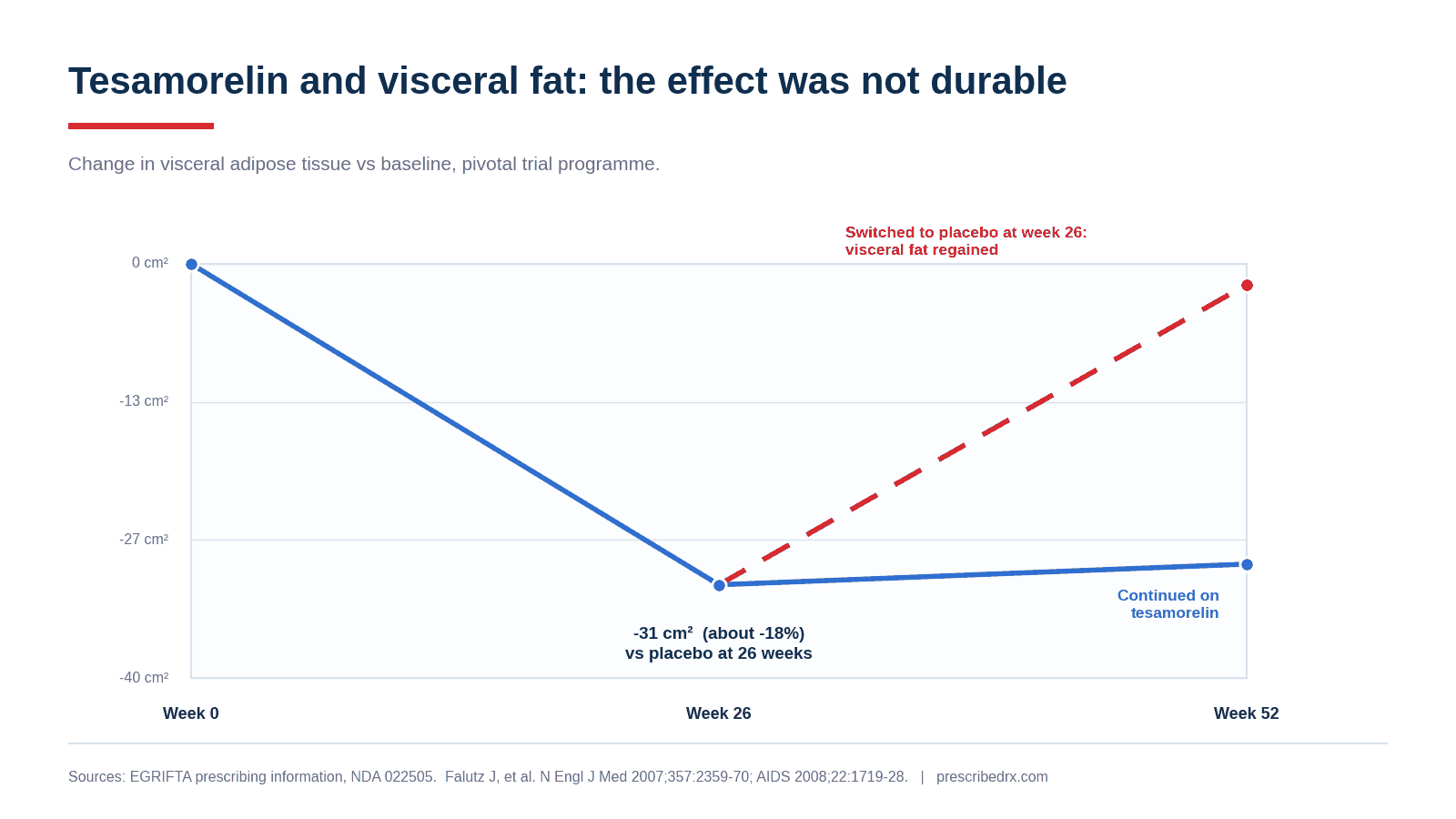
In the pivotal trial programme, visceral adipose tissue measured by CT fell by approximately 31 cm², around 18 percent, relative to placebo at 26 weeks. That is a real measured effect in the population studied.
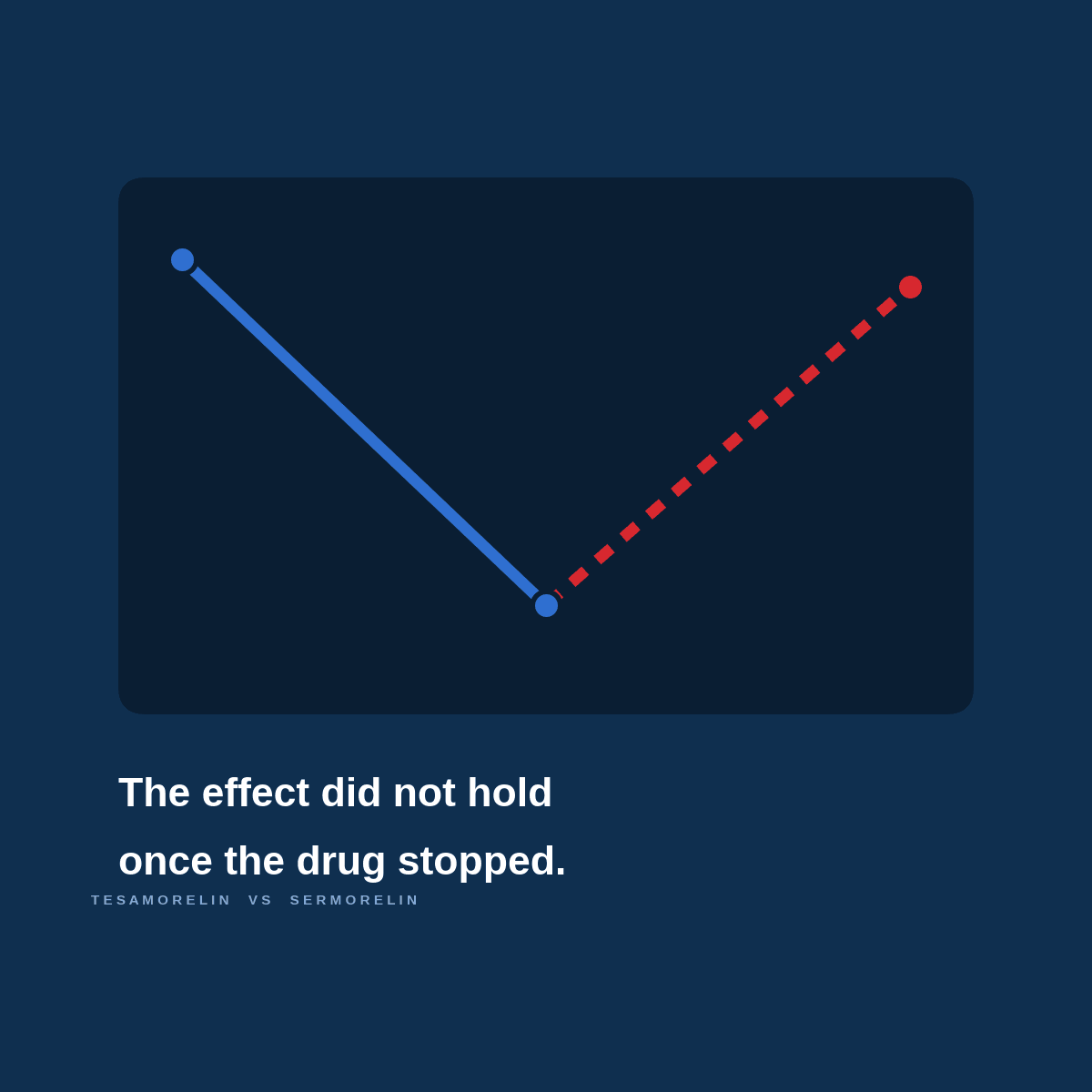
The follow-on finding is less often quoted. Participants switched from tesamorelin to placebo at week 26 regained the visceral fat they had lost by week 52. The effect was not sustained after the drug was stopped. Any description of tesamorelin as producing a lasting change in body composition is not supported by its own trial programme.
Sermorelin: approved, then discontinued
Sermorelin acetate was approved as GEREF under NDA 019863 on 28 December 1990, and under NDA 020443 on 26 September 1997, sponsored by EMD Serono. Neither is marketed today.
In a Federal Register notice dated 4 March 2013, FDA determined that the GEREF products “were not withdrawn from sale for reasons of safety or effectiveness.” The discontinuation was commercial rather than a safety action. This is a meaningfully different situation from a product removed after adverse findings, and it is rarely mentioned.
It does not make compounded sermorelin an approved drug. No approved sermorelin product is marketed, so present-tense statements that sermorelin “is FDA approved” are inaccurate. Compounded sermorelin is an unapproved drug prepared by a licensed pharmacy against an individual prescription.
The adult evidence is limited
The most cited adult study (Vittone and colleagues, 1997) enrolled 11 healthy older men on 2 mg nightly for six weeks. Nocturnal growth hormone release increased. IGF-1, body composition, lipids, glucose metabolism and muscle histology did not change. Eleven participants over six weeks is a small, short study that was not powered to detect modest effects, so it is better read as an absence of demonstrated benefit than as proof of no benefit.
Regulatory status side by side
| Tesamorelin | Sermorelin | |
|---|---|---|
| Currently marketed FDA approved product | Yes (EGRIFTA) | No, discontinued |
| Approved indication | HIV-associated lipodystrophy, abdominal fat | None currently marketed |
| Withdrawn for safety? | Not applicable | No (Federal Register, 4 Mar 2013) |
| FDA 503A bulks list (14 May 2026) | Not listed | Not listed |
| Category 2 significant safety risk finding | No | No |
| 503B nominations list (21 Mar 2025) | Not listed | Category 1 |
| Boxed warning | No | Not applicable |
One clarification that is often misused: 503B Category 1 is not an approval and not an endorsement. It describes substances nominated for use by outsourcing facilities that FDA has placed in an interim enforcement discretion posture while it completes its evaluation. Any page describing a peptide as “FDA Category 1 approved” is describing something that does not exist.
Differences worth understanding
Both are short acting, and neither is growth hormone
Both are given by subcutaneous injection and both are short acting GHRH analogues. Neither is a growth hormone product, and neither replaces growth hormone. They act on the pituitary’s own release mechanism. If a description of either one sounds like human growth hormone replacement, the description is inaccurate.
The populations they were studied in
This is the difference discussed least. Tesamorelin’s data comes from adults with HIV-associated lipodystrophy, a specific metabolic phenotype. Sermorelin’s approvals related to growth hormone deficiency, including paediatric diagnostic use. Neither compound was developed or trialled in healthy adults seeking changes in body composition or slower aging. Applying either trial result to that population is an extrapolation rather than a finding.
Documented adverse effects
Because tesamorelin has an approved label, its safety information is standardised and public. The label documents injection site reactions, arthralgia, peripheral oedema, myalgia and paraesthesia, and addresses the potential for glucose intolerance, since GHRH analogues raise IGF-1 and IGF-1 influences insulin sensitivity.
Compounded sermorelin has no approved label and therefore no equivalent standardised safety document. Effects reported in the literature and in practice centre on injection site reactions and flushing. The absence of a large adverse event dataset reflects the absence of a marketed approved product generating one, and should not be read as a demonstration of safety.
Questions a clinician will consider
Tesamorelin has an approved indication for HIV-associated lipodystrophy, and for anyone with that diagnosis it is a matter for the clinician managing their HIV care.
Outside that indication, both compounds are used off-label or as compounded preparations. Whether either is appropriate for a particular person is a clinical judgment that depends on their history, their current medications, and any testing the prescriber considers necessary, which commonly includes baseline IGF-1. This page does not attempt to answer that question and no website can.
Considering sermorelin therapy?
PrescribedRX offers sermorelin injections by prescription. Answer a few questions about your health history and a clinician licensed in your state reviews whether treatment is appropriate for you. Compounded sermorelin is not FDA approved, and a clinician may decide it is not right for you.
References
- U.S. Food and Drug Administration. Drugs@FDA: EGRIFTA (tesamorelin acetate) for injection, NDA 022505, approved 10 November 2010. Prescribing information.
- Falutz J, Allas S, Blot K, et al. Metabolic effects of a growth hormone-releasing factor in patients with HIV. New England Journal of Medicine. 2007;357(23):2359–2370.
- Falutz J, Allas S, Mamputu JC, et al. Long-term safety and effects of tesamorelin, a growth hormone-releasing factor analogue, in HIV patients with abdominal fat accumulation. AIDS. 2008;22(14):1719–1728.
- U.S. Food and Drug Administration. Determination That GEREF (Sermorelin Acetate) Injection and GEREF DIAGNOSTIC (Sermorelin Acetate) Injection Were Not Withdrawn From Sale for Reasons of Safety or Effectiveness. Federal Register, 4 March 2013.
- Vittone J, Blackman MR, Busby-Whitehead J, et al. Effects of single nightly injections of growth hormone-releasing hormone (GHRH 1-29) in healthy elderly men. Metabolism. 1997;46(1):89–96.
- U.S. Food and Drug Administration. Bulk Drug Substances Nominated for Use in Compounding Under Section 503A of the Federal Food, Drug, and Cosmetic Act. Updated 14 May 2026.
- U.S. Food and Drug Administration. Bulk Drug Substances Nominated for Use in Compounding Under Section 503B of the Federal Food, Drug, and Cosmetic Act. Updated 21 March 2025.
Related reading
Sermorelin therapy: the complete guide · Is sermorelin FDA approved? · Sermorelin before and after: what the evidence shows · Ipamorelin vs sermorelin · Sermorelin benefits
PrescribedRX offers sermorelin injections by prescription. We do not dispense tesamorelin. Whether any treatment is appropriate is determined by a clinician licensed in your state.