Ipamorelin vs Sermorelin: What the FDA Record Shows
FDA placed ipamorelin in Category 2 for significant safety risks. Sermorelin has no such finding. The documented differences between them.
 By Juan Montes
Updated October 3, 2026 · 6 min read
By Juan Montes
Updated October 3, 2026 · 6 min read
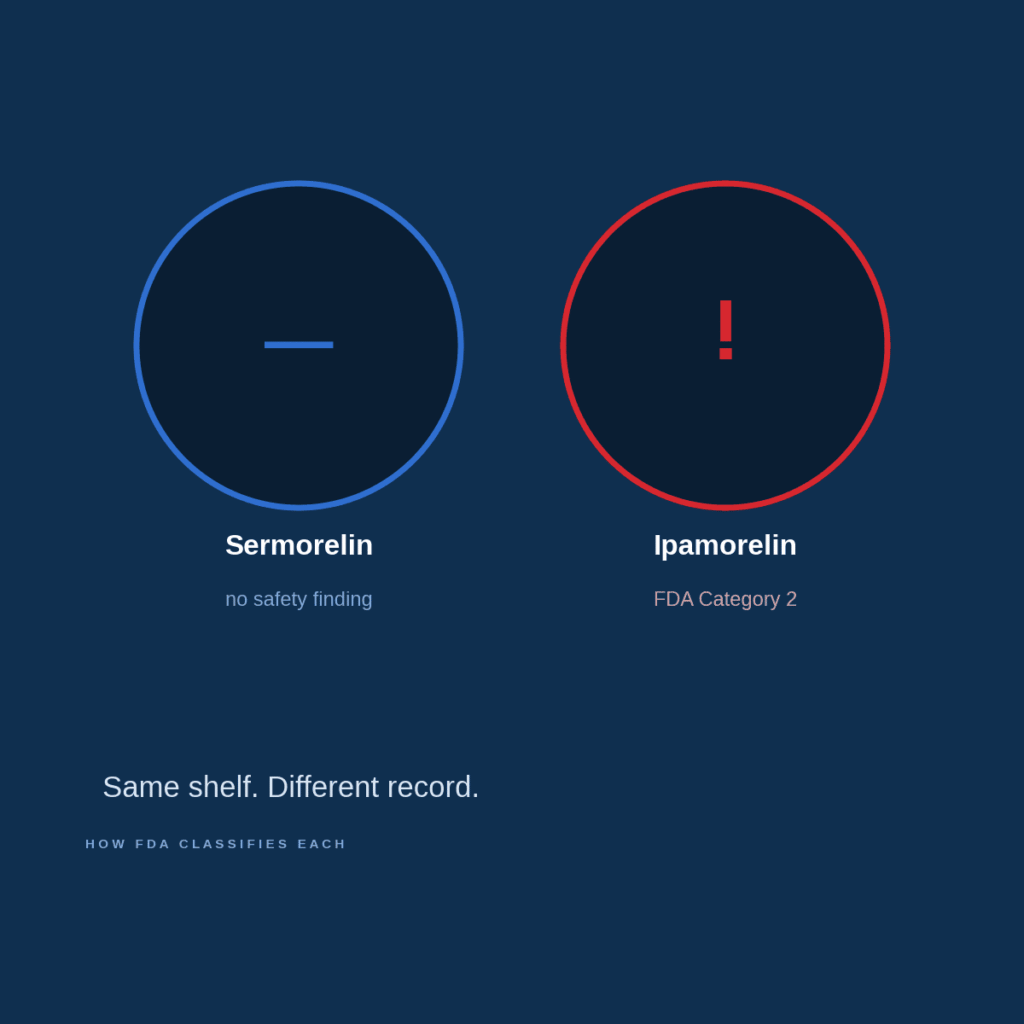
Ipamorelin and sermorelin are often described together as “growth hormone peptides,” and are sometimes presented as interchangeable. They are not the same class of compound, they act at different receptors, and their positions in FDA’s compounding records are different. FDA has published a specific safety-risk finding for ipamorelin. It has published none for sermorelin. This page documents that distinction and the evidence behind it.
Important
This article is general education, not medical advice, and nothing in it recommends or endorses a treatment for you. Compounded medications discussed here are not FDA approved. Only a clinician licensed in your state can decide whether any treatment is appropriate, and that decision follows a review of your history and any testing they consider necessary. Do not start, stop or change any medication based on something you read online. If you are having a medical emergency, call 911.
They do not work the same way
Sermorelin is a growth hormone releasing hormone (GHRH) analogue. It binds the GHRH receptor on the pituitary, the same receptor the hypothalamus uses, prompting release of the body’s own growth hormone.
Ipamorelin is a growth hormone secretagogue that acts at the ghrelin receptor (GHS-R), a different receptor on a different signalling pathway. It is a synthetic pentapeptide rather than an analogue of a human hormone. That structural point is relevant to the regulatory section below.
In short, sermorelin amplifies an existing physiological signal and ipamorelin activates a separate one. Descriptions treating them as two versions of the same thing are skipping the pharmacology.
The regulatory record, in FDA’s own words
Ipamorelin: Category 2
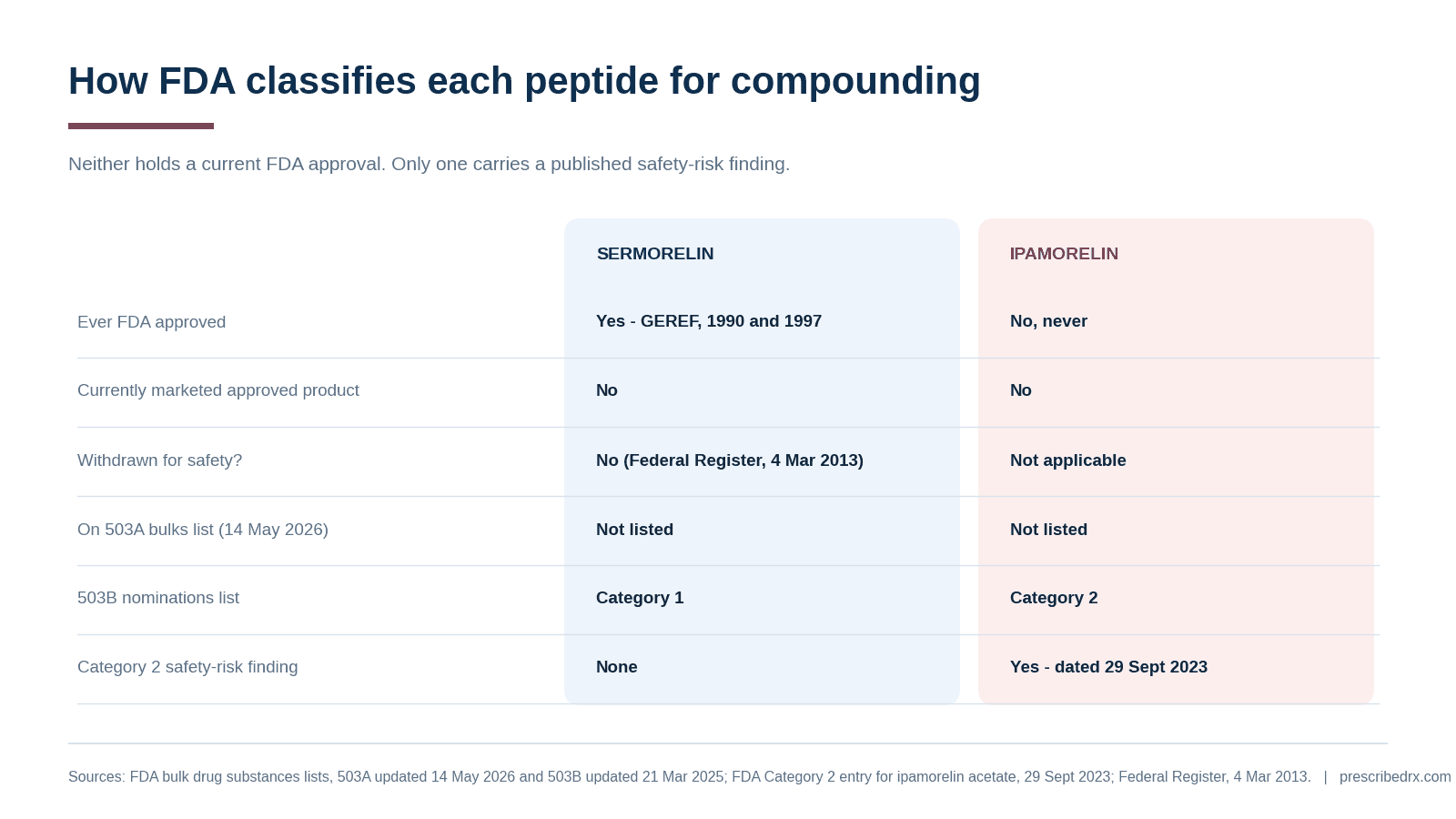
FDA placed ipamorelin acetate in Category 2 of its evaluation of bulk drug substances nominated for compounding. Category 2 is the category for substances that raise significant safety risks. The designation is tagged to section 503B and dated 29 September 2023.
FDA’s published reasoning covers three points: immunogenicity risk; the presence of unnatural amino acids in the molecule; and, in FDA’s language, “serious adverse events including death when ipamorelin was administered intravenously.”
The Pharmacy Compounding Advisory Committee reviewed it again on 29 October 2024 and recorded further concerns, including potential for reward and addiction behaviour and inadequate nonclinical data to support the safety of compounded use.
Ipamorelin does not appear on FDA’s 503A bulk drug substances list as updated 14 May 2026.
Sermorelin: no such finding
Sermorelin carries no Category 2 designation. It does not appear in Category 1, 2 or 3 of the 503A evaluation as of the 14 May 2026 update. It appears in Category 1 of the 503B nominations list updated 21 March 2025, which is a nomination and an interim enforcement discretion posture rather than an approval.
Sermorelin also held FDA approvals at one time: GEREF, NDA 019863 (28 December 1990) and NDA 020443 (26 September 1997). Both were discontinued, and FDA determined in a Federal Register notice dated 4 March 2013 that they “were not withdrawn from sale for reasons of safety or effectiveness.” Ipamorelin has never held an FDA approval.
Neither substance is FDA approved today. Compounded preparations of both are unapproved drugs. The difference on the record is that one carries a published FDA safety-risk finding and the other does not.
Side by side
| Sermorelin | Ipamorelin | |
|---|---|---|
| Class | GHRH analogue | Ghrelin receptor (GHS-R) agonist |
| Ever FDA approved | Yes, GEREF, 1990 and 1997 | No |
| Currently marketed approved product | No | No |
| Withdrawn for safety? | No (Federal Register, 4 Mar 2013) | Not applicable |
| FDA Category 2 safety-risk finding | No | Yes, 503B, 29 Sept 2023 |
| On 503A bulks list (14 May 2026) | No | No |
| 503B nominations list | Category 1 | Category 2 |
| Published positive Phase 2 or 3 trial | No adequately powered adult outcome trial | Primary endpoint not met in the published trial |
What the human trials show
Ipamorelin
Ipamorelin has one published Phase 2 trial in the peer-reviewed literature. Beck and colleagues (International Journal of Colorectal Disease, 2014) studied it for postoperative ileus, not body composition and not aging. The trial did not meet its primary endpoint, reporting a p-value of 0.15. Development for that indication did not continue.
Taken together, the published record for ipamorelin consists of a synthetic peptide with no approval, one controlled trial that did not meet its endpoint, and an FDA safety-risk finding.
Sermorelin
Sermorelin’s adult evidence is limited rather than negative. Vittone and colleagues (1997) gave 2 mg nightly to 11 healthy older men for six weeks. Nocturnal growth hormone release increased, while IGF-1, body composition, lipids, glucose metabolism and muscle histology did not change. Its historical approvals related to growth hormone deficiency, including diagnostic use. Eleven participants over six weeks is a small, short study that was not powered to detect modest effects.
Limited evidence and an unmet trial endpoint alongside a safety-risk finding are different situations, and the published record distinguishes between them.
On combining the two
A commonly promoted protocol pairs a GHRH analogue with a GHS-R agonist, on the reasoning that acting on two pathways produces a larger growth hormone pulse than either alone. The mechanistic rationale is coherent. What does not exist in the literature is a controlled trial establishing that the combination is safe or that it produces better clinical outcomes in healthy adults.
Whether a combination is appropriate for any individual is a clinical judgment, and the FDA findings summarised above are part of the information a prescriber would weigh.
Frequently asked
Does a Category 2 designation mean ipamorelin is banned?
No. Category 2 is FDA’s classification for nominated bulk drug substances that raise significant safety risks, within its evaluation of substances for use in compounding. It is a published safety finding, not a prohibition order, and it is specific to the compounding context.
Is either one FDA approved?
Neither is approved today. Sermorelin held approvals as GEREF in 1990 and 1997 that were later discontinued. Ipamorelin has never been approved.
Which one should I take?
That is not a question a website can answer. It depends on your medical history, your current medications and your prescriber’s clinical judgment.
Considering sermorelin therapy?
PrescribedRX offers sermorelin injections by prescription. Answer a few questions about your health history and a clinician licensed in your state reviews whether treatment is appropriate for you. Compounded sermorelin is not FDA approved, and a clinician may decide it is not right for you.
References
- U.S. Food and Drug Administration. Bulk Drug Substances That Raise Significant Safety Risks (Category 2). Ipamorelin acetate entry dated 29 September 2023.
- U.S. Food and Drug Administration. Pharmacy Compounding Advisory Committee meeting materials, 29 October 2024.
- U.S. Food and Drug Administration. Bulk Drug Substances Nominated for Use in Compounding Under Section 503A of the Federal Food, Drug, and Cosmetic Act. Updated 14 May 2026.
- U.S. Food and Drug Administration. Bulk Drug Substances Nominated for Use in Compounding Under Section 503B of the Federal Food, Drug, and Cosmetic Act. Updated 21 March 2025.
- U.S. Food and Drug Administration. Determination That GEREF (Sermorelin Acetate) Injection and GEREF DIAGNOSTIC (Sermorelin Acetate) Injection Were Not Withdrawn From Sale for Reasons of Safety or Effectiveness. Federal Register, 4 March 2013.
- Beck DE, Sweeney WB, McCarter MD, et al. Prospective, randomized, controlled, proof-of-concept study of the ghrelin mimetic ipamorelin for the management of postoperative ileus. International Journal of Colorectal Disease. 2014;29(12):1527–1534.
- Vittone J, Blackman MR, Busby-Whitehead J, et al. Effects of single nightly injections of growth hormone-releasing hormone (GHRH 1-29) in healthy elderly men. Metabolism. 1997;46(1):89–96.
Related reading
- The FDA peptide compounding status tracker, kept current
- Sermorelin therapy guide
- Is sermorelin FDA approved
- Tesamorelin
- Tesamorelin dosage
- Tesamorelin versus sermorelin
- Sermorelin benefits
- Sermorelin dosage
- Sermorelin before and after
- Peptide reconstitution calculator
Longevity plans from PrescribedRX
PrescribedRX prescribes longevity treatments through clinicians licensed in your state:
- Glutathione Injection. Administered by injection after a provider consultation.
- Glutathione Nasal Spray. A nasal alternative.
- NAD+ Injections. On a schedule set by your provider.
- NAD+ Nasal Spray. A nasal alternative.
- Sermorelin Injections. By prescription after consultation.
Every plan and its current price is on the plans page and the pricing page.
These are compounded preparations. Compounded drugs are not reviewed or approved by the FDA for safety or effectiveness, and treatment outcomes are not guaranteed.
This article is for general information. It is not medical advice and it is not a recommendation for any particular treatment. Whether a treatment is appropriate for you is a decision for a licensed clinician who has reviewed your health history and current medications.
About the author
Juan MontesJuan Montes writes and reviews PrescribedRX's clinical content, covering testosterone replacement therapy, men's sexual health, weight management and hair loss. He trained as a Professional Nurse at the Colombian Red Cross in Cali, Colombia, and has worked in healthcare since 2011, roughly six of those years in direct emergency and critical care nursing. He served as Head Nurse in Emergency…
More from Juan →This article is for information only and is not medical advice. Treatment is prescribed solely at the discretion of a licensed provider following a clinical evaluation.