
Tesamorelin Dosage: The Label, the Trials and the Gap
The FDA-approved tesamorelin dose, the doses used in the phase 3 trials, and why there is no established dose for fat loss or bodybuilding.
 By Juan Montes
Updated September 9, 2026 · 4 min read
By Juan Montes
Updated September 9, 2026 · 4 min read
Last updated 25 August 2026. Educational information about an FDA-approved prescription medicine. PrescribedRx does not currently offer tesamorelin. Dosing is set by a prescribing clinician, not by a web page.
Tesamorelin is one of the few substances in this category where a real FDA-approved dose exists, printed on an approved label and supported by phase 3 trials. That makes it easy to be accurate about, and it also makes the gap between the labelled dose and the doses circulating online very visible.
The FDA-approved dose
| Product | Dose | Route | Frequency |
|---|---|---|---|
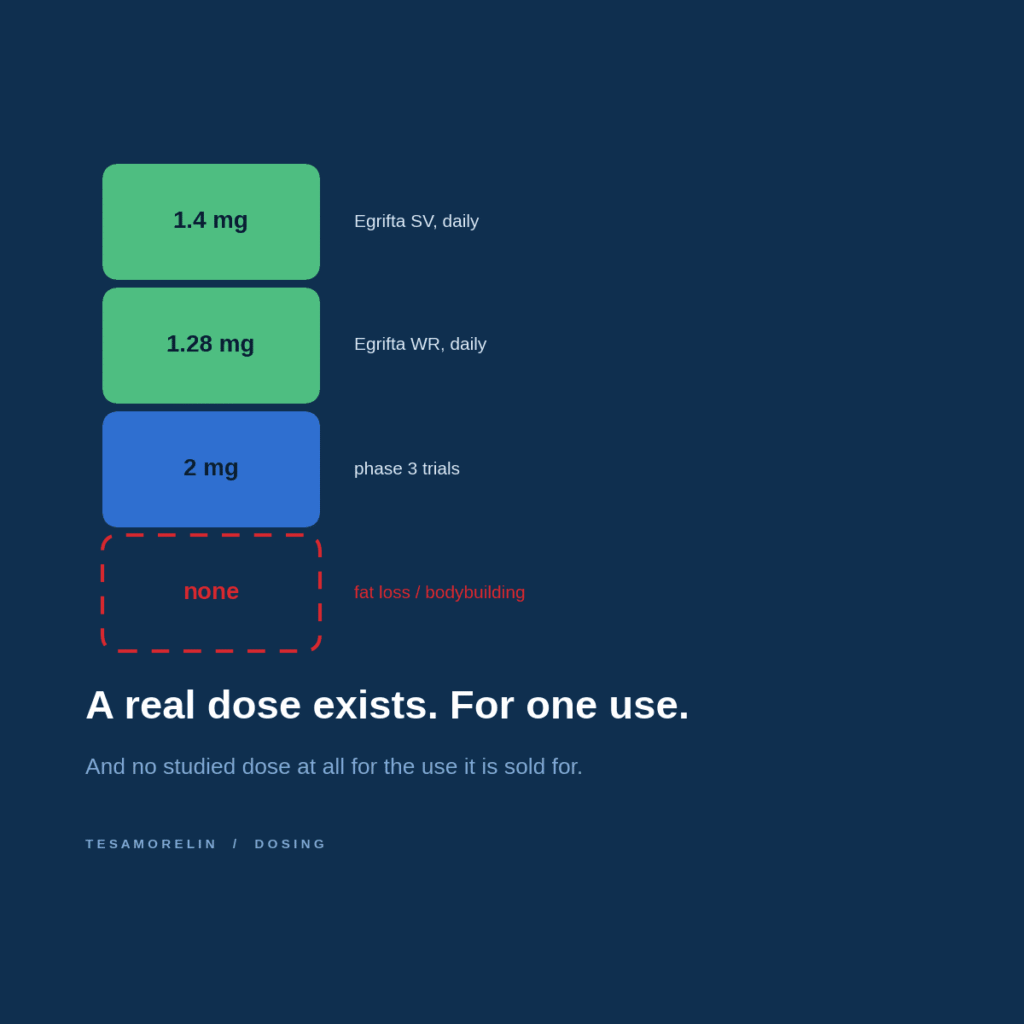
| Egrifta SV | 1.4 mg | Subcutaneous, abdomen | Once daily |
| Egrifta WR | 1.28 mg | Subcutaneous | Once daily |
| Egrifta (original) | 1.4 mg | Subcutaneous, abdomen | Once daily |
The label states that Egrifta WR and Egrifta SV are not substitutable. They are different formulations with different vial strengths and different reconstitution instructions, which is why the daily milligram figures differ.
Egrifta WR is supplied as an 11.6 mg vial reconstituted with 1.3 mL of bacteriostatic water, with one vial providing seven daily doses. Egrifta SV is a 2 mg single-dose vial.
What the trials used, and why it differs from the label
The doses in the published research are not the same as the marketed doses, which confuses people reading the papers:
| Study | Dose | Population |
|---|---|---|
| Phase 3 pivotal trials, 2010 pooled analysis | 2 mg daily, subcutaneous | HIV-associated lipodystrophy, n=806 |
| Non-HIV abdominal obesity trial, 2012 | 2 mg daily, subcutaneous | Reduced GH secretion, n=60, 12 months |
| Mild cognitive impairment trial, 2012 | 1 mg daily, subcutaneous | Adults 55 to 87, 20 weeks |
The difference is a formulation difference, not a change of mind about the right amount. The marketed products differ in potency from the formulation used in the original trials, so the labelled milligram figure is not directly comparable to the trial figure.
Tesamorelin dosage for fat loss, bodybuilding and cycling
These are the most searched dosing questions about tesamorelin, and the honest answer to all three is the same: there is no established dose, because there is no trial.
We could find no human study of tesamorelin for athletic performance, muscle building, or general cosmetic fat loss. The only doses with evidence behind them are the ones in the tables above, in the populations listed.
It is worth repeating what the FDA label says, because it bears directly on the fat-loss question: Egrifta SV “is not indicated for weight loss management as it has a weight neutral effect.” The pivotal trials measured visceral adipose tissue specifically. They did not show weight loss, and they did not show subcutaneous fat reduction.
Dosing charts and cycling protocols for tesamorelin circulate widely. None is derived from a published trial of the use it describes. Where a figure has no study behind it, we are not going to reprint it as though it does.
Working out the volume to draw
Tesamorelin is supplied as a lyophilised powder that is reconstituted before use, so a milligram dose has to be converted into a volume on a syringe. That arithmetic is a common source of error.
Our peptide reconstitution calculator converts a vial strength, a water volume and a prescribed dose into a syringe marking. It does not suggest a dose. Use the reconstitution volume specified in the instructions supplied with your product, because the same dose produces a completely different syringe marking at a different dilution.
Monitoring while on treatment
The label directs that IGF-1 levels be monitored during therapy, and says to consider discontinuing in patients with persistent elevations. It also carries warnings covering neoplasms, fluid retention, glucose intolerance and diabetes risk, hypersensitivity and injection site reactions.
These are label-directed monitoring requirements for a prescription medicine, and a matter for the prescribing clinician rather than something to self-manage.
What happens when treatment stops
Visceral fat reaccumulates. The FDA label reports increases of 25 cm² and 24 cm² in the two pivotal trials among patients switched from tesamorelin to placebo, and the 52-week published trial states that upon discontinuation visceral adipose tissue reaccumulated and that effects do not persist beyond the treatment period.
For anyone weighing dose and duration, that is the relevant fact: the labelled dose maintains an effect while it is being taken. More detail on our main tesamorelin page.
Common questions
What is the standard tesamorelin dose?
1.4 mg once daily subcutaneously for Egrifta SV, or 1.28 mg once daily for Egrifta WR. Those are the FDA-approved doses for the approved indication.
Is there a tesamorelin dosage calculator?
For converting a prescribed dose into a syringe volume after reconstitution, yes, and ours is here. For deciding what dose to take, no such tool exists or should, because that is a prescribing decision.
What is the dose for belly fat?
The approved indication is reduction of excess abdominal fat specifically in HIV-infected adults with lipodystrophy, at the doses above. There is no approved or studied dose for abdominal fat outside that population, other than one 12-month research trial in adults with documented reduced growth hormone secretion.
Should tesamorelin be cycled?
The trials dosed continuously, daily, for 26 or 52 weeks. Cycling protocols are not derived from the published research.
What about 10 mg vials?
Vial strength and daily dose are different things. A vial contains multiple doses once reconstituted. Check the strength and reconstitution instructions on the product you actually have, and see the calculator above.
References
- FDA. EGRIFTA SV prescribing information.
- FDA. EGRIFTA WR prescribing information, March 2025.
- Falutz J, Mamputu JC, Potvin D, et al. Effects of tesamorelin in HIV-infected patients with excess abdominal fat: a pooled analysis of two phase 3 trials. J Clin Endocrinol Metab. 2010;95(9):4291-4304. PMID 20554713
- Falutz J, et al. Long-term safety and effects of tesamorelin in HIV patients with abdominal fat accumulation. AIDS. 2008;22(14):1719-1728. PMID 18690162
- Makimura H, Feldpausch MN, Rope AM, et al. Metabolic effects of a growth hormone-releasing factor in obese subjects with reduced growth hormone secretion. J Clin Endocrinol Metab. 2012;97(12):4769-4779. PMC3513535
This page is general educational information, not medical advice, and not a description of a product available from PrescribedRx. Prescription treatment decisions are made by state-licensed clinicians.
Related reading
More on peptide and longevity therapy:
- The FDA peptide compounding status tracker, kept current
- Sermorelin therapy guide
- Tesamorelin
- Tesamorelin versus sermorelin
- Sermorelin benefits
- Sermorelin dosage
- Sermorelin before and after
- Is sermorelin FDA approved
- Ipamorelin versus sermorelin
- BPC-157 versus TB-500
This article is for general information. It is not medical advice and it is not a recommendation for any particular treatment. Whether a treatment is appropriate for you is a decision for a licensed clinician who has reviewed your health history and current medications.
About the author
Juan MontesJuan Montes writes and reviews PrescribedRX's clinical content, covering testosterone replacement therapy, men's sexual health, weight management and hair loss. He trained as a Professional Nurse at the Colombian Red Cross in Cali, Colombia, and has worked in healthcare since 2011, roughly six of those years in direct emergency and critical care nursing. He served as Head Nurse in Emergency…
More from Juan →This article is for information only and is not medical advice. Treatment is prescribed solely at the discretion of a licensed provider following a clinical evaluation.