BPC-157 vs TB-500: What the Evidence Actually Says
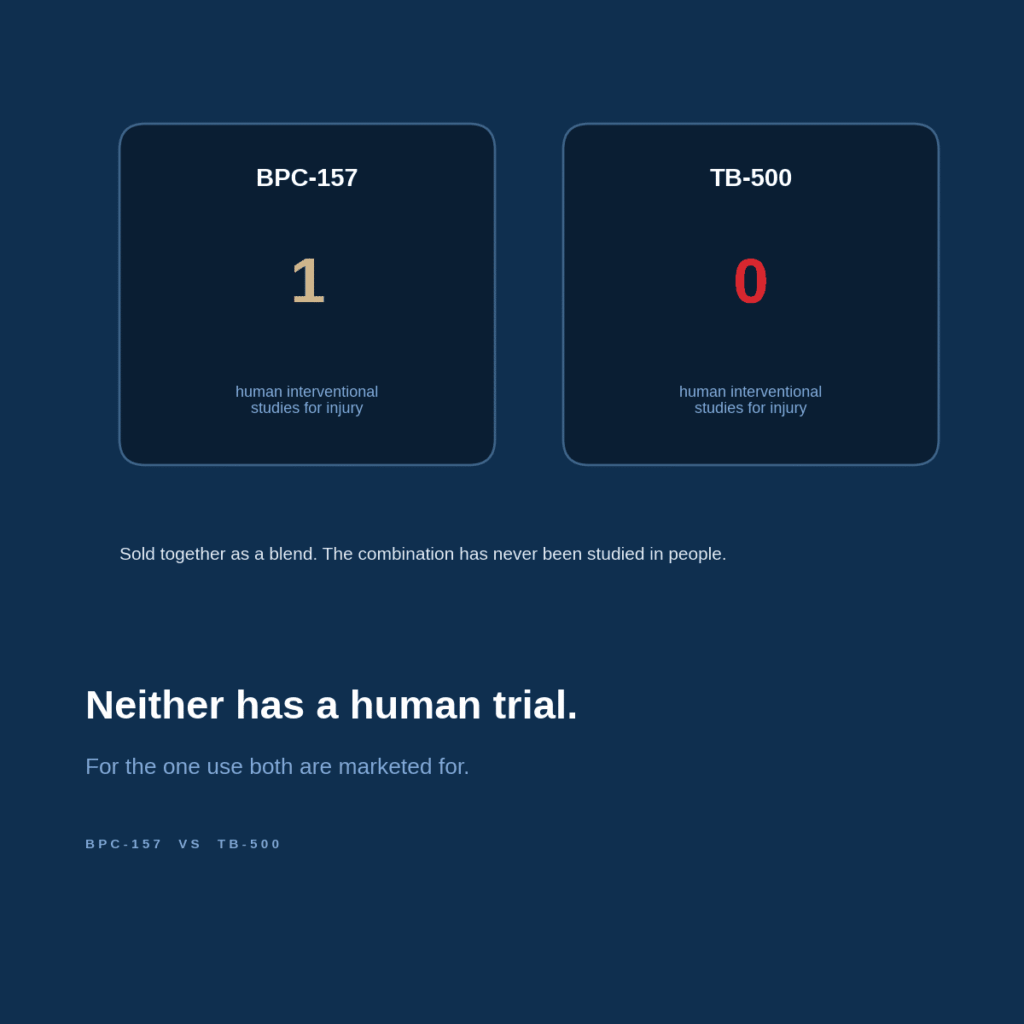
Neither peptide has a human interventional study for injury recovery, and the blend has never been studied in people. A side by side on what is actually published.
 By Juan Montes
Updated September 9, 2026 · 4 min read
By Juan Montes
Updated September 9, 2026 · 4 min read
Last updated 25 August 2026. This page is educational. Neither BPC-157 nor TB-500 is an FDA-approved drug, and neither is currently available for compounding in the United States. PrescribedRX offers neither. See our compounding status tracker.
BPC-157 and TB-500 are almost always sold together, usually as a pre-mixed blend marketed for injury recovery. They are unrelated molecules with separate evidence bases, and the combination itself has never been studied in people. This page compares them on what is actually published.
Side by side
| BPC-157 | TB-500 | |
|---|---|---|
| What it is | Synthetic 15-amino-acid peptide | Synthetic 7-residue fragment (LKKTETQ) of thymosin beta-4 |
| Studied mainly for | Tendon, muscle and gastrointestinal healing in animals | Wound healing. Marketed for musculoskeletal repair |
| Human clinical trials | One registered Phase 1 that never reported results | None identified |
| Published human reports | One retrospective single-clinic case series, 17 patients, some of whom received BPC-157 combined with thymosin beta-4 | None |
| Published human dosing | Only an unreported trial protocol | None |
| Prohibited in sport | Yes, S0, named explicitly | Yes, S2.3, named explicitly |
| On a DoD prohibited list | Yes | Not identified |
| FDA July 2026 committee vote | 8 to 6, 1 abstention, recommended | 8 to 6, 1 abstention, recommended |
| Compoundable today | No | No |
How the evidence differs
BPC-157 has the larger preclinical literature by a wide margin. A 2025 systematic review in orthopaedic sports medicine screened 544 articles and included 36, of which 35 were preclinical and one was human, and found no clinical safety data in humans. The animal work spans tendon, muscle, gastrointestinal and vascular models, though a large share of it comes from the single research group that originated the compound.
TB-500 has less direct evidence than BPC-157, and this is where most comparisons go wrong. Human trials do exist in this space, but they tested full-length thymosin beta-4 as an eye drop, not the LKKTETQ fragment sold as TB-500. FDA stated in July 2026 that it found no information on TB-500 administered in humans by any route. A 2026 scoping review of 80 studies found no human interventional studies of thymosin beta-4 or TB-500 in tendon, ligament, muscle, bone or cartilage.
So on the specific use both are sold for, injury recovery, neither has a human interventional study behind it. BPC-157 has more animal data. TB-500 has a related molecule with an ophthalmology trial programme whose recent Phase 3 results were negative.
The blend: what is known about combining them
Nothing has been published on administering BPC-157 and TB-500 together in humans. There is no combination pharmacokinetic data, no interaction data, and no combination safety data. The rationale offered for the blend is mechanistic plausibility, that one peptide is studied for tissue repair signalling and the other for actin regulation and cell migration, rather than any study of the pair.
Blend dosage calculators are widely available. They are not derived from clinical data for either component individually, let alone in combination, because no such data exists.
Legal status of both
As of 25 August 2026, neither is an FDA-approved drug and neither is lawfully available for compounding under section 503A.
Both were removed from FDA Category 2 in April 2026, which did not make either compoundable. Both were reviewed by the FDA Pharmacy Compounding Advisory Committee on 23 July 2026, where FDA proposed that neither be included on the Bulks List and the committee voted 8 to 6 with 1 abstention to recommend inclusion for each. Those votes are advisory and non-binding, FDA has not agreed, and rulemaking has not occurred.
BPC-157 additionally appears on the Department of Defense prohibited dietary supplement ingredients list, which states it is an unapproved drug that cannot legally be prescribed or sold over the counter.
Both are prohibited in sport
BPC-157 is prohibited at all times under section S0, non-approved substances, and is named as an example. TB-500 is prohibited at all times under section S2.3, growth factors, named as a derivative of thymosin beta-4. Any athlete subject to testing should treat a blend containing either as a positive test risk.
Read more
- BPC-157: what the research actually shows
- TB-500 and thymosin beta-4: not the same molecule
- Peptide compounding status tracker
What we offer
PrescribedRX offers neither BPC-157 nor TB-500 and will not unless federal rulemaking permits it. Among peptides that can currently be dispensed, we offer sermorelin, NAD+ and glutathione. Whether any treatment is appropriate for a particular person is a decision for a state-licensed clinician after reviewing their medical history.
References
- Vasireddi N, Hahamyan H, Salata MJ, et al. Emerging use of BPC-157 in orthopaedic sports medicine: a systematic review. HSS Journal. 2025;21(4):485-495. PMID 40756949
- McGuire F, Hughes E, Maak T, Cushman DM. Thymosin beta-4 and TB-500 in tissue healing, regeneration, and musculoskeletal repair: a scoping review. Applied Sciences. 2026;16(12):6202. doi:10.3390/app16126202
- FDA. TB-500 PCAC briefing document, July 2026.
- FDA. Pharmacy Compounding Advisory Committee briefing document, July 2026.
- DoD Operation Supplement Safety. BPC-157 advisory.
This page is general educational information, not medical advice, and not a description of a product available for purchase. Prescription treatment decisions are made by state-licensed clinicians.
Related reading
More on peptide and longevity therapy:
- The FDA peptide compounding status tracker, kept current
- BPC-157
- Epitalon
- Semax peptide
- KPV peptide
- MOTS-c dosage
- TB-500
- Glutathione injection versus nasal spray
- NAD+ therapy: the complete guide
- Sermorelin therapy guide
This article is for general information. It is not medical advice and it is not a recommendation for any particular treatment. Whether a treatment is appropriate for you is a decision for a licensed clinician who has reviewed your health history and current medications.
About the author
Juan MontesJuan Montes writes and reviews PrescribedRX's clinical content, covering testosterone replacement therapy, men's sexual health, weight management and hair loss. He trained as a Professional Nurse at the Colombian Red Cross in Cali, Colombia, and has worked in healthcare since 2011, roughly six of those years in direct emergency and critical care nursing. He served as Head Nurse in Emergency…
More from Juan →This article is for information only and is not medical advice. Treatment is prescribed solely at the discretion of a licensed provider following a clinical evaluation.