
Last updated 25 August 2026. This page is educational. KPV is not an FDA-approved drug and is not currently available for compounding in the United States. PrescribedRX does not offer it. See our compounding status tracker for the current federal position.
KPV is one of the most searched peptides on the internet and one of the least studied in people. That gap is the single most important thing to understand about it, and most of what is written about KPV does not make it clear. This page sets out what the published research actually found, which studies were done in humans and which were not, and where KPV currently stands with the FDA.
What is KPV?
KPV is a tripeptide made of three amino acids: lysine (K), proline (P) and valine (V). It is the C-terminal fragment of alpha-melanocyte-stimulating hormone (alpha-MSH), a 13-residue peptide derived from proopiomelanocortin. KPV corresponds to residues 11 to 13 of that parent molecule.
A widely circulated 2017 paper describes KPV as the three N-terminal amino acids of alpha-MSH. That is inconsistent with the structure of alpha-MSH and with the rest of the literature. KPV is the C-terminal tripeptide.
What has KPV been studied for?
Research interest in KPV centres on inflammation, and specifically on inflammatory bowel disease. Alpha-MSH has recognised anti-inflammatory activity, and the question researchers have asked is whether the much smaller KPV fragment retains that activity while being easier to deliver.
The studies below are the substantive published work. Note the study type column carefully.
| Study | What it examined | Conducted in |
|---|---|---|
| Dalmasso et al., Gastroenterology, 2008 | Uptake of KPV via the PepT1 transporter, and effects on inflammatory signalling | Human-derived cell lines and mice |
| Kannengiesser et al., Inflammatory Bowel Diseases, 2008 | KPV in two induced models of colitis | Mice |
| Land, Int J Physiol Pathophysiol Pharmacol, 2012 | Effects on inflammatory signalling in airway cells | Cultured human cell line |
| Xiao et al., Molecular Therapy, 2017 | Orally delivered KPV in nanoparticles for ulcerative colitis | Mice |
The mechanism that generated the interest
Dalmasso and colleagues reported that KPV is taken into intestinal and immune cells through PepT1, a peptide transporter, and that at nanomolar concentrations it inhibited NF-kB and MAP kinase signalling in those cells, with reduced markers of colitis in mice. What made this finding notable is that PepT1 expression increases in inflamed intestinal tissue, which in principle would concentrate an orally delivered peptide where inflammation is greatest.
Kannengiesser and colleagues reported earlier weight regain and reduced inflammatory infiltrate in KPV-treated mice across two different colitis models, with effects persisting in mice lacking a functional melanocortin-1 receptor, suggesting the activity does not depend on that receptor.
Land reported dose-dependent reductions in NF-kB activity, MMP-9 activity and IL-8 and eotaxin secretion in a cultured human bronchial epithelial cell line stimulated with TNF-alpha and respiratory syncytial virus.
Has KPV been studied in humans?
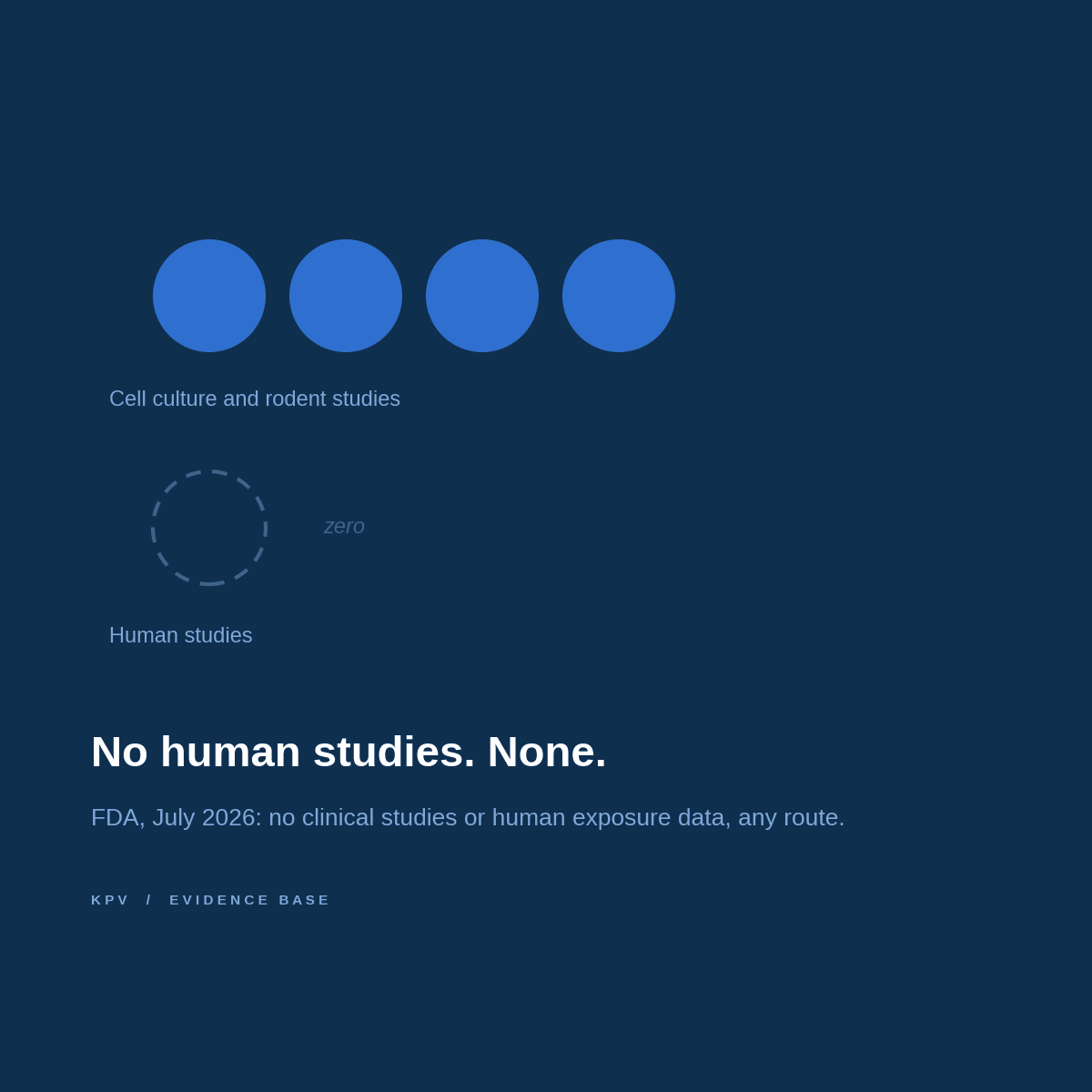
No. There is no completed or registered human clinical trial of KPV that we have been able to locate, and no record on ClinicalTrials.gov.
This is not merely our reading. In its briefing document for the July 2026 advisory committee meeting, FDA stated: “The nomination did not include, and FDA has not identified, any clinical studies or human exposure data for KPV via any route of administration.”
Everything currently known about how KPV behaves comes from cell culture and from mice.
KPV dosage: what is actually published
There is no published human dosing for KPV. Any specific human dose, protocol, or milligram figure circulating online is either extrapolated from rodent studies or invented. We are not going to reproduce one here, because doing so would present a number as though it had a basis it does not have.
For completeness, the doses that appear in the published literature are:
- Mice: 16 mg/kg per day by oral gavage, using nanoparticle-encapsulated KPV (Xiao et al., 2017)
- Cell culture: nanomolar concentrations (Dalmasso et al., 2008)
Rodent milligram-per-kilogram doses do not convert straightforwardly to human doses. Allometric scaling is not a substitute for a dose-finding study, and no dose-finding study of KPV in humans has been done.
KPV side effects and safety
The honest answer is that the human safety profile of KPV is unknown, because no human safety study has been conducted. FDA stated in July 2026 that it had not identified any clinical studies or human exposure data for KPV by any route.
In the rodent studies above, the authors did not report significant toxicity at the doses used. That is a meaningful observation about mice and a weak basis for conclusions about people. Absence of reported harm in a small number of animal experiments is not evidence of safety in humans.
FDA has separately noted, in the context of evaluating KPV for compounding, concerns about immunogenicity risk for certain routes of administration and about peptide-related impurities and characterisation of the active ingredient.
Is KPV legal in the United States?
KPV is not an FDA-approved drug, and as of 25 August 2026 it is not lawfully available for compounding under section 503A.
The position is frequently misreported, so it is worth stating the sequence precisely:
- In April 2026, FDA removed KPV from Category 2, the list of bulk substances identified as posing significant safety risks.
- Removal from Category 2 did not place KPV on the 503A Bulks List, and did not move it to Category 1. Enforcement discretion currently extends only to Category 1 substances.
- On 23 July 2026, the FDA Pharmacy Compounding Advisory Committee reviewed KPV. FDA proposed that it not be included on the Bulks List. The committee voted 8 to 6 with 1 abstention to recommend inclusion.
- That vote is advisory and non-binding. FDA must still decide, and any addition requires notice-and-comment rulemaking.
So KPV is currently in an unusual position: it is off the do-not-compound list, an advisory committee has recommended it, and it still cannot lawfully be compounded. Content stating that KPV became “legal again” in 2026 is incorrect.
For the current status of KPV and every other peptide in this category, see our compounding status tracker, which we update when FDA acts.
Is KPV banned in sport?
KPV is not named individually on the current prohibited list. Athletes subject to testing should be aware that the list is explicitly non-exhaustive and that section S0 captures any pharmacological substance with no current approval by any governmental regulatory health authority for human therapeutic use. Anyone competing under anti-doping rules should confirm status with their governing body rather than relying on absence from a list.
What we offer
PrescribedRX does not offer KPV and will not unless federal rulemaking permits it. We work with US state-licensed clinicians and licensed compounding pharmacies, and we are LegitScript certified.
Among peptides that can currently be dispensed, we offer sermorelin, NAD+ and glutathione. Whether any of these is appropriate for a particular person is a decision for a state-licensed clinician after reviewing that person’s medical history.
Common questions
What does KPV peptide do?
In cell culture and in mice, KPV has been reported to enter cells via the PepT1 transporter and to reduce inflammatory signalling through NF-kB and MAP kinase pathways. What it does in humans has not been studied.
Is KPV a steroid?
No. KPV is a three-amino-acid peptide fragment of alpha-MSH. It is structurally and functionally unrelated to anabolic steroids.
Can I get KPV on prescription?
Not lawfully in the United States at present. KPV is not FDA-approved and is not on the 503A Bulks List, so it cannot be compounded under current federal rules.
Why do some websites sell KPV?
Products are frequently sold labelled “for research use only”. FDA has issued warning letters to research-peptide sellers whose products carried “research use only” labelling while being advertised for human use, including letters in December 2024 and February 2025. A research-use-only label does not make a substance lawful to administer to a person.
Will KPV become available?
Possibly. The July 2026 advisory committee recommendation is a step toward it, but FDA has not agreed, rulemaking has not happened, and no timeline has been announced. We track the status on our peptide compounding tracker.
References
- Dalmasso G, Charrier-Hisamuddin L, Nguyen HTT, Yan Y, Sitaraman S, Merlin D. PepT1-mediated tripeptide KPV uptake reduces intestinal inflammation. Gastroenterology. 2008;134(1):166-178. PMID 18061177
- Kannengiesser K, Maaser C, Heidemann J, et al. Melanocortin-derived tripeptide KPV has anti-inflammatory potential in murine models of inflammatory bowel disease. Inflammatory Bowel Diseases. 2008;14(3):324-331. PMID 18092346
- Land SC. Inhibition of cellular and systemic inflammation cues in human bronchial epithelial cells by melanocortin-related peptides: mechanism of KPV action and a role for MC3R agonists. Int J Physiol Pathophysiol Pharmacol. 2012;4(2):59-73. PMID 22837805
- Xiao B, Xu Z, Viennois E, et al. Orally targeted delivery of tripeptide KPV via hyaluronic acid-functionalized nanoparticles efficiently alleviates ulcerative colitis. Molecular Therapy. 2017;25(7):1628-1640. doi:10.1016/j.ymthe.2016.11.020
- FDA. Pharmacy Compounding Advisory Committee briefing document, July 2026.
- FDA. PCAC meeting, 23 to 24 July 2026.
This page is general educational information, not medical advice, and not a description of a product available for purchase. Prescription treatment decisions are made by state-licensed clinicians.
Related reading
More on peptide and longevity therapy:
- The FDA peptide compounding status tracker, kept current
- BPC-157
- BPC-157 versus TB-500
- TB-500
- Epitalon
- Semax peptide
- MOTS-c dosage
- Glutathione injection versus nasal spray
- NAD+ therapy: the complete guide
- Sermorelin therapy guide
This article is for general information. It is not medical advice and it is not a recommendation for any particular treatment. Whether a treatment is appropriate for you is a decision for a licensed clinician who has reviewed your health history and current medications.