
The short answer
Smokers have higher measured testosterone than non-smokers. So do users of smokeless nicotine.
That is a real, replicated observation. It is also one of the clearest examples in men’s health of a number moving in the opposite direction to the outcome.
The same nicotine that raises your testosterone reading lowers your sperm count and impairs your erections.
The finding
A meta-analysis of 28 observational studies, covering 13,317 men, found smokers had higher mean testosterone by 1.53 nmol/L — roughly 44 ng/dL.
A cross-sectional analysis of 7,797 US men from NHANES found a positive relationship between serum cotinine, the main nicotine metabolite, and total testosterone. Above a cotinine level of 487 ng/mL the relationship reversed and testosterone began to fall.
In a cohort of 2,008 young Danish men, daily smokers had 6.2% higher total and free testosterone than non-users — alongside lower sperm counts.
Why it is not what it looks like
Three things explain most of it, and none of them is a benefit.
It is largely a binding protein effect. Smoking raises SHBG, the protein that carries testosterone in your blood. More carrier means more hormone held in circulation, which inflates your total testosterone without a matching rise in what your tissues can actually use.
The cessation data show this directly. In 76 men attempting to quit, one year later: total testosterone fell from 12.5 to 11.1 nmol/L, which was not statistically significant. SHBG fell from 26.2 to 20.0 nmol/L, which was.
Quitting did not meaningfully lower testosterone. It lowered the binding protein. That is exactly the pattern you would expect if the smoker advantage is mostly an artefact.
Smokers are leaner on average. Body fat is the single largest modifiable suppressor of testosterone, and most of these studies adjust for it imperfectly or not at all.
No randomised evidence exists, and none will. You cannot randomise people to smoke. Every study here is observational, and the authors of the largest meta-analysis say so themselves.
Nicotine without combustion does the same thing
This is the cleanest part of the evidence, because it separates nicotine from smoke.
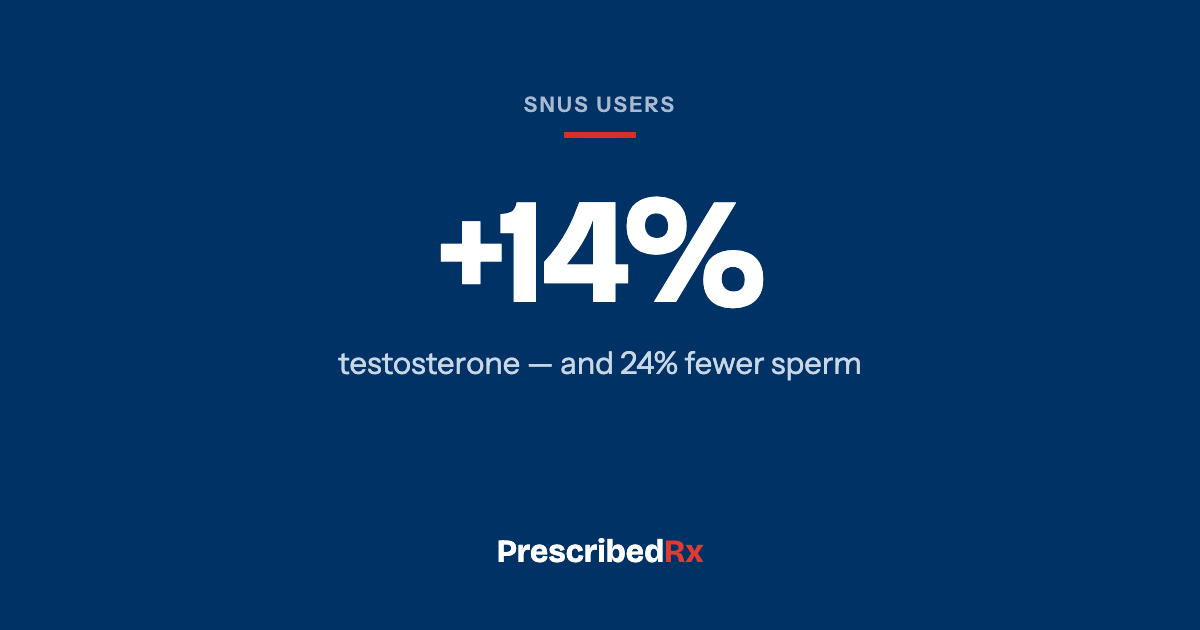
A study of 613 Swedish men, 109 of them snus users, found:
- Testosterone 14% higher in snus users
- Total sperm count 24% lower
Urinary cotinine tracked positively with testosterone, and the effect was dose-dependent on weekly consumption.
A larger 2026 study of 6,158 never-smokers found snus users had higher testosterone than non-users — and former users showed no significant difference, suggesting the effect reverses.
So nicotine by itself raises the testosterone number while damaging sperm production. The number and the outcome move in opposite directions in the same men.
What nicotine does to erections
Here the evidence is better than anything in the testosterone literature, because it is randomised.
Twenty-eight sexually functional non-smoking men were given either 6 mg nicotine gum — roughly one high-yield cigarette — or placebo, double-blind, in a crossover design.
Physiological sexual arousal fell 23%, measured directly, in 16 of the 20 men with valid recordings.
Their subjective arousal did not change. They did not feel less aroused. Their bodies responded less.
This is a single acute dose in young healthy men, so do not over-read it. But it is the only placebo-controlled human evidence in this area, and it points one way.
Longer term, a meta-analysis of eight observational studies covering 28,586 men found current smokers had a 51% higher odds of erectile dysfunction than never-smokers. A larger review of 62 studies and 240,882 men found a dose-response: relative risk 1.26 at around nine cigarettes a day, rising to 1.53 above twenty.
The mechanism is vascular — reduced nitric oxide availability, endothelial damage, oxidative stress. Erections are a blood flow event before they are a hormone event.
Quitting reverses it. In one randomised trial of 719 men, 53.8% of quitters reported improved erectile function against 28.1% of those who continued.
Sperm
A meta-analysis of 16 studies covering 10,823 infertile men found smoking associated with a 29% higher risk of low sperm count and significantly more sperm malformations — head, neck and tail defects.
In that same population, smoking showed no significant effect on testosterone, FSH, LH or prolactin.
Read that together with the snus finding above and the picture is consistent: nicotine damages sperm while leaving, or raising, the hormone numbers.
Vaping
Less is known, and what exists is thin.
The Danish cohort included only 25 daily e-cigarette users — about 2% of the sample. They had lower sperm counts than non-users but showed no consistent differences in testosterone, unlike the cigarette smokers. That is far too small a group to conclude anything.
Laboratory and animal work consistently shows e-cigarette aerosol constituents impairing testosterone production in Leydig cells, through oxidative stress and suppression of steroidogenic enzymes. A 2026 review synthesising that work noted the largest human study found no significant testosterone difference.
Biological plausibility without human confirmation. That is the honest state of it.
One study to be careful with. A 2025 retrospective study of IVF outcomes reported better live birth rates in e-cigarette users than cigarette smokers. It had no non-smoking control group, and its own authors state it is not an endorsement of e-cigarettes. It is widely misreported.
The point of all this
If you are using nicotine and your testosterone reading looks healthy, that reading is not telling you what you want it to tell you.
A man optimising his testosterone number through nicotine is trading sperm count, erectile function and cardiovascular health for a laboratory value that is partly a binding-protein artefact.
There is also a rodent complication worth noting for completeness: in rats, nicotine reduces testosterone and disrupts sperm production. The human observational data point the other way. Species, dose and route all differ, and we mention it only so you know the picture is not tidy.
If you think your testosterone is low
Nicotine use is a reason to interpret a testosterone result carefully, not a reason to skip testing.
A diagnosis requires two early-morning fasting blood tests, interpreted alongside your symptoms and your SHBG — which matters especially here, since nicotine shifts it.
Our $69 TRT Health Assessment starts that process. A US-licensed provider reviews your intake and orders the lab work needed. If your levels and symptoms support treatment, TRT is $387 every 10 weeks — about $39 a week, the same at every dose. If they do not, you are not prescribed.
Prescription required. A provider decides if treatment is appropriate. Payment never guarantees a prescription. Not available in every state.
Common questions
Does nicotine increase testosterone? Measured total testosterone is consistently higher in nicotine users. Much of that appears to be a rise in SHBG, the binding protein, rather than more usable hormone.
Does quitting smoking lower testosterone? In men followed for a year after quitting, total testosterone did not fall significantly. SHBG did.
Does vaping affect testosterone? Human data are limited and show no clear difference. Laboratory studies show impaired testosterone production. There is not enough human evidence to call it safe.
Does nicotine cause erectile dysfunction? A single dose reduced physiological arousal by 23% in a placebo-controlled trial. Smokers have around 51% higher odds of ED, with a dose-response relationship.
Will quitting improve my erections? In one randomised trial, 53.8% of quitters improved against 28.1% of continuers.
Related reading
- Free testosterone vs total — why SHBG changes what your total means.
- Exercise and testosterone — what the evidence supports and what it does not.
- At-home testosterone testing — how to interpret a result properly.
- Online ED treatment compared — if erections are the reason you are reading this.
This article is for general information. It is not medical advice and it is not a recommendation for any particular treatment. Whether a treatment is appropriate for you is a decision for a licensed clinician who has reviewed your health history and current medications.