
What PrescribedRX charges
The TRT Health Assessment is $69, one time. TRT, if prescribed, is $387 every 10 weeks — about $39 a week, the same at every dose.
Prescription required. A provider decides if treatment is appropriate. Payment never guarantees a prescription. Not available in every state.
The short answer
Total testosterone is everything circulating in your blood. Most of it is bound to proteins and not available to your tissues.
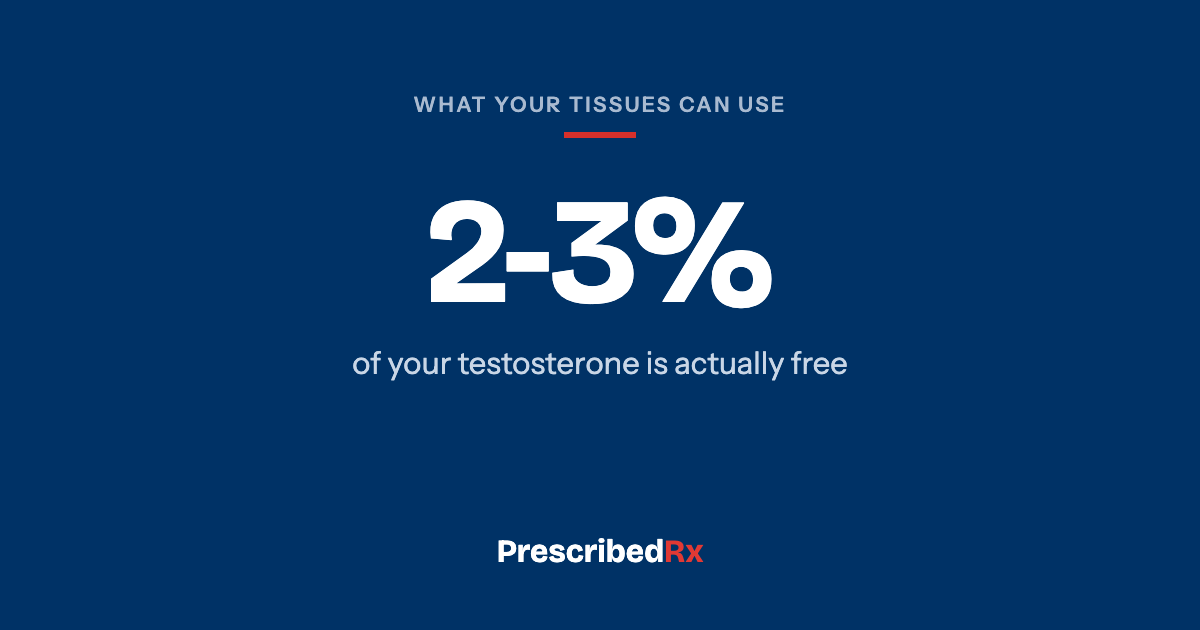
Free testosterone is the unbound fraction — roughly 2 to 3% of the total.
Total is the first-line test in every guideline. Free matters when something has shifted your binding proteins, because then your total number stops being a fair description of what your body can actually use.
How testosterone travels
Testosterone in your bloodstream exists in three states:
| Fraction | Roughly | Available to tissue |
|---|---|---|
| Bound to SHBG | 44–65% | No, bound tightly |
| Bound to albumin | 30–50% | Yes, bound loosely |
| Free | 2–3% | Yes |
SHBG is sex hormone-binding globulin, the high-affinity carrier. It is the variable that makes total and free disagree.
Bioavailable testosterone is free plus albumin-bound — the portion generally considered accessible.
When total testosterone misleads you
This is the whole point of the free test, and it cuts both ways.
High SHBG inflates your total. More carrier protein means more testosterone held in circulation. Your total looks respectable while your free level is low. Classic in older men, lean men, men with thyroid excess, and men on certain medications.
Low SHBG deflates your total. Less carrier protein means less testosterone held in circulation. Your total looks deficient while your free level is adequate. Classic in men with obesity or insulin resistance.
| Raises SHBG | Lowers SHBG |
|---|---|
| Ageing | Obesity |
| Thyroid hormone excess | Insulin resistance |
| Oestrogens | Androgen use |
| Weight loss | — |
| Anti-androgens and 5-alpha-reductase inhibitors | — |
The practical upshot: a man with obesity and a total of 280 ng/dL and a lean 70-year-old with a total of 420 ng/dL may have very similar free testosterone. Without SHBG, you cannot tell.
When guidelines say to measure it
They disagree, and it is worth knowing where your provider is drawing from.
| Body | Position on free testosterone |
|---|---|
| AUA | Recommends against it as a primary diagnostic tool. May assist when total is 230–317 ng/dL |
| Endocrine Society | Measure when total is borderline, 200–400 ng/dL, or when SHBG is altered |
| EAU | Uses a threshold of 220 pmol/L, especially when total is borderline or SHBG is abnormal |
| BSSM | Below 180 pmol/L usually warrants therapy; below 225 pmol/L supports treatment with symptoms |
The AUA does not use it at all. The European guidelines build their algorithms around it. That is a real split, not a nuance.
Most free testosterone results are calculated, not measured
This is the part almost nobody is told, and it matters more than anything else on this page.
There are two ways to get a free testosterone number.
Measure it directly. Equilibrium dialysis with mass spectrometry. This is the reference method. Mayo Clinic Laboratories does this.
Calculate it. Take total testosterone, SHBG and albumin, and run them through an equation. The standard Quest free testosterone result is calculated using a modified Vermeulen equation.
The equations do not agree with measurement, or with each other:
| Equation | How it compares to direct measurement |
|---|---|
| Vermeulen | Overestimates by about 19–30% |
| Ly | Median accurate, but ranges from 50% to 150% depending on SHBG |
| Zakharov | Roughly double the measured value |
A separate analysis found that at least 25% of samples deviated unacceptably from direct measurement regardless of which equation was used, with the worst agreement in men with elevated SHBG — exactly the men for whom you ordered the test.
There is a third method, the direct analog immunoassay, which every guideline rejects for clinical use.
What this means practically: two men can both hold a lab report saying free testosterone and the numbers are not comparable. One may be a calculation, the other a measurement. Check which you have.
Reference ranges for free testosterone are unsettled
Total testosterone ranges vary between labs. Free testosterone ranges vary more.
| Source | Reference range |
|---|---|
| 2023 research study, standardized equilibrium dialysis | 120–368 pg/mL, men 19–39 |
| Mayo Clinic Laboratories | 52.5–207 pg/mL, age 20–25 |
| Quest Diagnostics | 46.0–224.0 pg/mL, age 18–69 |
The lower bound in the research reference set is more than double either commercial lab lower bound — and all three use equilibrium dialysis.
We are not going to tell you which is right. We are telling you that free testosterone reference intervals are materially less settled than total testosterone reference intervals, and that a low free testosterone result should be read with that in mind.
What to actually order
If you are investigating symptoms for the first time:
- Total testosterone, two early-morning fasting samples
- SHBG, so the total can be interpreted
- Free testosterone, if total is borderline or SHBG is abnormal
- LH and FSH, to locate the problem
- Plus haematocrit and PSA as a baseline if treatment is being considered
Ordering free testosterone alone, without total and SHBG, tells you very little — and if it was calculated, it was derived from the total and SHBG anyway.
Common questions
Is free or total testosterone more important? Total is the first-line test and every diagnostic threshold is built on it. Free becomes important when your total is borderline or your SHBG is abnormal.
Can I have normal total testosterone and low free testosterone? Yes. High SHBG inflates total while leaving less unbound. This is common in older and leaner men.
Can I have low total testosterone and normal free testosterone? Also yes. Low SHBG deflates total. This is common with obesity and insulin resistance.
What is a normal free testosterone level? It depends on the lab and the method more than most measurements. Reference ranges from reputable labs using the same technique vary by more than twofold at the lower bound.
Why does my free testosterone look different at a different lab? Probably because one calculated it and the other measured it. The most widely used equation runs about 19 to 30% above direct measurement.
Do I need free testosterone tested? Not routinely. It is useful when your total is in the borderline range, or when you have a condition that shifts SHBG — obesity, diabetes, thyroid disease, or simply being older.
Related reading
- Average testosterone levels by age — where your total sits against the data.
- At-home testosterone testing — what to order alongside free testosterone.
- Normal testosterone levels — the reference ranges explained.
- How much does TRT cost — if your results support treatment.
This article is for general information. It is not medical advice and it is not a recommendation for any particular treatment. Whether a treatment is appropriate for you is a decision for a licensed clinician who has reviewed your health history and current medications.