
What PrescribedRX charges
The TRT Health Assessment is $69, one time. That covers your intake and provider review.
If a provider prescribes treatment, TRT is $387 every 10 weeks — about $39 a week, the same at every dose, whether you are prescribed injections, cream or enclomiphene.
Prescription required. A provider decides if treatment is appropriate. Payment never guarantees a prescription. Not available in every state.
The short answer
An at-home testosterone test can tell you roughly where your level sits. It cannot diagnose low testosterone.
Every major guideline requires two separate early-morning samples, drawn fasting, interpreted alongside your symptoms. One number from one morning is a starting point, not an answer.
That is not a criticism of home testing. It is how the diagnosis works.
The three kinds of at-home test, and they are not equivalent
Mail-in venous serum. The kit is a requisition. You go to a patient service centre and have blood drawn from a vein. The specimen is identical to one your doctor would order. This is the strongest option.
Finger-prick capillary blood. You lance a fingertip and either fill a small tube or blot onto a dried-blood-spot card, then post it. A 2025 systematic review of 26 studies found self-collected capillary samples correlated with venous samples at r = 0.89, and agreed on above-or-below-threshold results 99% of the time. Two caveats matter. That review did not analyse testosterone specifically. And the authors named the failure modes plainly: haemolysis, insufficient volume, contamination.
Saliva. The weakest option. Testosterone binds to proteins in saliva, so salivary testosterone is not interchangeable with blood. Collection method alone changes the result — one study found correlation with serum free testosterone of 0.71 by passive drool but only 0.43 using a cotton-roll device. Several insurers classify salivary testosterone testing as unproven. No major society recommends it for diagnosing low testosterone in men.
Why the time of day changes your number
Testosterone follows a daily rhythm. It peaks in the early morning and falls through the day.
In men aged 30 to 40, levels measured at 4pm ran 20 to 25% lower than the same men at 8am. The effect is smaller in older men but it does not disappear, which is why guidelines restrict testing to the morning at every age.
The European Association of Urology specifies a window of 7am to 10am.
Why you should not eat first
This one surprises people.
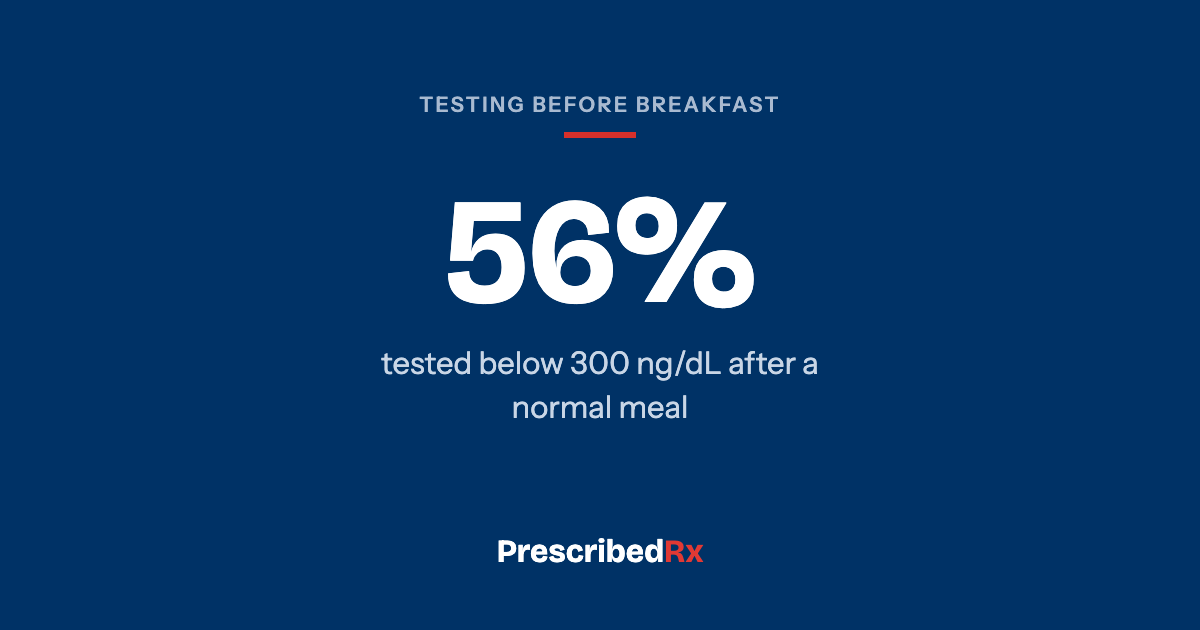
In a study of 60 healthy men with no diabetes, a standard mixed meal dropped testosterone by an average of 123 ng/dL. At the low point, 56% of these healthy men tested below 300 ng/dL — the threshold commonly used to define deficiency.
They were not deficient. They had eaten breakfast.
The decline started within 20 minutes and most men were still below baseline two hours later. A British guideline puts non-fasting levels as much as 30% lower.
If you test after breakfast, you may be measuring your breakfast.
Why one test is never enough
Testosterone varies day to day in the same man. Measured on consecutive mornings, the between-day variation is about 18.7%.
Two morning results have to differ by more than 50% before that difference means anything real.
The practical consequence: roughly 30% of men whose first test comes back low are normal on a repeat. That is why every guideline asks for two.
Where the number comes from matters too
Laboratories do not agree on what normal is.
| Laboratory | Adult male reference range |
|---|---|
| Labcorp | 264–916 ng/dL |
| Quest Diagnostics | 250–1,100 ng/dL |
| Mayo Clinic Laboratories | 240–950 ng/dL |
The same 255 ng/dL result is flagged low at Labcorp and Mayo, and sits inside the range at Quest.
The assay matters as well. Mass spectrometry is the reference method. Older immunoassays lose accuracy at exactly the low concentrations that matter for this diagnosis — below about 115 ng/dL, measured bias against reference methods has ranged from 5% to 220%.
Ask which method your test uses. Then use the same laboratory for every repeat, because serial results from different labs are not comparable.
What a complete panel includes
Total testosterone on its own does not tell a provider what to do next. A full workup usually adds:
- SHBG — the carrier protein. High SHBG inflates your total testosterone; low SHBG deflates it. Without it, the total number can mislead.
- Free testosterone — the unbound fraction. Useful when total is borderline or SHBG is abnormal.
- LH and FSH — these separate a testicular problem from a pituitary one. That distinction changes the treatment entirely.
- Prolactin — screens for a pituitary cause that is treatable at its source.
- Haematocrit — a baseline, because testosterone raises red cell count.
- PSA — checked before starting in men over 40.
A provider who prescribes testosterone without any of this is not following either major US guideline.
What the industry actually does
In 2022, researchers assessed seven direct-to-consumer testosterone platforms against guideline standards.
One out of seven measured morning testosterone on two separate occasions.
Six out of seven offered testosterone therapy to a simulated patient who had normal levels and wanted to preserve fertility.
A separate 2026 analysis of 200 real patients newly prescribed testosterone found 12% had received a complete diagnostic workup.
We mention this because it is the reason our process starts where it does.
What happens when you start with us
- You complete the $69 TRT Health Assessment.
- A US-licensed provider reviews it and orders the lab work needed.
- If your levels and symptoms support treatment, you are prescribed a plan at $387 every 10 weeks.
- If they do not, you are not. Treatment only follows if your provider says so.
We would rather tell you that you do not need TRT than sell you something you do not.
Common questions
Are at-home testosterone tests accurate? It depends entirely on the type. A mail-in kit that routes you to a venous draw at a certified lab produces the same specimen your doctor would order. Finger-prick has reasonable but thinner support. Saliva is not recommended for this purpose.
Can I diagnose low testosterone with a home test? No. A diagnosis requires two early-morning fasting measurements plus symptoms, interpreted by a clinician. A home test can tell you whether that conversation is worth having.
What time should I test? Between 7am and 10am, before eating.
My result was 280 ng/dL. Am I deficient? Possibly, and possibly not. That number sits near the threshold, it falls inside Quest’s reference range, and about 30% of low first results normalise on retest. It needs a second morning sample and a provider’s read.
Do I still need blood work if I already tested at home? Usually yes. A provider needs a confirmatory sample plus the wider panel — SHBG, LH, FSH, haematocrit, PSA — before prescribing anything.
Related reading
- Free testosterone vs total — why the two numbers disagree.
- Average testosterone levels by age — what the data actually shows.
- How much does TRT cost — our published pricing and the market range.
- Buying testosterone online — what is legal and what is not.
This article is for general information. It is not medical advice and it is not a recommendation for any particular treatment. Whether a treatment is appropriate for you is a decision for a licensed clinician who has reviewed your health history and current medications.