
What PrescribedRX charges
The TRT Health Assessment is $69, one time. TRT, if prescribed, is $387 every 10 weeks — about $39 a week, the same at every dose.
Prescription required. A provider decides if treatment is appropriate. Payment never guarantees a prescription. Not available in every state.
The short answer
Testosterone therapy has real side effects. The most common one is a rise in your red blood cell count, and how likely that is depends heavily on which form you take.
TRT also suppresses fertility. That effect is usually reversible, but it is not optional — it happens to nearly everyone.
Most other effects are manageable with monitoring and dose adjustment. That is what the blood work is for.
Raised red blood cell count
This is the side effect with the best numbers behind it, and the one that most often forces a dose change.
Testosterone tells your body to make more red blood cells. Too many thickens the blood.
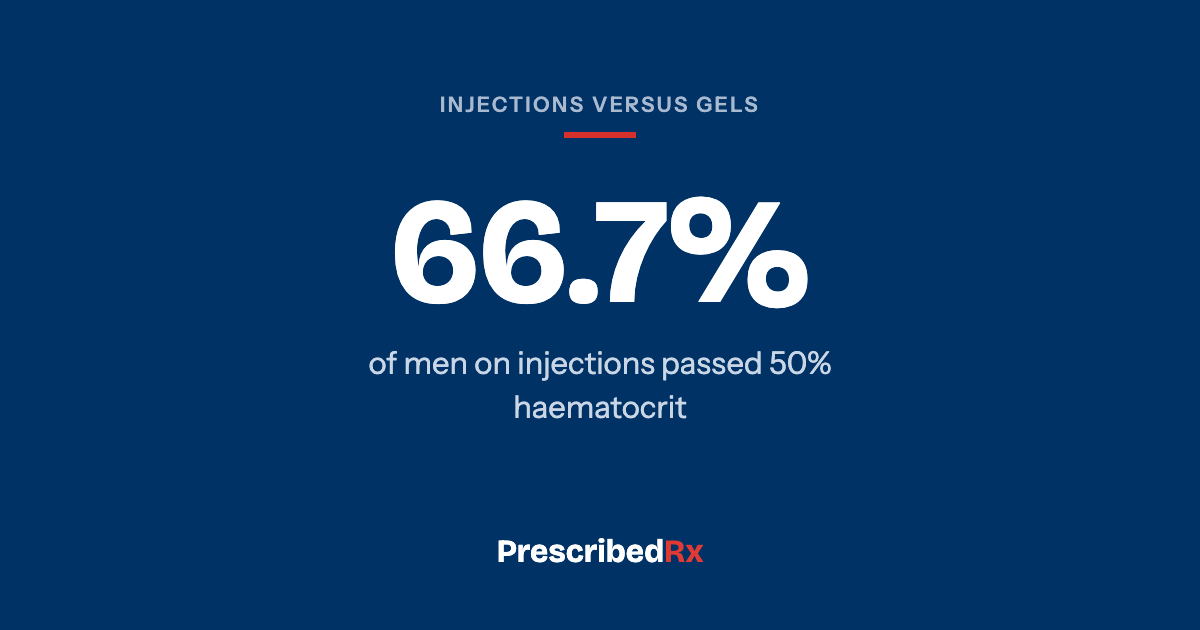
One study of 178 men measured how often haematocrit passed 50%, by formulation:
| Form | Rate | Average time to onset |
|---|---|---|
| Injections | 66.7% | 10.5 months |
| Pellets | 35.1% | 16.4 months |
| Gels | 12.8% | 14.0 months |
Injections carry the highest risk by a wide margin. In the large TRAVERSE trial, which used a daily gel, fewer than 1% of men exceeded 54%.
What happens if yours rises. At 54% or above, guidelines call for reducing the dose or stopping. Some clinics offer blood donation or phlebotomy instead — note that this is debated, and some researchers argue the evidence for it is thin. Lowering the dose is the uncontested first step.
This is why haematocrit is checked before you start, again at three to six months, and then routinely.
Effects on fertility
Exogenous testosterone shuts down the signal that tells your testicles to produce sperm. It is not a side effect in the incidental sense. It is the predictable consequence of the mechanism.
In a WHO study of men on weekly testosterone enanthate, 157 of 241 men (65%) had no measurable sperm after six months. The average time to that point was 120 days.
Recovery, after stopping:
| Time off testosterone | Probability of returning to 20 million sperm/mL |
|---|---|
| 6 months | 67% |
| 12 months | 90% |
| 24 months | 100% |
Recovery tends to be slower in older men, after longer treatment, and with longer-acting formulations.
An honest caveat: those figures come from healthy, fertile men in contraception trials on defined regimens. Men on long-term TRT, at higher doses, or with pre-existing fertility problems recover less reliably.
If you want children. Say so before you start. Testosterone should not be prescribed to a man currently trying to conceive. There are alternatives — enclomiphene raises your own testosterone rather than replacing it, and hCG alongside TRT has been shown in one small study of 26 men to prevent azoospermia entirely. Note that enclomiphene is not FDA-approved for this use and is prescribed off-label.
Testicular shrinkage
Same mechanism, visible version. When the signal from the pituitary stops, the testicles get less work to do and reduce in size.
It is common and it generally reverses after stopping. We are not going to give you a percentage, because no reliable trial has measured one, and the figures circulating online are not sourced to anything.
Blood pressure
In February 2025, the FDA required a new blood pressure warning on every testosterone product, across all forms — oral, gel, patch, and injection. Ambulatory monitoring studies confirmed the effect is class-wide.
The oral products quantify it: around 4 to 5 mmHg systolic on average over four months. In the Jatenzo trial, 7% of men needed new or increased blood pressure medication.
If your blood pressure is not controlled, it should be before you start.
Skin
Acne is the most frequently reported skin effect, at 0.6% to 9.1% across ten studies. Oily skin and increased body hair occur at lower rates. Injectable forms produce more skin effects than topicals or orals.
Across all of those studies, two participants stopped treatment because of acne.
Sleep apnea
Older case reports suggested testosterone worsens sleep apnea. The better evidence suggests a small effect that may be temporary.
In one randomised trial, apnea measures were elevated at 7 weeks but not significantly different at 18 weeks. A 2021 review concluded testosterone likely plays a small role in exacerbating it.
If you have severe untreated sleep apnea, that is a reason to hold off until it is treated.
The cardiovascular question, stated accurately
This is where most articles get it wrong in one direction or the other.
TRAVERSE was an FDA-mandated safety trial: 5,204 men aged 45 to 80 with low testosterone and existing cardiovascular disease or high risk, on daily gel or placebo, followed an average of 33 months.
What it found: no increase in the primary endpoint of cardiovascular death, heart attack or stroke. 7.0% on testosterone versus 7.3% on placebo.
What it also found:
| Outcome | Testosterone | Placebo |
|---|---|---|
| Pulmonary embolism | 0.9% | 0.5% |
| Atrial fibrillation | 3.5% | 2.4% |
| Arrhythmia needing intervention | 5.2% | 3.3% |
| Acute kidney injury | 2.3% | 1.5% |
A separate analysis of the same men found more fractures on testosterone: 3.50% versus 2.46%, a hazard ratio of 1.43. Researchers expected the opposite, since testosterone improves bone density. The reason is unexplained.
What the FDA did. In February 2025 it removed cardiovascular risk language from the boxed warning and added the trial results to every label. It also added the blood pressure warning described above, and kept the limitation stating testosterone is not approved for age-related low testosterone alone.
That was not a clean bill of health. It was one warning removed and another added.
What the Endocrine Society said in July 2026. It reiterated the pulmonary embolism and fracture findings and stated that long-term safety, including prostate cancer risk, remains unestablished.
Both of those things are true at once. Anyone telling you testosterone has been proven cardiovascular-safe is overstating a non-inferiority trial that ran for one to four years.
Prostate and PSA
TRAVERSE found no significant increase in prostate cancer. The event numbers were small and the men had been screened to exclude those at high risk, so this is reassurance rather than proof.
PSA does rise modestly on testosterone — about 0.11 to 0.15 ng/mL, plateauing after the first year.
Your provider should refer you to a urologist if PSA rises more than 1.4 ng/mL above baseline within 12 months, or exceeds 4.0 ng/mL at any point.
Mood
You will read that testosterone causes aggression. At replacement doses, controlled evidence for that is limited. Mood changes are reported, and they are worth telling your provider about, but the confident claims made in both directions outrun the data.
Who should not take testosterone
- Active prostate or breast cancer
- A PSA above 4 ng/mL, or above 3 with risk factors, without a urology workup
- Haematocrit already elevated at baseline
- Severe untreated sleep apnea
- Uncontrolled heart failure
- A heart attack or stroke in the recent past — the Endocrine Society says within 6 months, the VA says 4
- A clotting disorder or unexplained blood clot history
- Severe urinary symptoms
- Any plan to father children in the near term
The monitoring that makes this manageable
| What | When |
|---|---|
| Testosterone level | 3–6 months, then every 6–12 months |
| Haematocrit | 3–6 months, then routinely |
| PSA | Before starting if over 40, then per screening schedule |
| Blood pressure | Before starting and ongoing |
| Symptoms and side effects | 3–12 months, then annually |
Most of the risks on this page are detected by a blood test before you feel anything. That is the argument for staying in a monitored plan rather than sourcing testosterone elsewhere.
Common questions
What is the most common side effect of TRT? A rise in red blood cell count. It affects about two thirds of men on injections within the first year.
Does testosterone cause heart attacks? The largest trial found no increase in heart attack, stroke or cardiovascular death. It did find more pulmonary embolisms, atrial fibrillation and fractures. Long-term risk is unknown.
Will TRT make me infertile? It will suppress sperm production in most men. Around 90% recover within 12 months of stopping. If you want children soon, tell your provider before starting.
Do side effects go away? Many are dose-related and improve when the dose is reduced. Fertility suppression and testicular shrinkage usually reverse after stopping. Some effects, like raised blood pressure, need managing rather than waiting out.
Related reading
- Testosterone shots for men — why injections carry the highest blood count risk.
- Oral testosterone — how the modern pills differ from the old ones.
- At-home testosterone testing — what a diagnosis actually requires.
- How much does TRT cost — what treatment costs before you commit.
This article is for general information. It is not medical advice and it is not a recommendation for any particular treatment. Whether a treatment is appropriate for you is a decision for a licensed clinician who has reviewed your health history and current medications.