
What PrescribedRX charges
The TRT Health Assessment is $69, one time. TRT, if prescribed, is $387 every 10 weeks — about $39 a week, the same at every dose.
Prescription required. A provider decides if treatment is appropriate. Payment never guarantees a prescription. Not available in every state.
The short answer
Oral testosterone exists, it is FDA-approved, and it is not the same drug that gave oral androgens their reputation for liver damage.
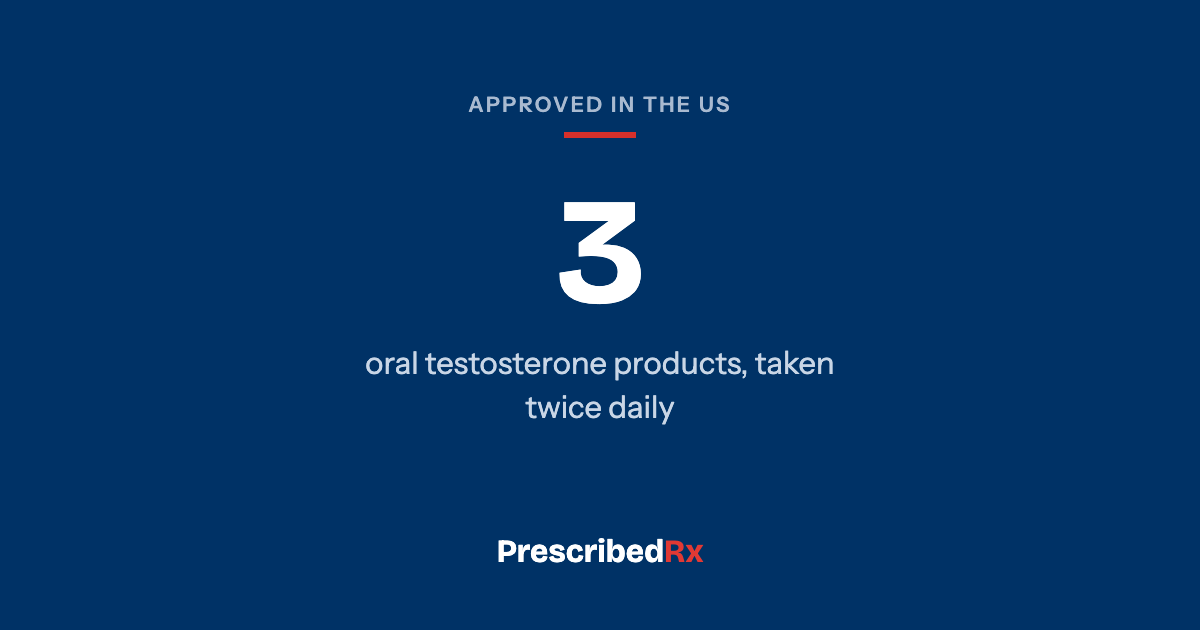
Three products are approved in the US, all of them testosterone undecanoate. All three are taken twice a day with food, indefinitely. All three carry a boxed warning — for blood pressure, not for the liver.
They avoid needles. They do not reduce the amount of monitoring you need.
Why the old oral testosterone was a problem
Older oral androgens — methyltestosterone, oxymetholone, stanozolol — were 17-alpha-alkylated. Chemists modified the molecule at one carbon so it would survive passage through the liver.
That modification is what made them work orally, and it is what damaged livers.
The documented injuries were serious: cholestasis, where bile flow stalls and deep jaundice develops with only mild enzyme changes, estimated at around 1% of treated patients. Peliosis hepatis, where blood-filled cavities form in liver tissue. Liver adenomas and, after five to fifteen years of use, hepatocellular carcinoma.
The line worth knowing, from the NIH LiverTox database: cholestasis has not been described in patients receiving unmodified testosterone.
How modern oral testosterone is different
Testosterone undecanoate is not 17-alpha-alkylated. It is ordinary testosterone with a long-chain fatty acid attached, suspended in an oil-based formulation.
That changes the route. Instead of going through the liver first, it is absorbed via the intestinal lymphatic system. Same hormone as an injection, different path in.
That is why the approved oral products do not carry liver warnings.
One honest caveat: LiverTox notes that liver tumours have been associated with unmodified and esterified testosterone preparations too, though not quantified. The cholestatic injury is specific to the old alkylated drugs. A residual long-term question about tumours is not.
The three approved products
| Product | Approved | Dosing | Titration |
|---|---|---|---|
| Jatenzo | March 2019 | 237 mg twice daily with food | Yes, 158–396 mg |
| Tlando | March 2022 | 225 mg twice daily with food | No, fixed dose |
| Kyzatrex | July 2022 | 200 mg twice daily with food | Yes, 100–400 mg |
All three are Schedule III controlled substances.
Food is not optional. The formulation depends on dietary fat for absorption. Taking Tlando fasted cuts peak concentration by 65%. Kyzatrex absorption rises 37 to 94% with fat present versus fasting. A pill taken on an empty stomach may not deliver a therapeutic dose.
Timing your blood test matters. Jatenzo is measured 6 hours after the morning dose. Kyzatrex at 3 to 5 hours. Draw at the wrong hour and the number is meaningless.
The boxed warning is about blood pressure
All three carry it. The Jatenzo trial measured a mean rise of 4.9 mmHg systolic over four months, with 7% of men requiring new or intensified blood pressure medication. Tlando showed 4.3 to 4.8 mmHg.
Worth keeping in perspective. In February 2025, the FDA added a blood pressure warning to every testosterone product, having found the effect is class-wide across oral, gel, patch and injection. The orals carry it prominently because they were approved after the FDA started requiring ambulatory monitoring data.
Oral testosterone raises blood pressure is half the story. Testosterone raises blood pressure, and the orals were simply measured first.
How it compares to injections and gels
On effectiveness, there is no head-to-head evidence. A December 2025 review stated it plainly: no large randomised trial has compared oral testosterone undecanoate against injectable, transdermal or implantable testosterone. Anyone claiming one is more effective is not citing data.
Within their own single-arm trials: Jatenzo brought 87% of men into range, Tlando 80%, Kyzatrex 88%.
On convenience, the trade is narrower than it looks.
| Oral TU | Injections | Gels | |
|---|---|---|---|
| Frequency | Twice daily, with food | Weekly to every 10 weeks | Daily |
| Needles | No | Yes | No |
| Transfer risk to partner | No | No | Yes |
| Blood count risk | Lower | Highest | Lowest |
| Blood test timing | Product-specific hours | Midway between doses | 2–8 hours after |
Oral testosterone is the most frequent dosing schedule of any route. You are trading needles for remembering two doses a day with meals, forever.
The one clean advantage: no risk of transferring testosterone to a partner or child through skin contact. That is a labelled concern for gels with no oral equivalent.
On cost. Oral testosterone is generally the most expensive route, and insurance usually requires prior authorisation. Generic injectable testosterone cypionate is by far the cheapest. Prices move, so check current figures rather than trusting a number in an article.
Compounded oral testosterone is a different thing
Compounding pharmacies make testosterone creams, gels, troches and injectables. What they do not meaningfully replicate is the lipid formulation that makes the approved oral capsules absorb the way they do — that formulation is the product.
More importantly, compounded drugs are not FDA-approved. The FDA does not review their safety, effectiveness or quality before they are sold.
That has specific consequences:
- No FDA-approved labelling
- No boxed warning
- No required blood pressure monitoring data
- No FDA-reviewed adverse reaction table
- The February 2025 class-wide labelling change applied to approved products, not compounded ones
There is a distinction between a 503A compounding pharmacy and a 503B outsourcing facility — the latter is FDA-inspected and subject to manufacturing standards. Neither is FDA-approved. Marketing that implies FDA-registered facility means FDA-approved drug is misleading.
Who oral testosterone suits
It is a reasonable option if you will not inject, you want no transfer risk, your blood pressure is controlled, and you will reliably take two doses a day with food.
It is a poor fit if you have uncontrolled hypertension, you want the cheapest route, you skip meals, or you would rather deal with treatment once a week than twice a day.
Common questions
Is oral testosterone safe for the liver? Modern oral testosterone undecanoate is not 17-alpha-alkylated and the approved products do not carry liver warnings. The liver injuries associated with oral androgens came from the older alkylated drugs.
Is oral testosterone as effective as injections? No trial has compared them directly. Each approved oral product brought 80 to 88% of men into the normal range in its own trial.
Do I have to take it with food? Yes. Absorption depends on dietary fat. Taking it fasted can cut the dose you actually absorb by more than half.
Why does oral testosterone have a boxed warning? For blood pressure. The FDA has since confirmed the blood pressure effect applies to all testosterone products, not just orals.
Is compounded oral testosterone the same? No. Compounded products are not FDA-approved, carry no approved labelling, and have not been through the review the branded products went through.
Related reading
- Testosterone shots for men — the injectable alternative, compared.
- Testosterone side effects — what the evidence shows, with rates.
- Our TRT plans — $387 every 10 weeks, the same at every dose.
- How much does TRT cost — the full pricing picture.
This article is for general information. It is not medical advice and it is not a recommendation for any particular treatment. Whether a treatment is appropriate for you is a decision for a licensed clinician who has reviewed your health history and current medications.