
What PrescribedRX charges
The TRT Health Assessment is $69, one time. TRT, if prescribed, is $387 every 10 weeks — about $39 a week, the same at every dose, whether you are prescribed injections, cream or enclomiphene.
Prescription required. A provider decides if treatment is appropriate. Payment never guarantees a prescription. Not available in every state.
The short answer
Three injectable testosterone esters are used in the US. Two of them — cypionate and enanthate — are short-acting and given weekly or every two weeks. The third, undecanoate, lasts ten weeks but cannot be self-administered at home.
Injections are the most effective route at raising levels and the most likely to raise your red blood cell count. That trade-off is the main thing to understand before choosing one.
The three esters
| Ester | Common brand | Route | Interval | Half-life |
|---|---|---|---|---|
| Cypionate | Depo-Testosterone | Intramuscular | Every 1–2 weeks | About 8 days |
| Enanthate | Xyosted auto-injector | Subcutaneous | Weekly | About 4–5 days |
| Undecanoate | Aveed | Intramuscular | Every 10 weeks | Very long |
Cypionate and enanthate are close cousins. The practical difference is about three or four days of half-life. Both are prescribed at labelled doses of 50 to 400 mg every two to four weeks, though weekly or twice-weekly dosing at smaller amounts is common in practice.
Undecanoate is the only genuinely long-acting injection: 750 mg at the start, again at four weeks, then every ten weeks. The convenience comes with conditions. It carries a boxed warning for pulmonary oil microembolism and anaphylaxis, it is available only through a restricted programme requiring certified prescribers, and you must be observed for 30 minutes after every injection. It is not a home treatment.
Intramuscular versus subcutaneous
Intramuscular means into the muscle, usually the gluteal or thigh. Subcutaneous means into the fat layer, usually the abdomen, with a much shorter needle.
The best direct comparison followed 234 men on 100 mg weekly for 12 weeks:
| Baseline | 12 weeks | |
|---|---|---|
| IM cypionate | 313.6 ng/dL | 536.4 ng/dL |
| SC enanthate | 246.6 ng/dL | 552.8 ng/dL |
Route was not independently associated with the final testosterone level. Subcutaneous was associated with lower estradiol and lower haematocrit — both meaningful, since those are the two variables that most often force a dose change.
One thing worth stating plainly: subcutaneous administration is FDA-approved only for the Xyosted auto-injector. Subcutaneous cypionate is off-label. Many clinics prescribe it that way and it is legal off-label prescribing, but it is not an approved route.
You will read that subcutaneous injection is now more common than intramuscular. We could not find that claim supported by national prescribing data, so we are not going to repeat it. What is fair to say is that it is widely used, clinically supported, and the route of the only approved self-injection product.
How the dose gets set
There is no standard milligram figure, and anyone quoting one without seeing your labs is guessing.
Typical injectable regimens in the Endocrine Society guideline are 150 to 200 mg every two weeks, or 75 to 100 mg weekly. Xyosted starts at 75 mg weekly.
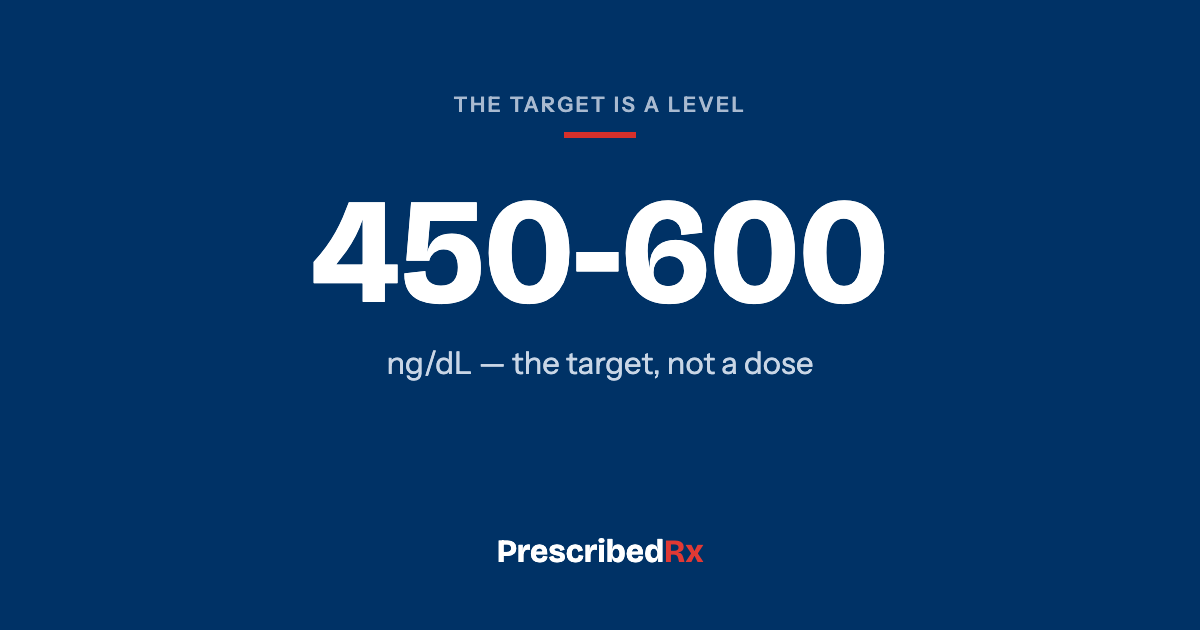
The target is not a dose. It is a concentration. The AUA aims for the middle of the normal range, roughly 450 to 600 ng/dL.
The Xyosted label shows how titration works in practice: measure the trough level after six weeks, then adjust in 25 mg steps. Below 350 ng/dL, increase. Above 650, decrease. Between, hold.
Absorption and clearance vary between men. Two people on identical doses can land in different places.
Peaks and troughs, and why injection frequency is debated
Short-acting esters do not hold a steady level. After an injection, testosterone rises above the normal range, then falls — sometimes back into the deficient range before the next dose.
Some men feel that swing. The pattern is early peak-related effects — acne, mood changes, breast tenderness — followed by a return of low-testosterone symptoms late in the cycle.
The usual response is to inject smaller amounts more often, which flattens the curve.
A 2026 review pushed back on treating that as automatic. Its position: every-two-weeks should not be the default, weekly is often reasonable and many men do well on it, and twice-weekly or more frequent schedules are tools for men who actually cycle symptomatically, not a universal upgrade.
If you feel fine on your current schedule, more frequent injections are solving a problem you do not have.
What monitoring looks like
| What | When | Action threshold |
|---|---|---|
| Testosterone level | 3–6 months, then every 6–12 months | Target mid-range, about 450–600 ng/dL |
| Haematocrit | 3–6 months, then routinely | Dose reduction or stop at 54% |
| PSA | Baseline if over 40, then per screening | Urology referral if up more than 1.4 ng/mL in 12 months, or above 4.0 ng/mL |
| Blood pressure | Baseline and ongoing | — |
Timing your blood draw matters. On weekly cypionate or enanthate, the sample is taken midway between injections — commonly day three or four. Draw it the day after an injection and you will measure a peak, not your actual level.
The haematocrit point deserves emphasis here. In one study, 66.7% of men on injections exceeded 50% haematocrit, against 12.8% on gels. If you are choosing injections, expect your red blood cell count to be the number your provider watches most closely.
Self-injection
Training is a labelled requirement, not a suggestion. The Xyosted patient labelling states you should not inject until you have been shown how.
Sharps go into an FDA-cleared disposal container immediately after use — never household trash, never a reused container. Fill to about three quarters, then dispose through a community drop-off, household hazardous waste, or a mail-back programme.
Common questions
How often do you take testosterone shots? It depends on the ester. Cypionate and enanthate are typically weekly to every two weeks. Undecanoate is every ten weeks but must be given in a clinic.
Do testosterone injections hurt? Subcutaneous injections use a much shorter needle than intramuscular and most men find them easier. Trials found comparable effectiveness between the two routes.
What is a normal starting dose? Common regimens are 75 to 100 mg weekly or 150 to 200 mg every two weeks, then adjusted based on a blood level taken midway between doses.
Why do I feel different at the end of the week? Short-acting esters produce a peak and a trough. If symptoms return late in the cycle, splitting the dose into smaller, more frequent injections usually flattens it.
Are injections better than gel? Injections raise levels reliably and cost less. Gels are steadier and far less likely to raise your red blood cell count. Which is better depends on which trade-off you prefer.
Related reading
- Testosterone side effects — including the blood count risk specific to injections.
- Oral testosterone — if you would rather not inject.
- Our injectable TRT plan — pricing and what is included.
- Buying testosterone online — how to tell a legitimate provider from an illegal one.
This article is for general information. It is not medical advice and it is not a recommendation for any particular treatment. Whether a treatment is appropriate for you is a decision for a licensed clinician who has reviewed your health history and current medications.