
What PrescribedRX charges
The TRT Health Assessment is $69, one time. TRT, if prescribed, is $387 every 10 weeks — about $39 a week, the same at every dose.
Prescription required. A provider decides if treatment is appropriate. Payment never guarantees a prescription. Not available in every state.
The short answer
In healthy men who are not obese, the median testosterone level barely changes between 40 and 79.
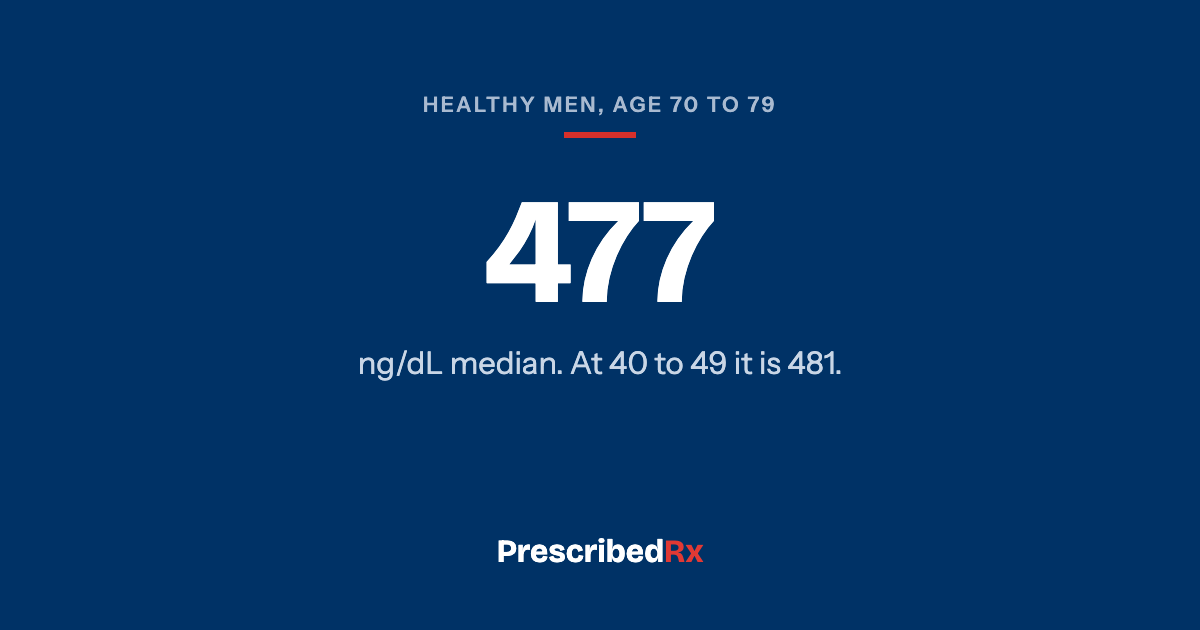
You have probably read that testosterone falls about 1% a year from your thirties. In the largest harmonized dataset available, the median for men aged 40 to 49 is 481 ng/dL. For men aged 70 to 79 it is 477 ng/dL.
What changes with age is the bottom of the range, not the middle. And a substantial part of the decline seen in the general population is driven by weight, illness and medication rather than age itself.
The numbers
These come from 9,054 community-dwelling men across four large cohort studies, measured with a CDC-standardized assay. This is the dataset the Endocrine Society adopted.
| Age | 2.5th percentile | Median | 97.5th percentile |
|---|---|---|---|
| 19–39 | 267 | 531 | 929 |
| 40–49 | 235 | 481 | 929 |
| 50–59 | 219 | 477 | 929 |
| 60–69 | 218 | 477 | 929 |
| 70–79 | 218 | 477 | 926 |
| 80–99 | 157 | 476 | 913 |
All figures ng/dL.
Read the middle column again. Between 40 and 99, the median moves by five points.
The lower boundary does fall — from 267 in your twenties and thirties to 235 in your forties — and then it plateaus for three decades before dropping after 80.
One honest limitation: these cohorts were largely white men in the US and Europe. How well the ranges generalise to other populations is not established.
Why this contradicts what you have read
Two different questions get answered with the same number.
What is the average level for a man my age is answered by cross-sectional population data. How much will my level fall as I age is answered by following the same men over time.
They are not interchangeable, and the healthy-cohort figures above differ substantially from general-population figures.
In NHANES, which samples the US household population rather than a screened healthy cohort, the covariate-adjusted geometric mean at age 20 was 393 ng/dL, at 35 it was 354, at 55 it was 378, and at 80 it was 275.
Notice that levels peaked at 20 and again around 55 to 60. That is not a smooth decline. The researchers flagged it as unexpected.
So a 55-year-old average is roughly 477 ng/dL if you use healthy non-obese men, and roughly 378 if you use the general population. Both numbers are correct. They describe different men.
Younger men may be measured against the wrong threshold
The 300 ng/dL cutoff used to define low testosterone came largely from replacement trials that enrolled men over 45.
A study of NHANES data restricted to morning samples in men aged 20 to 44 found:
| Age | Mean total testosterone |
|---|---|
| 20–24 | 501 ng/dL |
| 25–29 | 514 ng/dL |
| 30–34 | 456 ng/dL |
| 35–39 | 438 ng/dL |
| 40–44 | 430 ng/dL |
The authors proposed age-specific thresholds ranging from 409 ng/dL for men in their early twenties down to 350 for men in their early forties, arguing the standard cutoff under-diagnoses symptomatic younger men.
No medical society has adopted those thresholds. Treat them as a published challenge to the 300 cutoff, not as a standard. But if you are 26 with symptoms and a level of 380, it explains why you might feel unwell while being told you are normal.
Where the diagnostic line sits, and why it moves
Different bodies draw it in different places.
| Body | Threshold |
|---|---|
| American Urological Association | Below 300 ng/dL |
| Endocrine Society | Below 264 ng/dL |
| European Association of Urology | Below 346 ng/dL |
| British Society for Sexual Medicine | Below 231 ng/dL usually treated; 231–347 a trial based on symptoms |
That is a spread of 115 ng/dL between the lowest and highest threshold. Insurers add their own — some require below 300, others below 250.
Your lab normal range is not universal
| Laboratory | Adult male reference range |
|---|---|
| Labcorp | 264–916 ng/dL |
| Quest Diagnostics | 250–1,100 ng/dL |
| Mayo Clinic Laboratories | 240–950 ng/dL |
A result of 255 ng/dL is flagged low at Labcorp and Mayo, and inside the range at Quest. A result of 1,000 is flagged high at Labcorp and Mayo, and normal at Quest.
This is why guidelines advise using the same laboratory with the same method for repeat testing. Serial results from different labs are not comparable.
What your number does not tell you
A single result tells you very little on its own.
Time of day. Men aged 30 to 40 test 20 to 25% lower at 4pm than at 8am.
Whether you ate. In healthy men, a standard meal dropped testosterone by an average of 123 ng/dL, and 56% of them temporarily fell below 300.
Day-to-day variation. Between-day variation in morning testosterone is about 18.7%. Two results have to differ by more than 50% before the difference is real.
Repeat testing. About 30% of men whose first test is low are normal on a second.
This is why every guideline requires two early-morning, fasting samples before anyone diagnoses anything.
What actually moves the number
If your level is genuinely low and you want to know what changes it, the evidence points at body composition more than anything else.
A review of 24 trials found diet-induced weight loss raised total testosterone by an average of 83 ng/dL, and bariatric surgery by 251 ng/dL. The magnitude of weight lost was the strongest predictor — more than the method used.
For comparison, a meta-analysis of 11 randomised trials found exercise training on its own had a negligible effect on resting testosterone in men who were previously inactive.
Sleep matters too. Eight nights of five-hour sleep reduced daytime testosterone by 10 to 15% in young healthy men.
The Endocrine Society position as of July 2026: for men with a BMI over 27 and no other identified cause, weight loss is generally first-line before testosterone therapy.
Common questions
What is a normal testosterone level for a 40-year-old? In healthy non-obese men aged 40 to 49, the median is 481 ng/dL and the 2.5th to 97.5th percentile range is 235 to 929 ng/dL.
Does testosterone really drop 1% per year? Not in healthy, non-obese men. In that population the median barely moves between 40 and 79. Declines seen in the general population are substantially driven by weight gain, illness and medication.
What is considered low testosterone? Depends who you ask. Thresholds range from 231 to 346 ng/dL across major medical societies. The most commonly used figure in the US is 300 ng/dL, confirmed on two morning tests alongside symptoms.
My level is normal for my age but I feel terrible. What now? Age-specific ranges are not diagnostic criteria, and symptoms are part of the diagnosis. It is also worth checking SHBG and free testosterone, since a normal total can mask a low free level.
Should I get tested? The Endocrine Society recommends against population-wide screening. If you have symptoms, testing is reasonable — done in the morning, fasting, and repeated.
Related reading
- Normal testosterone levels — the reference ranges explained.
- Free testosterone vs total — why a normal total can hide a low free level.
- At-home testosterone testing — how to get a number you can trust.
- Exercise and testosterone — what actually moves the number.
This article is for general information. It is not medical advice and it is not a recommendation for any particular treatment. Whether a treatment is appropriate for you is a decision for a licensed clinician who has reviewed your health history and current medications.