TB-500 and Thymosin Beta-4: Not the Same Molecule
The human trials cited for TB-500 tested a different molecule. What thymosin beta-4 research actually found, what is known about TB-500, and its FDA status.
 By Juan Montes
Updated September 9, 2026 · 6 min read
By Juan Montes
Updated September 9, 2026 · 6 min read
Last updated 25 August 2026. This page is educational. TB-500 is not an FDA-approved drug and is not currently available for compounding in the United States. PrescribedRX does not offer it. See our compounding status tracker for the current federal position.
Almost every article about TB-500 cites human clinical trials. Almost every one of those citations is misattributed, because the trials were conducted on a different molecule. This page explains the distinction, which is not a technicality, and sets out what is actually known.
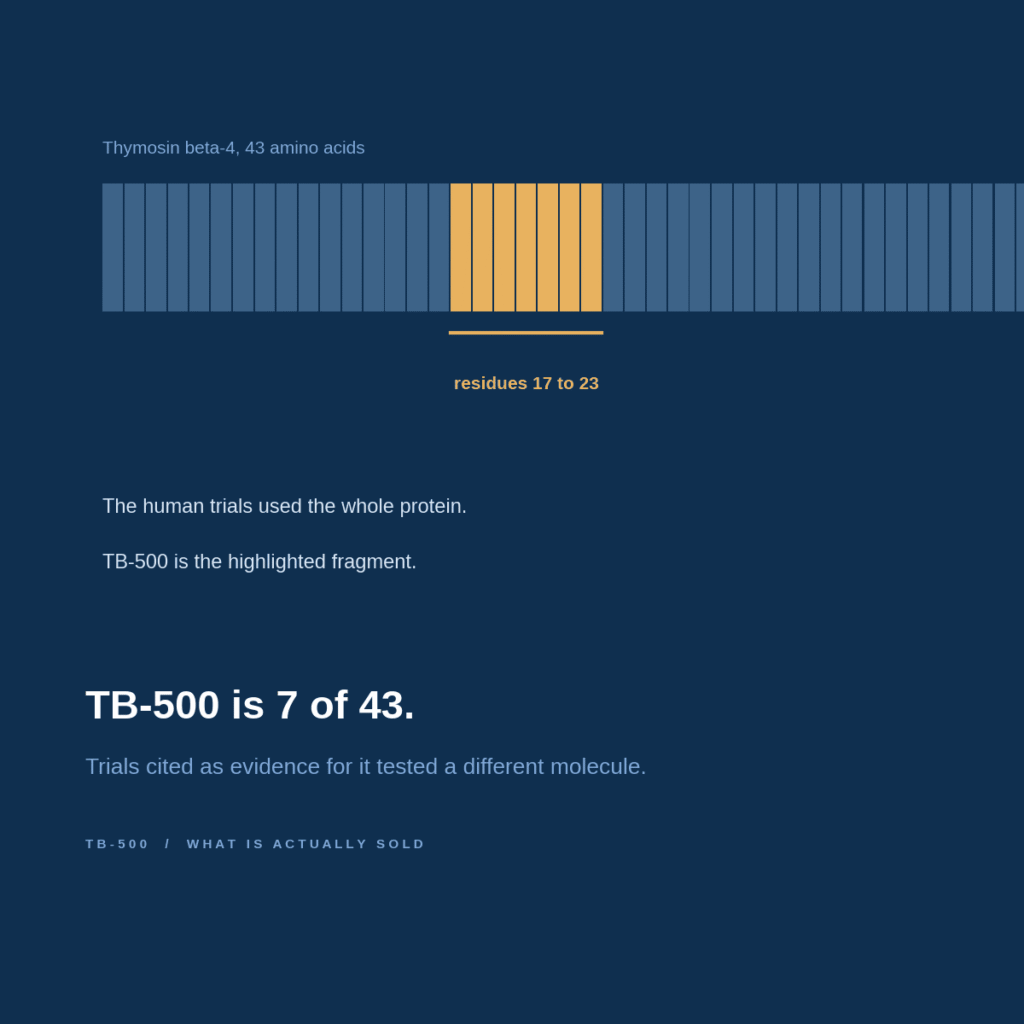
TB-500 and thymosin beta-4 are not the same molecule
| Thymosin beta-4 | TB-500 | |
|---|---|---|
| Structure | A naturally occurring 43-amino-acid protein | A 7-residue fragment, sequence LKKTETQ, residues 17 to 23 |
| Origin | Endogenous human protein | Synthetic fragment sold commercially |
| Human clinical trials | Several, mainly in ophthalmology | None identified |
| How FDA refers to it | Thymosin beta-4 | “Thymosin beta-4, fragment (LKKTETQ), also known as TB-500” |
The sequence sold as TB-500 is the heptapeptide LKKTETQ. It corresponds to residues 17 to 23 of thymosin beta-4, comprising the six-residue actin-binding region LKKTET at residues 17 to 22 plus one additional amino acid. That relationship is real, and it is why the two are conflated. But a seven-residue fragment is not the parent 43-residue protein, and results obtained with one cannot be assumed to transfer to the other.
The anti-doping authorities treat them as related but distinct, prohibiting “thymosin beta-4 and its derivatives, for example TB-500”. FDA uses the fragment description explicitly in its own compounding tables. A 2026 scoping review put it plainly, describing TB-500 as a commercial designation for synthetic products marketed as related to thymosin beta-4, with usage of the term varying across commercial, regulatory and research contexts.
What the human trials actually tested
There is a genuine clinical programme here, and it is worth reporting accurately, including the parts that did not work. All of it used full-length thymosin beta-4, formulated as an eye drop, not TB-500.
| Trial | Size | Result |
|---|---|---|
| Phase 2, severe dry eye (2015) | 9 patients | Reported reductions in ocular discomfort and corneal staining versus vehicle |
| Phase 2, dry eye, controlled adverse environment model (2015) | 72 participants | Primary endpoints not met. Some secondary measures improved |
| Phase 3 SEER-1, neurotrophic keratopathy (2023) | 18 subjects | Primary endpoint not met (60% vs 12.5% healing at day 29, p = 0.0656) |
| Phase 3 SEER-3 (reported 2025) | Not published | Failed. No statistically significant difference in complete corneal healing at 4 weeks versus placebo |
A separate Phase 1a safety study of recombinant human thymosin beta-4 given intravenously in healthy volunteers completed, enrolling 54 participants across seven ascending dose cohorts from 0.05 to 25 micrograms per kilogram.
The 2015 controlled adverse environment trial and the 2023 SEER-1 trial are both frequently cited as positive. Both missed their primary endpoints. Two authors of the SEER-1 paper were employed by the company developing the product.
What is known about TB-500 specifically
Very little. In its July 2026 briefing document on TB-500, FDA stated that the nomination did not include, and FDA did not find, information on products containing TB-500 free base or TB-500 acetate administered in humans, and that there is a lack of evidence to evaluate effectiveness.
The 2026 scoping review of 80 studies found direct TB-500 evidence limited to a single included study, and found no human interventional studies of administered thymosin beta-4 or TB-500 in tendon, ligament, muscle, bone or cartilage. Those are precisely the uses for which TB-500 is marketed.
The preclinical work that generated the interest
The most cited mechanistic paper, published in Nature in 2004, used full-length synthetic thymosin beta-4 in mice and reported enhanced cardiomyocyte survival and migration through integrin-linked kinase and Akt signalling, with improved cardiac function after coronary artery ligation. It is a strong paper. It is a mouse study, and it did not use TB-500.
TB-500 dosage: what is actually published
There is no published human dosing for TB-500. FDA found no human exposure data of any kind.
Published human dosing exists only for full-length thymosin beta-4:
- 0.1% ophthalmic solution, applied topically to the eye
- 0.05 to 25 micrograms per kilogram intravenously, in the Phase 1a safety study
Neither of those is a systemic dose of TB-500 for musculoskeletal use, and neither can be used to derive one. Dosage calculators for TB-500 are not built on published human data, because none exists.
TB-500 side effects and safety
The human safety profile of TB-500 has not been characterised. FDA stated in July 2026 that “the nomination did not include, and FDA did not find information on products containing TB-500 (free base) or TB-500 acetate administered in humans.” The agency has also noted concern that compounded TB-500 may pose immunogenicity risk for certain routes of administration due to the potential for aggregation and for peptide-related impurities.
Safety data from the full-length thymosin beta-4 trials, which involved a topical eye drop or a single controlled intravenous dose in a monitored setting, does not transfer to self-administered injection of a synthetic fragment obtained outside the regulated supply chain.
Is TB-500 banned in sport?
Yes. Thymosin beta-4 and its derivatives, TB-500 named explicitly as an example, are prohibited at all times under section S2.3, growth factors. This covers both the parent protein and the fragment.
Is TB-500 legal in the United States?
TB-500 is not an FDA-approved drug, and as of 25 August 2026 it is not lawfully available for compounding under section 503A.
- It was removed from FDA Category 2 in April 2026, which did not make it compoundable.
- On 23 July 2026 the FDA Pharmacy Compounding Advisory Committee reviewed it, nominated for wound healing. FDA proposed that it not be included. The committee voted 8 to 6 with 1 abstention to recommend inclusion.
- The vote is advisory and non-binding. FDA has not agreed and rulemaking has not occurred.
Current status across this category is on our peptide compounding status tracker.
TB-500 and BPC-157 blends
The two are commonly sold together. They are unrelated molecules with separate and separately thin evidence bases, and neither is lawfully compoundable at present. There is no published study of the combination in humans. See our page on BPC-157.
What we offer
PrescribedRX does not offer TB-500 and will not unless federal rulemaking permits it. We work with US state-licensed clinicians and licensed compounding pharmacies, and we are LegitScript certified.
Among peptides that can currently be dispensed, we offer sermorelin, NAD+ and glutathione. Whether any treatment is appropriate for a particular person is a decision for a state-licensed clinician after reviewing their medical history.
Common questions
Is TB-500 the same as thymosin beta-4?
No. TB-500 is a seven-amino-acid fragment corresponding to part of the 43-amino-acid thymosin beta-4 protein. Human trials have used the full-length protein.
Does TB-500 heal injuries?
A 2026 scoping review found no human interventional studies of thymosin beta-4 or TB-500 in tendon, ligament, muscle, bone or cartilage. The claim rests on animal work.
What is the standard TB-500 dose?
There is no published human dose for TB-500. Protocols in circulation are not derived from clinical data.
Can I get TB-500 on prescription?
Not lawfully in the United States at present. It is not FDA-approved and is not on the 503A Bulks List.
References
- McGuire F, Hughes E, Maak T, Cushman DM. Thymosin beta-4 and TB-500 in tissue healing, regeneration, and musculoskeletal repair: a scoping review. Applied Sciences. 2026;16(12):6202. doi:10.3390/app16126202
- Sosne G, Qiu P, Goldstein AL, Wheater M. Biological activities of thymosin beta4 defined by active sites in short peptide sequences. FASEB J. 2010;24(7):2144-2151. PMID 20179146
- Sosne G, Dunn SP, Kim C. Thymosin beta4 significantly improves signs and symptoms of severe dry eye in a phase 2 randomized trial. Cornea. 2015;34(5):491-496. PMID 25826322
- Sosne G, Ousler GW. Thymosin beta 4 ophthalmic solution for dry eye: a randomized, placebo-controlled, phase II clinical trial. Clin Ophthalmol. 2015;9:877-884. doi:10.2147/OPTH.S80954
- Sosne G, Kleinman HK, Springs C, et al. 0.1% RGN-259 (thymosin beta-4) ophthalmic solution in neurotrophic keratopathy: a phase III trial. Int J Mol Sci. 2023;24(1):554. doi:10.3390/ijms24010554
- Bock-Marquette I, Saxena A, White MD, DiMaio JM, Srivastava D. Thymosin beta4 activates integrin-linked kinase and promotes cardiac cell migration, survival and cardiac repair. Nature. 2004;432:466-472. doi:10.1038/nature03000
- FDA. TB-500 PCAC briefing document, July 2026.
This page is general educational information, not medical advice, and not a description of a product available for purchase. Prescription treatment decisions are made by state-licensed clinicians.
Related reading
More on peptide and longevity therapy:
- The FDA peptide compounding status tracker, kept current
- BPC-157
- KPV peptide
- MOTS-c dosage
- BPC-157 versus TB-500
- Epitalon
- Semax peptide
- Peptide reconstitution calculator
- Is NAD+ FDA approved?
- Sermorelin dosage
This article is for general information. It is not medical advice and it is not a recommendation for any particular treatment. Whether a treatment is appropriate for you is a decision for a licensed clinician who has reviewed your health history and current medications.
About the author
Juan MontesJuan Montes writes and reviews PrescribedRX's clinical content, covering testosterone replacement therapy, men's sexual health, weight management and hair loss. He trained as a Professional Nurse at the Colombian Red Cross in Cali, Colombia, and has worked in healthcare since 2011, roughly six of those years in direct emergency and critical care nursing. He served as Head Nurse in Emergency…
More from Juan →This article is for information only and is not medical advice. Treatment is prescribed solely at the discretion of a licensed provider following a clinical evaluation.