MOTS-c Dosage: What Is Actually Published
There is no published human dose for MOTS-c. What the mouse studies actually used, why the human exercise data is misread, and where MOTS-c stands with the FDA.
 By Juan Montes
Updated September 9, 2026 · 6 min read
By Juan Montes
Updated September 9, 2026 · 6 min read
Last updated 25 August 2026. This page is educational. MOTS-c is not an FDA-approved drug and is not currently available for compounding in the United States. PrescribedRX does not offer it. See our compounding status tracker for the current federal position.
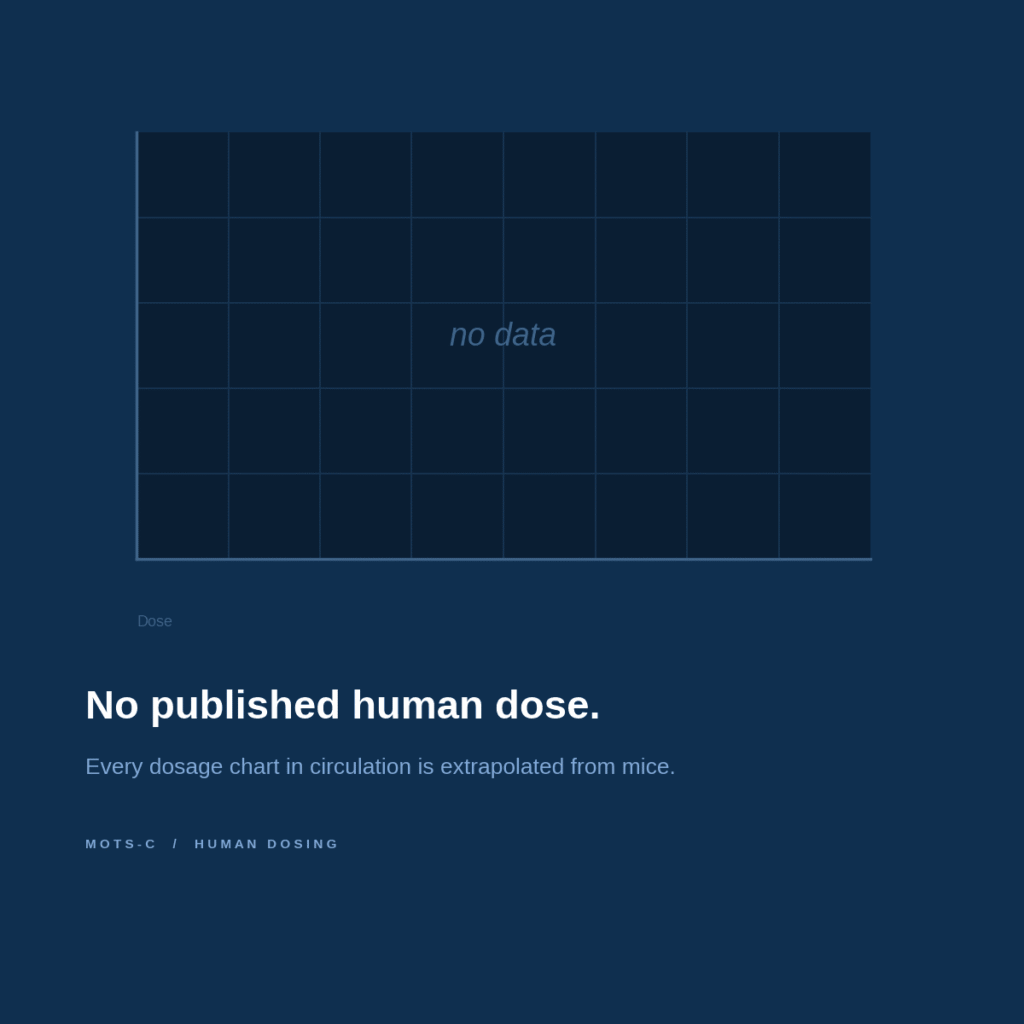
Searches for MOTS-c dosage charts and protocols vastly outnumber searches for MOTS-c itself, which tells you most people looking it up have already decided to use it. So it is worth being direct at the top of this page: there is no published human dose for MOTS-c. Every dosage chart in circulation is extrapolated from mice or invented. This page explains what is actually published, and why the distinction matters more for this peptide than for most.
What is MOTS-c?
MOTS-c is a 16-amino-acid peptide encoded in mitochondrial DNA rather than in the cell nucleus, which makes it one of a small group known as mitochondrial-derived peptides. Research interest centres on metabolism, insulin sensitivity and exercise physiology.
The distinction that most MOTS-c content collapses
There are two entirely separate bodies of MOTS-c research, and they get merged constantly.
| Research type | What it studies | What it can tell you |
|---|---|---|
| Endogenous MOTS-c | Levels of MOTS-c your own body produces, measured in blood or muscle | That MOTS-c is biologically meaningful, and that exercise raises it |
| Administered MOTS-c | Effects of injecting MOTS-c | Whether taking it does anything. This is almost entirely mice |
The most cited human finding, from a 2021 Nature Communications paper, is that skeletal muscle MOTS-c rose roughly twelve-fold in healthy young men after cycling exercise. That is a measurement of the body producing its own MOTS-c in response to exercise. No MOTS-c was administered to anyone in that study. It is frequently presented as evidence for injecting the peptide. It is not.
What has MOTS-c been studied for?
The administered-peptide research is in mice and cell culture, and centres on metabolic outcomes: insulin sensitivity, body composition, and age-related physical decline. The 2021 Nature Communications work reported effects on muscle function and physical capacity in mice, including a late-life regimen begun at around 23.5 months of age.
Published reviews characterise the field consistently: predominantly animal work, with human data limited to cross-sectional measurement of circulating MOTS-c rather than administration studies.
MOTS-c dosage: what is actually published
No human dose has been published. FDA stated in July 2026 that it had not identified any clinical studies or human exposure data for MOTS-c administered by any route.
The doses that appear in the literature are:
- Mice: 5 and 15 milligrams per kilogram per day, intraperitoneally (Reynolds et al., 2021)
- Mice, late-life regimen: 15 milligrams per kilogram per day, three times weekly
- Cell culture: 10 micromolar
One human trial is currently recruiting (see below). Its registry record specifies a “fixed daily dose” administered subcutaneously but does not state the amount, and it has not reported.
A dosage chart implies a dose-finding study established a range in people, and for MOTS-c no such study has been completed. If you already have a prescribed dose for any peptide and need the syringe volume, our reconstitution calculator does that conversion. For MOTS-c, no such study has been completed. Converting a mouse milligram-per-kilogram figure to a human dose by bodyweight is not a validated method, and published charts do not disclose how their numbers were derived because there is nothing to disclose.
Has MOTS-c been studied in humans?
Not for administered peptide, with one trial now underway.
A Phase 2a trial (NCT07505745, “MOTS-MET”) began recruiting in February 2026, testing subcutaneous MOTS-c against placebo over twelve weeks in 120 adults with prediabetes and overweight or obesity, with both arms receiving lifestyle counselling. Primary completion is estimated for February 2027. This appears to be the first interventional human trial of administered MOTS-c. It has not reported, and until it does there is no human efficacy or safety result to discuss.
MOTS-c side effects and safety
The human safety profile is unknown. FDA was direct about this in its July 2026 briefing document: “There is a lack of clinical and nonclinical safety information on the use of MOTS-c. FDA is particularly concerned about the lack of human data on drug products containing this substance administered via any route of administration.” The agency also stated that potential safety risks associated with the use of MOTS-c-related substances in humans are unknown.
That is a stronger statement than FDA made about most of the peptides it reviewed at the same meeting, and it is worth weighing accordingly.
Is MOTS-c banned in sport?
Yes, and it is easy to miss. MOTS-c is prohibited at all times under section S4.4.1, metabolic modulators, as an activator of AMP-activated protein kinase, listed alongside AICAR.
People checking peptide status typically look under S2, peptide hormones and growth factors, where MOTS-c does not appear. Any athlete subject to testing should treat MOTS-c as prohibited.
Is MOTS-c legal in the United States?
MOTS-c is not an FDA-approved drug, and as of 25 August 2026 it is not lawfully available for compounding under section 503A.
- It was removed from FDA Category 2 in April 2026, which did not make it compoundable.
- On 23 July 2026 the FDA Pharmacy Compounding Advisory Committee reviewed MOTS-c for obesity and osteoporosis. FDA proposed that it not be included on the Bulks List. The committee voted 7 to 5 with 2 abstentions to recommend inclusion.
- The vote is advisory and non-binding. FDA has not agreed and rulemaking has not occurred.
See our peptide compounding status tracker for the current position across this whole category.
What we offer
PrescribedRX does not offer MOTS-c and will not unless federal rulemaking permits it. We work with US state-licensed clinicians and licensed compounding pharmacies, and we are LegitScript certified.
Among peptides that can currently be dispensed, we offer sermorelin, NAD+ and glutathione. Whether any treatment is appropriate for a particular person is a decision for a state-licensed clinician after reviewing their medical history.
Common questions
What is the correct MOTS-c dosage?
No correct human dosage has been established, because no completed human dose-finding study exists. The first interventional trial began in February 2026 and has not reported.
Is MOTS-c good for weight loss?
Mice given MOTS-c showed metabolic changes in published studies. Whether that translates to weight loss in people has not been tested. A trial in adults with prediabetes and overweight is running now and will report no earlier than 2027.
Does exercise raise MOTS-c?
Yes. That is one of the better-supported human findings, with skeletal muscle levels rising substantially after cycling in healthy young men. It is a finding about your own MOTS-c production, not about supplementation.
Can I get MOTS-c on prescription?
Not lawfully in the United States at present. It is not FDA-approved and is not on the 503A Bulks List.
Is MOTS-c detectable on a drug test?
It is prohibited in sport under S4.4 as a metabolic modulator. Athletes should assume testing risk and confirm with their governing body.
References
- Reynolds JC, et al. MOTS-c is an exercise-induced mitochondrial-encoded regulator of age-dependent physical decline and muscle homeostasis. Nature Communications. 2021;12:470. doi:10.1038/s41467-020-20790-0
- Kong BS, Lee C, Cho YM. Mitochondrial-encoded peptide MOTS-c, diabetes, and aging-related diseases. Diabetes & Metabolism Journal. 2023;47(3):315-324. doi:10.4093/dmj.2022.0333
- Kaminski K, Szyszka M, Blatkiewicz M, Rucinski M. Protective and multi-organ effects of MOTS-c and other mitochondrial-derived peptides in the endocrine system. Medical Journal of Cell Biology. 2023;11(4):99-107. doi:10.2478/acb-2023-0017
- ClinicalTrials.gov. NCT07505745, MOTS-c for improving insulin sensitivity in adults with prediabetes and overweight/obesity (MOTS-MET). Recruiting.
- FDA. Pharmacy Compounding Advisory Committee briefing document, July 2026.
- FDA. PCAC meeting, 23 to 24 July 2026.
This page is general educational information, not medical advice, and not a description of a product available for purchase. Prescription treatment decisions are made by state-licensed clinicians.
Related reading
More on peptide and longevity therapy:
- The FDA peptide compounding status tracker, kept current
- BPC-157
- TB-500
- Epitalon
- Semax peptide
- KPV peptide
- BPC-157 versus TB-500
- Peptide reconstitution calculator
- NAD+ dosage and what determines it
- Is sermorelin FDA approved
This article is for general information. It is not medical advice and it is not a recommendation for any particular treatment. Whether a treatment is appropriate for you is a decision for a licensed clinician who has reviewed your health history and current medications.
About the author
Juan MontesJuan Montes writes and reviews PrescribedRX's clinical content, covering testosterone replacement therapy, men's sexual health, weight management and hair loss. He trained as a Professional Nurse at the Colombian Red Cross in Cali, Colombia, and has worked in healthcare since 2011, roughly six of those years in direct emergency and critical care nursing. He served as Head Nurse in Emergency…
More from Juan →This article is for information only and is not medical advice. Treatment is prescribed solely at the discretion of a licensed provider following a clinical evaluation.