BPC-157: What the Research Actually Shows
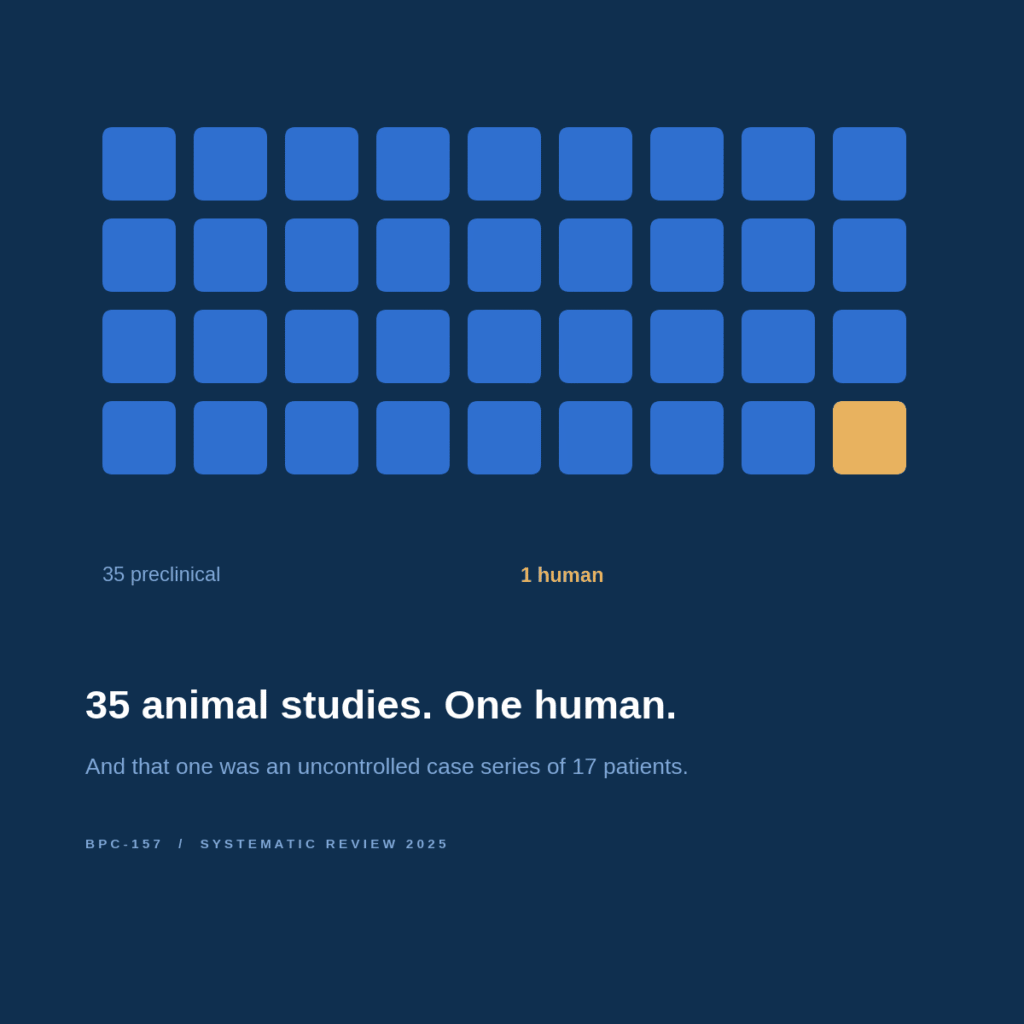
A systematic review found 35 animal studies and one human study of BPC-157. What the research shows, what the published dosing is, and where it stands with the FDA.
 By Juan Montes
Updated September 9, 2026 · 7 min read
By Juan Montes
Updated September 9, 2026 · 7 min read
Last updated 25 August 2026. This page is educational. BPC-157 is not an FDA-approved drug and is not currently available for compounding in the United States. PrescribedRX does not offer it. See our compounding status tracker for the current federal position.
BPC-157 is the most searched peptide in this category by a wide margin, and the gap between how confidently it is discussed and what has actually been demonstrated in people is larger than for almost any substance we have looked at. This page sets out the published evidence, separates the animal work from the human work, and states the current legal position.
What is BPC-157?
BPC-157 is a synthetic 15-amino-acid peptide. The name stands for Body Protection Compound. Its sequence is described in the literature as derived from a protein found in human gastric juice, and research on it began with gastrointestinal protection before broadening to tendon, muscle and other tissue.
The single most important fact about the BPC-157 evidence base
In 2025, a team at Case Western Reserve published a systematic review of BPC-157 in orthopaedic sports medicine. They screened 544 articles and included 36. Thirty-five were preclinical. One was human. They concluded that no clinical safety data were available, and advised clinicians to counsel athletes about the lack of FDA approval and about unregulated manufacturing.
That ratio is the honest summary of the field. Nearly everything asserted about what BPC-157 does is an extrapolation from rats.
What has BPC-157 been studied for?
The preclinical literature is genuinely large and covers tendon and ligament healing, muscle injury, gastrointestinal mucosal protection, and various vascular and neurological models. A representative example: a 2021 study in rats with surgically induced myotendinous junction defects reported restoration of the junction at 28 and 42 days after surgery. The peptide was given both intraperitoneally, at 10 micrograms per kilogram and 10 nanograms per kilogram, and orally in drinking water at 0.16 micrograms per millilitre and 0.16 nanograms per millilitre.
A large share of the primary BPC-157 literature comes from a single research group, which originated the compound. Their reviews are useful for locating primary studies but should be read as advocacy-adjacent rather than as independent assessment.
Has BPC-157 been studied in humans?
Barely, and the detail matters.
The one published human report
A 2021 paper in Alternative Therapies in Health and Medicine described intra-articular injection for knee pain in 17 patients at a single private clinic between 2019 and mid 2020, with 16 reached by telephone for follow-up. It reported that 14 of those 16 patients, 87.5%, had relief of knee pain.
Three things about that result matter. First, it was a retrospective single-clinic case series with telephone follow-up, uncontrolled and unblinded, with no placebo group and a sample of 17 people, conducted at a clinic that administers the peptide. Second, and most importantly, not all patients received BPC-157 alone. The reported outcome covers patients treated with BPC-157 or a combination of BPC-157 and thymosin beta-4, so it cannot be read as evidence for BPC-157 on its own. Third, it is not a clinical trial. It is the single human study included in the 2025 systematic review, which found no clinical safety data.
The registered trial that never reported
A Phase 1 trial (NCT02637284) was registered in 2015 to assess the safety and pharmacokinetics of an oral BPC-157 product in healthy volunteers, randomised and placebo-controlled, with an estimated enrolment of 42. Its status is listed as unknown, and no results have been posted. It has been more than a decade.
The claim you will see that we could not verify
A great deal of online content states that BPC-157 completed Phase II trials for ulcerative colitis. The citations offered are two conference abstracts published in journal supplements, from 2003 and 2005. We were unable to locate or verify either. They are not full papers and no published trial reports appear to exist. We would treat the “Phase II” claim as unsubstantiated until someone produces the actual data.
BPC-157 dosage: what is actually published
The only human dosing regimen published anywhere is the protocol of the Phase 1 trial that never reported results: oral tablets of 1 mg, given as single doses of one, three or six tablets, then three tablets every eight hours for two weeks. Because that trial never published, there is no human pharmacokinetic or safety data attached to it.
Published animal dosing, for context only:
- Rats: 10 nanograms per kilogram to 10 micrograms per kilogram intraperitoneally
- Rats: 0.16 nanograms per millilitre to 0.16 micrograms per millilitre in drinking water
The dose used in the 17-patient knee study is not stated in the material we could access.
Dosage charts and calculators for BPC-157 circulate widely. If you already have a prescribed dose and need the syringe volume, our reconstitution calculator does that conversion. None of them rests on a published human dose-finding study, because no such study has been published. Rodent milligram-per-kilogram figures do not convert straightforwardly to human dosing.
Oral, injectable, capsules and nasal spray
BPC-157 is sold in injectable, oral capsule and nasal spray formats. The published human dosing that exists is oral. The single human clinical report is intra-articular injection. There is no published comparison of bioavailability between these routes in humans.
FDA has specifically noted, in evaluating BPC-157 for compounding, that it may pose immunogenicity risk for certain routes of administration and may present complexities regarding peptide-related impurities and characterisation of the active ingredient. Route is not a trivial detail for a peptide.
BPC-157 side effects and safety
The 2025 systematic review found no clinical safety data. The US Anti-Doping Agency states that there are no human clinical trials establishing efficacy for BPC-157 for any diagnosis or treatment. The Department of Defense supplement safety programme states that lack of human clinical studies means there is little to no reliable scientific evidence to support the safety or effectiveness of BPC-157 in humans.
An additional consideration specific to unapproved peptides: products sold outside the regulated supply chain are not subject to the identity, purity and potency controls that apply to approved or lawfully compounded drugs. The systematic review authors flagged unregulated manufacturing explicitly.
Is BPC-157 legal in the United States?
BPC-157 is not an FDA-approved drug, and as of 25 August 2026 it is not lawfully available for compounding under section 503A.
- It was removed from FDA Category 2 in April 2026. This did not make it compoundable. Removal from the do-not-compound list is not the same as being placed on the 503A Bulks List.
- On 23 July 2026 the FDA Pharmacy Compounding Advisory Committee reviewed it. FDA proposed that it not be included. The committee voted 8 to 6 with 1 abstention to recommend inclusion.
- The vote is advisory and non-binding. FDA has not agreed and rulemaking has not occurred.
It is also on the Department of Defense prohibited dietary supplement ingredients list, which states it is an unapproved drug that cannot legally be prescribed or sold over the counter.
Current status for every peptide in this category is on our compounding status tracker.
Is BPC-157 banned in sport?
Yes. BPC-157 is prohibited at all times under section S0, non-approved substances, and is named explicitly as an example on the prohibited list. Any athlete subject to anti-doping testing should treat it as a positive test risk.
What we offer
PrescribedRX does not offer BPC-157 and will not unless federal rulemaking permits it. We work with US state-licensed clinicians and licensed compounding pharmacies, and we are LegitScript certified.
Among peptides that can currently be dispensed, we offer sermorelin, NAD+ and glutathione. Whether any treatment is appropriate for a particular person is a decision for a state-licensed clinician after reviewing their medical history.
Common questions
Does BPC-157 actually work?
In rodents, a large number of studies report accelerated healing across several tissue types. In humans, there is one uncontrolled retrospective review of 17 patients. That is not enough evidence to answer the question, and anyone stating otherwise is going beyond the data.
Is oral BPC-157 absorbed?
The only registered human trial used an oral formulation, but it never reported pharmacokinetic results, so human oral bioavailability has not been published.
Why is BPC-157 sold everywhere if it is not legal?
It is generally sold labelled “for research use only”. FDA has issued warning letters to research-peptide sellers whose products carried that labelling while being advertised for human use, including letters in December 2024 and February 2025. The label does not make a substance lawful to administer to a person.
Is BPC-157 the same as TB-500?
No. They are different molecules and are frequently sold together as a blend. See our page on TB-500 and thymosin beta-4.
Will BPC-157 become available on prescription?
It is possible. The July 2026 advisory committee recommendation is a step in that direction, but FDA has not agreed, rulemaking has not happened, and no timeline exists. We update our tracker when the position changes.
References
- Vasireddi N, Hahamyan H, Salata MJ, et al. Emerging use of BPC-157 in orthopaedic sports medicine: a systematic review. HSS Journal. 2025;21(4):485-495. PMID 40756949
- Lee E, Padgett B. Intra-articular injection of BPC 157 for multiple types of knee pain. Altern Ther Health Med. 2021;27(4):8-13. PMID 34324435
- Japjec M, Horvat Pavlov K, Petrovic A, et al. Stable gastric pentadecapeptide BPC 157 as a therapy for the disable myotendinous junctions in rats. Biomedicines. 2021;9(11):1547. doi:10.3390/biomedicines9111547
- Sikiric P, Hahm KB, Blagaic AB, et al. Stable gastric pentadecapeptide BPC 157. Gut and Liver. 2020;14(2):153-167. doi:10.5009/gnl18490
- US Anti-Doping Agency. BPC-157: experimental peptide creates risk for athletes.
- DoD Operation Supplement Safety. BPC-157: a prohibited peptide and an unapproved drug.
- ClinicalTrials.gov. NCT02637284.
- FDA. Pharmacy Compounding Advisory Committee briefing document, July 2026.
This page is general educational information, not medical advice, and not a description of a product available for purchase. Prescription treatment decisions are made by state-licensed clinicians.
Related reading
More on peptide and longevity therapy:
- The FDA peptide compounding status tracker, kept current
- Epitalon
- Semax peptide
- KPV peptide
- MOTS-c dosage
- BPC-157 versus TB-500
- TB-500
- NAD+ side effects
- Sermorelin before and after
- Is glutathione FDA approved?
This article is for general information. It is not medical advice and it is not a recommendation for any particular treatment. Whether a treatment is appropriate for you is a decision for a licensed clinician who has reviewed your health history and current medications.
About the author
Juan MontesJuan Montes writes and reviews PrescribedRX's clinical content, covering testosterone replacement therapy, men's sexual health, weight management and hair loss. He trained as a Professional Nurse at the Colombian Red Cross in Cali, Colombia, and has worked in healthcare since 2011, roughly six of those years in direct emergency and critical care nursing. He served as Head Nurse in Emergency…
More from Juan →This article is for information only and is not medical advice. Treatment is prescribed solely at the discretion of a licensed provider following a clinical evaluation.