
Peptide Reconstitution Calculator
Convert vial strength, bacteriostatic water volume and dose into insulin syringe units. Worked examples, and the mistakes that cause tenfold errors.
 By Juan Montes
Updated October 3, 2026 · 3 min read
By Juan Montes
Updated October 3, 2026 · 3 min read
Last updated 25 August 2026. This is a unit-conversion tool. It does not recommend a dose, and it is not medical advice.
Reconstituting a lyophilised peptide vial involves two numbers people routinely get wrong: how concentrated the solution becomes once water is added, and how that translates to a marking on an insulin syringe. Getting it wrong by a factor of ten is easy, and it happens. This calculator does the arithmetic.
Peptide reconstitution calculator
Works out how much liquid to draw once a lyophilised vial has been reconstituted. Arithmetic only. It does not suggest a dose.
10 units
on a 1 mL U-100 insulin syringe
How to read this. An insulin syringe marked U-100 has 100 units per millilitre, so 1 unit is 0.01 mL. The units figure above is a volume marking on that syringe, not a quantity of drug.
This tool does not tell you what dose to take. It converts a dose someone has already been given into a syringe marking. Dose selection is a decision for a state-licensed clinician who knows your medical history. Check the arithmetic against your vial and your prescription before drawing anything, and follow the storage and beyond-use dating on the label you were dispensed.
How reconstitution maths actually works
Three steps, and the calculator above is doing nothing more than this:
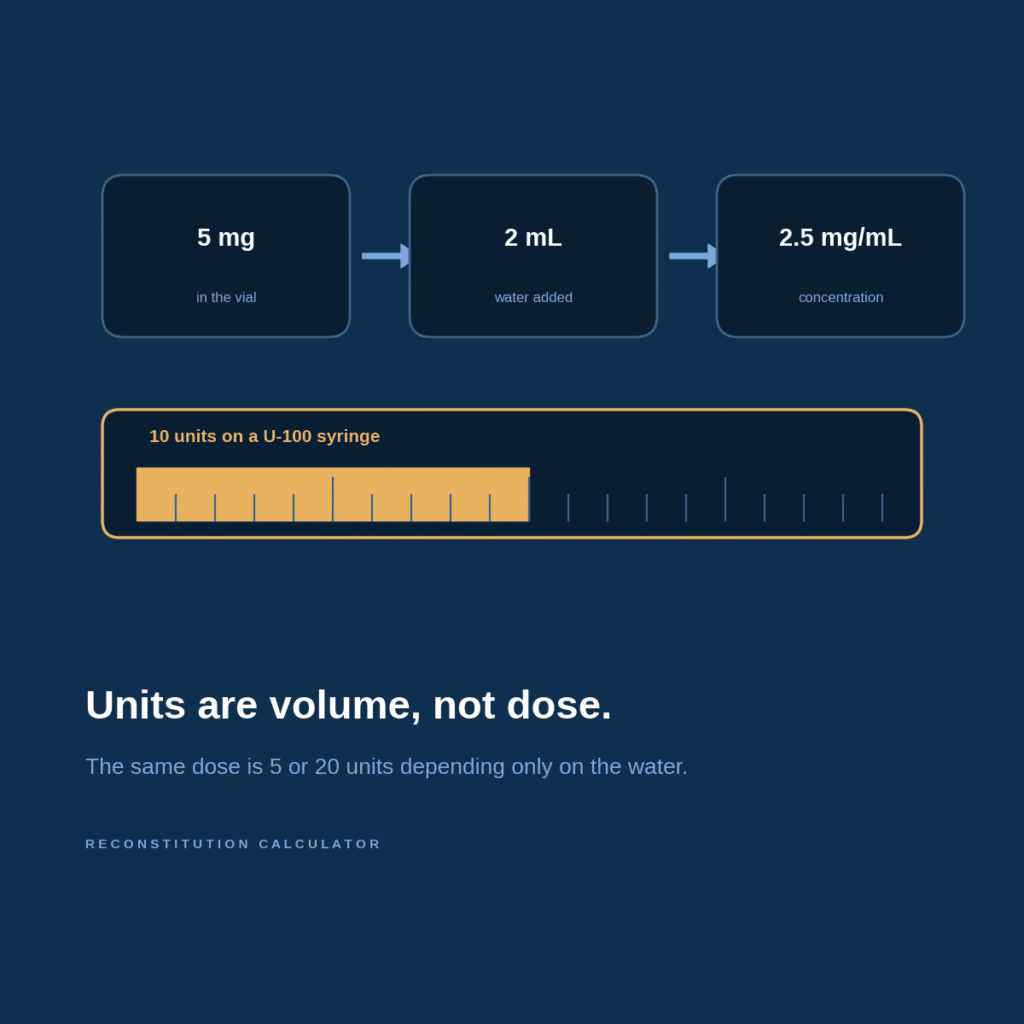
- Concentration. Divide the amount in the vial by the volume of bacteriostatic water added. A 5 mg vial with 2 mL of water gives 2.5 mg per mL.
- Volume per dose. Divide the dose by the concentration. A 250 mcg dose, which is 0.25 mg, at 2.5 mg per mL is 0.1 mL.
- Syringe units. A U-100 insulin syringe has 100 markings per millilitre, so one unit is 0.01 mL. 0.1 mL is 10 units.
The units on an insulin syringe measure volume, not drug. Ten units of a dilute solution and ten units of a concentrated one contain very different amounts. This is the single most common source of error.
Worked examples
| Vial | Water added | Concentration | Dose | Draw to |
|---|---|---|---|---|
| 5 mg | 2 mL | 2.5 mg/mL | 250 mcg | 10 units |
| 5 mg | 1 mL | 5 mg/mL | 250 mcg | 5 units |
| 10 mg | 3 mL | 3.33 mg/mL | 500 mcg | 15 units |
| 2 mg | 1 mL | 2 mg/mL | 100 mcg | 5 units |
| 5 mg | 5 mL | 1 mg/mL | 1 mg | 100 units, a full 1 mL syringe |
Notice rows one and two. Same vial, same dose, different amount of water, and the syringe marking halves. The water volume is arbitrary, which is exactly why a number of units is meaningless without knowing the concentration it refers to.
How much water should be added?
That is set by whoever prepared or prescribed the product, and it should be on the label or in the instructions supplied with it. The calculator takes it as an input rather than suggesting one.
The practical consideration, which is a measurement question rather than a clinical one, is that very dilute solutions produce large volumes and very concentrated solutions produce volumes too small to measure accurately. Below roughly two units on an insulin syringe the graduations are hard to read, and small absolute errors become large percentage errors. The calculator flags that case.
Common mistakes
- Confusing micrograms and milligrams. A factor of 1,000. The unit selector exists because this is the most consequential error possible here.
- Treating units as a dose. A protocol that says “10 units” means nothing unless it also states the vial size and the water volume.
- Copying a protocol with a different reconstitution. The same dose can be 5 units or 20 units depending only on how much water was added.
- Drawing the water volume rather than the calculated dose volume. These are different numbers.
- Ignoring beyond-use dating. Once reconstituted, a peptide has a limited shelf life that depends on the product and its storage. Follow the label you were dispensed.
What this tool will not do
It will not tell you what dose to take, how often, or whether a substance is appropriate for you. Those are clinical decisions belonging to a state-licensed clinician who knows your medical history.
It also will not tell you whether a given peptide is legal to obtain. Many of the peptides people reconstitute are not lawfully available for compounding in the United States. We maintain a peptide compounding status tracker setting out where each one currently stands with the FDA.
Common questions
What is a U-100 syringe?
An insulin syringe calibrated so 100 units equals 1 millilitre, meaning one unit is 0.01 mL. U-100 is the standard in the United States.
Does the syringe size matter?
Only for whether the volume fits and how precisely you can read it. A 0.3 mL syringe holds 30 units and has finer graduations, which makes small volumes easier to measure accurately. The calculator warns when the calculated volume exceeds the syringe selected.
Can I use ordinary water?
Bacteriostatic water and sterile water are not interchangeable and carry different storage implications. Use whatever the product instructions specify, and ask the pharmacy that dispensed it if the label is unclear.
Why does my protocol give a different number of units?
Almost always because it assumes a different reconstitution volume. Check the vial size and water volume a protocol assumes before following its unit figures.
Related
This page is general educational information, not medical advice. Prescription treatment decisions are made by state-licensed clinicians.
Related reading
More on peptide and longevity therapy:
- The FDA peptide compounding status tracker, kept current
- NAD+ injections and what the evidence covers
- Ipamorelin versus sermorelin
- BPC-157 versus TB-500
- Glutathione injection versus nasal spray
- NAD+ therapy: the complete guide
- Sermorelin therapy guide
- BPC-157
- Glutathione therapy: the complete guide
This article is for general information. It is not medical advice and it is not a recommendation for any particular treatment. Whether a treatment is appropriate for you is a decision for a licensed clinician who has reviewed your health history and current medications.
About the author
Juan MontesJuan Montes writes and reviews PrescribedRX's clinical content, covering testosterone replacement therapy, men's sexual health, weight management and hair loss. He trained as a Professional Nurse at the Colombian Red Cross in Cali, Colombia, and has worked in healthcare since 2011, roughly six of those years in direct emergency and critical care nursing. He served as Head Nurse in Emergency…
More from Juan →This article is for information only and is not medical advice. Treatment is prescribed solely at the discretion of a licensed provider following a clinical evaluation.