
Semax: The One Peptide Here With Human Trials, and Their Limits
Semax has randomised human stroke trials behind it, unlike other peptides in this category. Why that evidence is harder to audit than it looks, and its FDA status.
 By Juan Montes
Updated September 9, 2026 · 5 min read
By Juan Montes
Updated September 9, 2026 · 5 min read
Last updated 25 August 2026. This page is educational. Semax is not an FDA-approved drug and is not currently available for compounding in the United States. PrescribedRX does not offer it. See our compounding status tracker for the current federal position.
Semax is the unusual case in this category. Of the peptides the FDA reviewed in July 2026, it is the only one with genuine randomised placebo-controlled human trials behind it. It is also the one whose evidence base is hardest for an English-speaking reader to audit, because nearly all of it is published in Russian.
What is Semax?
Semax is a synthetic heptapeptide developed in Russia. It is usually described as an analogue of ACTH(4-10), though the more precise description used in the primary literature is ACTH(4-7) with a proline-glycine-proline tail: Met-Glu-His-Phe-Pro-Gly-Pro. It is administered in Russian clinical practice as a nasal solution.
The human evidence, and its limits
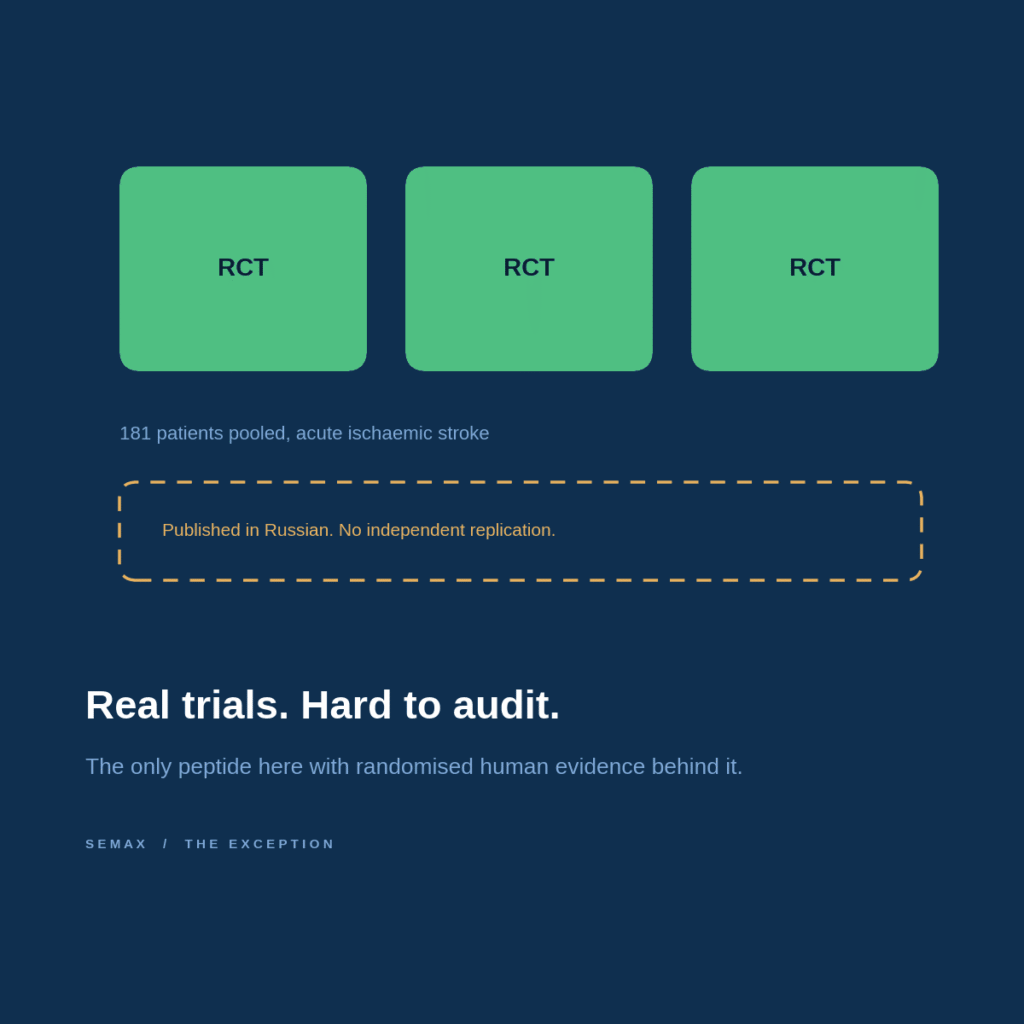
A 2018 meta-analysis pooled three randomised, placebo-controlled trials totalling 181 patients treated in the acute period of ischaemic stroke. It reported reduced stroke severity on the NIHSS scale at days 10 to 14 and at day 21 in moderate-to-severe stroke, and improvement in mobility on the Rivermead index. Benefit on functional independence appeared only in moderate-to-severe cases.
That is a real result, and it puts Semax ahead of every other peptide in this category. The qualifications matter:
- The meta-analysis is itself published in Russian, in a Russian rehabilitation journal.
- It screened eight studies covering 654 patients and included three, totalling 181 patients. These are small trials.
- The analysis explicitly focused on the domestic Russian literature, drawn from PubMed and eLibrary.ru.
- There is no independent replication outside Russia, and no Cochrane systematic review of Semax has been published. We checked.
A separate human study in 36 patients with primary glaucoma used a 0.1% Semax solution alongside standard therapy and reported no negative change in optic nerve head structure and no adverse reactions. That study was comparative but not randomised, 12 of the 36 patients formed the comparison group, and follow-up was one month.
The preclinical work
The animal literature is independently published and reasonably solid. A 2021 study in rats with transient middle cerebral artery occlusion reported changes in protein expression consistent with a protective effect, including upregulation of active CREB in subcortical structures and downregulation of MMP-9 and c-Fos in adjacent cortex, using 100 micrograms per kilogram intraperitoneally at three timepoints. Earlier rat work reported increased BDNF expression across multiple brain regions after administration.
Semax dosage
We are not publishing a human dose for Semax. The only human dose we could verify from a primary source is the 0.1% solution used in the glaucoma study. The doses used in the three Russian stroke trials are not stated in the material we were able to access, and we are not going to reproduce a figure we cannot trace to its source.
Published animal dosing: rats, 100 micrograms per kilogram intraperitoneally.
Semax vs Selank
Selank is a different Russian-developed synthetic peptide, an analogue of tuftsin, studied mainly for anxiety rather than for stroke and cognition. The two are frequently compared because they come from the same research tradition and are sold together. Neither is FDA-approved, neither is on the 503A Bulks List, and Selank was not among the peptides recommended by the July 2026 advisory committee. Selank reached neither Category 1 nor Category 2 and has no compounding pathway at present.
Safety
FDA has noted that compounded Semax may pose immunogenicity risk for certain routes of administration due to potential aggregation and peptide-related impurities, and that the agency has no or limited safety-related information for the proposed routes of administration. The Russian trials reported no significant adverse reactions, but they were small and their safety monitoring is not described in the material available in English.
Is Semax legal in the United States?
Semax is not an FDA-approved drug in the United States, and as of 25 August 2026 it is not lawfully available for compounding under section 503A.
- It was removed from FDA Category 2 in April 2026, which did not make it compoundable.
- On 24 July 2026 the FDA Pharmacy Compounding Advisory Committee reviewed Semax, nominated for cerebral ischaemia, migraine and trigeminal neuralgia. FDA proposed that it not be included. The committee voted to recommend inclusion.
- The vote is advisory and non-binding.
Semax is widely described online as an approved medicine in Russia. That is plausible and consistent with the clinical literature, but we were not able to verify a Russian regulatory record directly and are not stating it as fact.
See our peptide compounding status tracker for current status across the category.
Anti-doping status
Semax is not named individually on the current prohibited list. The list is explicitly non-exhaustive and section S0 captures substances with no current approval by any governmental regulatory health authority for human therapeutic use. Because Semax is reportedly approved in Russia, its S0 status is genuinely ambiguous. Athletes should confirm with their governing body rather than assume.
What we offer
PrescribedRX does not offer Semax and will not unless federal rulemaking permits it. Among peptides that can currently be dispensed, we offer sermorelin, NAD+ and glutathione. Whether any treatment is appropriate for a particular person is a decision for a state-licensed clinician after reviewing their medical history.
References
- Shmonin AA, Verbickaya EV, Soloveva LN, Malceva MN, Melnikova EV. Meta-analysis: efficacy of Semax in the acute period of ischaemic stroke. Bulletin of Rehabilitation Medicine. 2018;17(2):81-88. Record (in Russian)
- Strakhov VV, Popova AA, Fedorov VN. The results of Semax neuroprotective efficacy investigation. Ophthalmology Reports. 2014;7(4):43-51. doi:10.17816/OV2014443-51 (in Russian)
- Sudarkina OY, Filippenkov IB, Stavchansky VV, et al. Brain protein expression profile confirms the protective effect of the ACTH(4-7)PGP peptide (Semax) in a rat model of cerebral ischemia-reperfusion. Int J Mol Sci. 2021;22(12):6179. doi:10.3390/ijms22126179
- Dolotov OV, Seredenina TS, Levitskaya NG, et al. The heptapeptide SEMAX stimulates BDNF expression in different areas of the rat brain in vivo. Doklady Biological Sciences. 2003;391(1-6):292-295. doi:10.1023/A:1025177812262
- FDA. Pharmacy Compounding Advisory Committee briefing document, July 2026.
This page is general educational information, not medical advice, and not a description of a product available for purchase. Prescription treatment decisions are made by state-licensed clinicians.
Related reading
More on peptide and longevity therapy:
- The FDA peptide compounding status tracker, kept current
- BPC-157
- KPV peptide
- MOTS-c dosage
- BPC-157 versus TB-500
- TB-500
- Epitalon
- Tesamorelin versus sermorelin
- Glutathione side effects and the sourcing question
- NAD+ therapy: the complete guide
This article is for general information. It is not medical advice and it is not a recommendation for any particular treatment. Whether a treatment is appropriate for you is a decision for a licensed clinician who has reviewed your health history and current medications.
About the author
Juan MontesJuan Montes writes and reviews PrescribedRX's clinical content, covering testosterone replacement therapy, men's sexual health, weight management and hair loss. He trained as a Professional Nurse at the Colombian Red Cross in Cali, Colombia, and has worked in healthcare since 2011, roughly six of those years in direct emergency and critical care nursing. He served as Head Nurse in Emergency…
More from Juan →This article is for information only and is not medical advice. Treatment is prescribed solely at the discretion of a licensed provider following a clinical evaluation.