
Epitalon: What Was Actually Studied
The famous Epitalon longevity study used a different substance, and the mouse study found no increase in mean lifespan. What the research actually shows.
 By Juan Montes
Updated September 9, 2026 · 5 min read
By Juan Montes
Updated September 9, 2026 · 5 min read
Last updated 25 August 2026. This page is educational. Epitalon is not an FDA-approved drug and is not currently available for compounding in the United States. PrescribedRX does not offer it. See our compounding status tracker for the current federal position.
Epitalon is marketed almost entirely on two claims: that it lengthens telomeres, and that it extended human lifespan in a study of 266 elderly people. The first comes from a single cell-culture experiment. The second used a different substance entirely. This page separates what was actually studied from what is asserted.
What is Epitalon?
Epitalon, also written Epithalon, is a synthetic tetrapeptide: alanine-glutamate-aspartate-glycine, abbreviated AEDG.
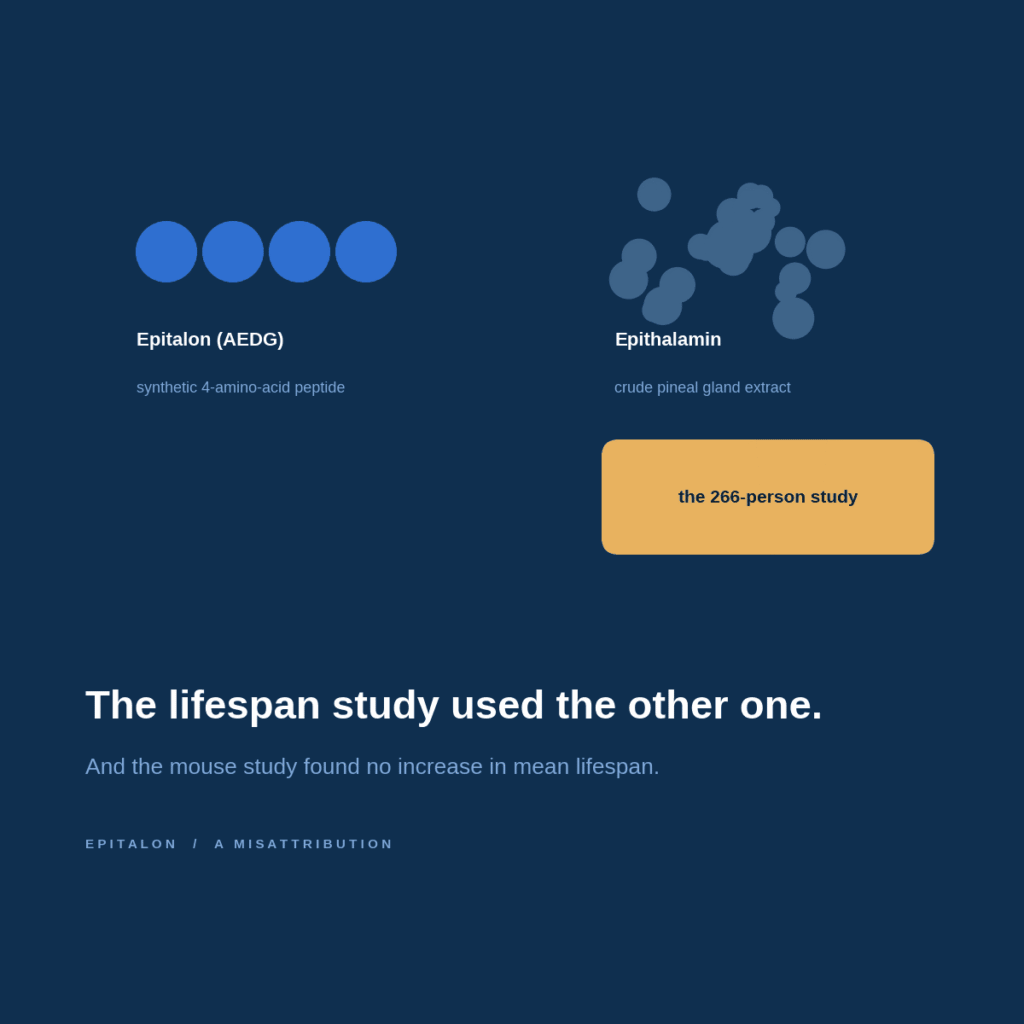
Epitalon is not Epithalamin, and this matters a great deal
| Epitalon (AEDG) | Epithalamin | |
|---|---|---|
| What it is | Synthetic four-amino-acid peptide | Crude peptide extract of the pineal gland |
| Human longevity study | None | The 266-person follow-up study |
| Sold as a peptide | Yes | No |
The widely cited human longevity result, in which 266 elderly people were followed for six to eight years, used Epithalamin, a pineal gland extract, together with Thymalin, a thymic extract. It did not use synthetic Epitalon. Content that cites that study as evidence for Epitalon is misattributing it, and this misattribution appears in a very large share of what is published about the peptide.
The telomerase claim
The origin of every “Epitalon lengthens telomeres” statement is a 2003 experiment in which cultured human fetal fibroblasts, a telomerase-negative cell line, showed activation of the telomerase catalytic subunit and telomere lengthening after exposure to the peptide.
That is a cell-culture study. No human subjects and no animals were involved. Telomere lengthening in a dish is a real observation and a long way from an effect on human ageing.
The mouse lifespan study, including the part usually left out
A 2003 study gave Epitalon to female mice from three months of age until natural death, at 1.0 microgram per mouse subcutaneously for five consecutive days each month, with 54 animals per group. The reported results:
- Mean lifespan was not increased.
- Maximum lifespan increased by 12.3%.
- Leukaemia incidence was reduced.
- Chromosome aberrations fell by 17.1%.
The finding that mean lifespan did not increase is consistently omitted from marketing summaries of this study.
Has Epitalon been studied in humans?
A small number do exist, and this is a point where most content about Epitalon, including much of the sceptical content, gets it wrong in both directions. FDA’s briefing document for Epitalon identifies a small number of human studies, including a randomised placebo-controlled study reported in 2021. What FDA stated it had not identified were clinical studies assessing the safety of epitalon-related substances administered in humans.
So the accurate position is narrower than “no human research”. It is that the human research is sparse, comes largely from the same research tradition as the animal work, is not indexed in the major English-language databases in the way a Western trial would be, and does not include a study designed to assess safety. There is no ClinicalTrials.gov record.
Who produced this research
The Epitalon literature is dominated by one research group in St Petersburg, publishing largely in the early 2000s in Russian-affiliated journals, with limited independent replication. That is not a reason to dismiss the work, but it is a reason to weight it differently from a body of evidence built by multiple independent teams.
An independent Polish review published in 2025 is the best current summary. It describes roughly 25 years of in vitro, in vivo and in silico study, notes that it remains uncertain whether the proposed mechanisms are the only ones at work, and observes that even basic physico-chemical and structural characterisation of the peptide remains quite limited.
Epitalon dosage
There is no published human dosing for synthetic Epitalon. Published animal dosing is 1.0 microgram per mouse, roughly 30 to 40 micrograms per kilogram, subcutaneously for five days per month. The concentrations used in the fibroblast telomerase experiment are not stated on the record we were able to access.
Safety
The human safety profile is uncharacterised. FDA stated in July 2026 that it had not identified clinical studies assessing the safety of epitalon-related substances administered in humans. FDA has also noted that compounded epitalon may pose immunogenicity risk for certain routes of administration due to potential aggregation and peptide-related impurities, and that it has not identified safety-related information for the proposed route of administration.
Is Epitalon legal in the United States?
Epitalon is not an FDA-approved drug, and as of 25 August 2026 it is not lawfully available for compounding under section 503A.
- It was removed from FDA Category 2 in April 2026, which did not make it compoundable.
- On 24 July 2026 the FDA Pharmacy Compounding Advisory Committee reviewed Epitalon, nominated for insomnia. FDA proposed that it not be included. The committee voted to recommend inclusion.
- The vote is advisory and non-binding.
See our peptide compounding status tracker for current status across the category.
Anti-doping status
Epitalon is not named individually on the current prohibited list, though section S0 may still apply to any substance without regulatory approval for human therapeutic use. Athletes should confirm with their governing body.
What we offer
PrescribedRX does not offer Epitalon and will not unless federal rulemaking permits it. Among peptides that can currently be dispensed, we offer sermorelin, NAD+ and glutathione. Whether any treatment is appropriate for a particular person is a decision for a state-licensed clinician after reviewing their medical history.
References
- Araj SK, Brzezik J, Madra-Gackowska K, Szeleszczuk L. Overview of Epitalon, a highly bioactive pineal tetrapeptide with promising properties. Int J Mol Sci. 2025;26(6):2691. PMID 40141333
- Khavinson VKh, Bondarev IE, Butyugov AA. Epithalon peptide induces telomerase activity and telomere elongation in human somatic cells. Bull Exp Biol Med. 2003;135(6):590-592. doi:10.1023/A:1025493705728
- Anisimov VN, Khavinson VKh, Popovich IG, et al. Effect of Epitalon on biomarkers of aging, life span and spontaneous tumor incidence in female Swiss-derived SHR mice. Biogerontology. 2003;4(4):193-202. doi:10.1023/A:1025114230714
- Khavinson V, Morozov V. Peptides of pineal gland and thymus prolong human life. Neuro Endocrinol Lett. 2003;24(3-4):233-240. PMID 14523363. Note: this study used Epithalamin and Thymalin, not synthetic Epitalon.
- FDA. Pharmacy Compounding Advisory Committee briefing document, July 2026.
This page is general educational information, not medical advice, and not a description of a product available for purchase. Prescription treatment decisions are made by state-licensed clinicians.
Related reading
More on peptide and longevity therapy:
- The FDA peptide compounding status tracker, kept current
- BPC-157
- Semax peptide
- KPV peptide
- MOTS-c dosage
- BPC-157 versus TB-500
- TB-500
- Peptide reconstitution calculator
- NAD+ side effects
- Tesamorelin dosage
This article is for general information. It is not medical advice and it is not a recommendation for any particular treatment. Whether a treatment is appropriate for you is a decision for a licensed clinician who has reviewed your health history and current medications.
About the author
Juan MontesJuan Montes writes and reviews PrescribedRX's clinical content, covering testosterone replacement therapy, men's sexual health, weight management and hair loss. He trained as a Professional Nurse at the Colombian Red Cross in Cali, Colombia, and has worked in healthcare since 2011, roughly six of those years in direct emergency and critical care nursing. He served as Head Nurse in Emergency…
More from Juan →This article is for information only and is not medical advice. Treatment is prescribed solely at the discretion of a licensed provider following a clinical evaluation.