Sermorelin Before and After: What the Evidence Actually Shows
What sermorelin actually changed in the published trial data, and why this page publishes no before-and-after photos or results timeline.
 By Juan Montes
Updated October 3, 2026 · 5 min read
By Juan Montes
Updated October 3, 2026 · 5 min read
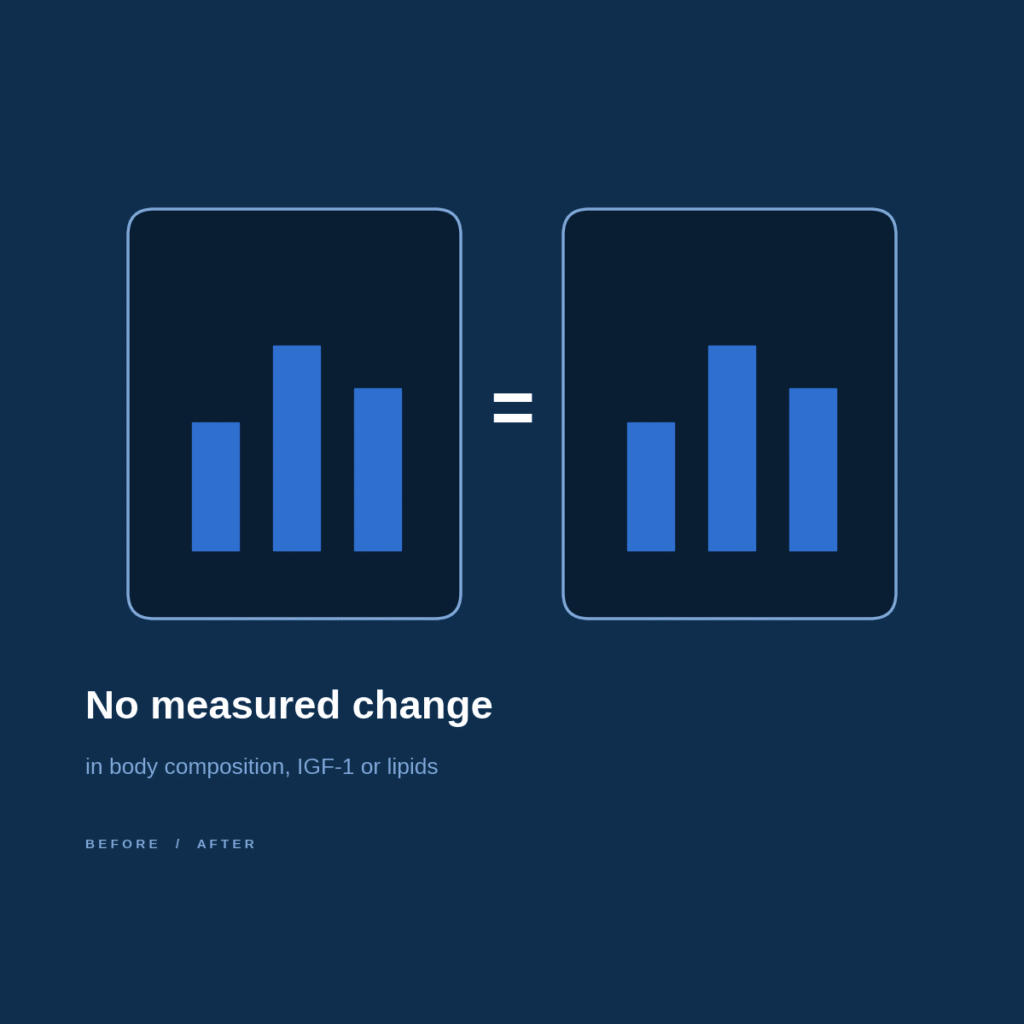
If you are searching for sermorelin before-and-after results, you are probably looking for photographs. This page does not publish any, and the reason is the most useful thing on it. Below is what the controlled human research on sermorelin has actually measured, what it did not find, and why a photograph cannot answer the question you are asking.
Important
This article is general education, not medical advice, and nothing in it recommends or endorses a treatment for you. Compounded medications discussed here are not FDA approved. Only a clinician licensed in your state can decide whether any treatment is appropriate, and that decision follows a review of your history and any testing they consider necessary. Do not start, stop or change any medication based on something you read online. If you are having a medical emergency, call 911.
Why before-and-after photos are weak evidence
Sermorelin is usually taken alongside things that change how a person looks on their own: resistance training, dietary change, improved sleep, weight loss, and in some cases testosterone therapy. A photograph cannot separate one variable from the others.
A photo also cannot control for lighting, posture, hydration, tan, camera lens, or a twelve-week gap during which someone was unusually motivated. This is not an accusation against anyone who publishes such images. It is a limitation of the format. An uncontrolled photograph is not capable of demonstrating that a specific compound caused a specific change.
What the controlled human research found
The adult evidence base for sermorelin is small and dates largely from the 1990s.
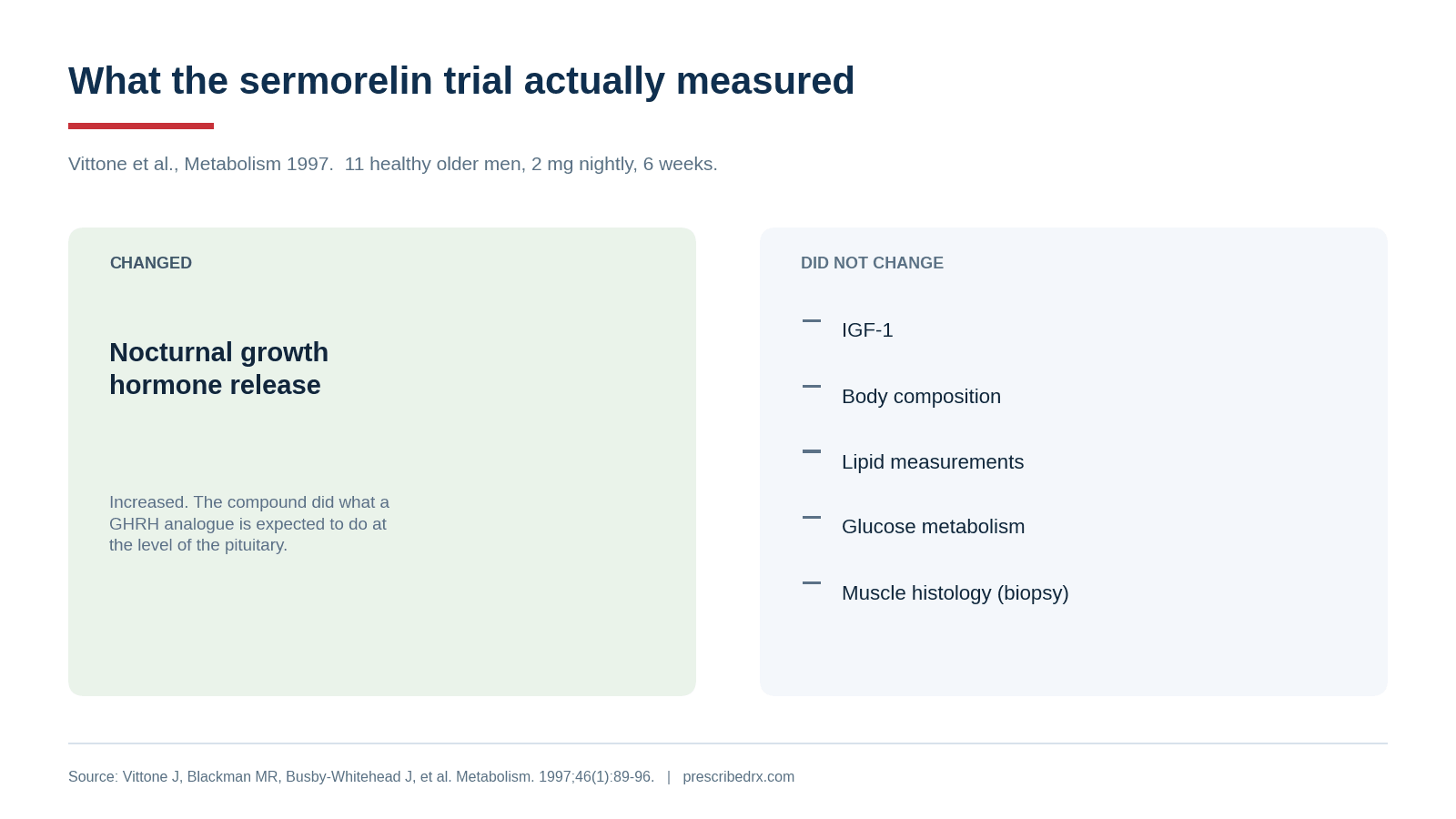
The most frequently cited controlled study is Vittone and colleagues, published in Metabolism in 1997. Eleven healthy older men received 2 mg nightly for six weeks. The researchers measured what happened.
What changed
- Nocturnal growth hormone release increased. The compound did what a growth hormone releasing hormone analogue is expected to do at the level of the pituitary.
What did not change
- IGF-1 levels
- Body composition
- Lipid measurements
- Glucose metabolism
- Muscle histology on biopsy
That is the finding, stated plainly. A measurable pharmacological effect on growth hormone secretion, without accompanying changes in the downstream outcomes that people generally have in mind when they search for before-and-after results.
Some important caveats work in both directions. Eleven participants is a very small sample, six weeks is a short window, and the study was not designed or powered to detect modest changes in body composition. A study that finds no change is not the same as proof that no change is possible. It does mean the evidence people cite for dramatic transformation does not exist in the controlled literature.
Why we do not publish a results timeline
Many sermorelin pages present a week-by-week schedule: sleep improves by week two, recovery by week four, body composition by week twelve. Those timelines are not drawn from trial data. There is no published controlled study of sermorelin in healthy adults that measured those outcomes on that schedule and reported those results.
Publishing a timeline anyway would mean inventing the specifics, so this page does not include one. Individual responses vary, and what any one person experiences is something for them and their clinician to observe and document rather than something a website can forecast.
Where sermorelin does have an FDA record
Sermorelin acetate was approved as GEREF under NDA 019863 on 28 December 1990, and again under NDA 020443 on 26 September 1997, sponsored by EMD Serono. Both products were discontinued and neither is marketed today.
One detail is frequently omitted. In a Federal Register notice dated 4 March 2013, FDA determined that the GEREF products “were not withdrawn from sale for reasons of safety or effectiveness.” The discontinuation was a commercial decision rather than a safety action, which is a materially different situation from a product removed after adverse findings.
That history does not make present-day sermorelin an approved drug. No approved sermorelin product is on the market, so statements that sermorelin “is FDA approved” are inaccurate in the present tense. Compounded sermorelin is an unapproved drug prepared by a licensed pharmacy against an individual prescription. Regarding compounding lists, sermorelin does not appear in Category 1, 2 or 3 of FDA’s 503A bulk drug substances evaluation as updated 14 May 2026, and it appears in Category 1 of the 503B nominations list updated 21 March 2025. Category 1 is a nomination and an interim enforcement posture. It is not an approval or an endorsement.
What can be measured instead of photographed
Where before-and-after imagery is uncontrolled, laboratory values and validated questionnaires are not. If a clinician is monitoring a course of therapy, the measurements typically discussed include IGF-1, metabolic markers such as fasting glucose and HbA1c, and standardised sleep or quality-of-life instruments. Whether any of these apply to a given person, and how often they would be checked, is entirely a clinical decision made by the prescriber.
Frequently asked
Are the before-and-after photos on other sites fake?
That is not the claim being made here. The point is narrower: an uncontrolled photograph cannot establish that sermorelin caused a change, regardless of whether the photograph is authentic.
Is sermorelin FDA approved?
Not currently. It held two approvals as GEREF, in 1990 and 1997. Both products were discontinued, and FDA stated in 2013 that the withdrawal was not for reasons of safety or effectiveness. Compounded sermorelin available today is an unapproved drug.
How long before anything happens?
There is no published controlled trial in healthy adults that answers this, so this page does not give a number. It is a question for the prescribing clinician.
Considering sermorelin therapy?
PrescribedRX offers sermorelin injections by prescription. Answer a few questions about your health history and a clinician licensed in your state reviews whether treatment is appropriate for you. Compounded sermorelin is not FDA approved, and a clinician may decide it is not right for you.
References
- Vittone J, Blackman MR, Busby-Whitehead J, et al. Effects of single nightly injections of growth hormone-releasing hormone (GHRH 1-29) in healthy elderly men. Metabolism. 1997;46(1):89–96.
- U.S. Food and Drug Administration. Determination That GEREF (Sermorelin Acetate) Injection and GEREF DIAGNOSTIC (Sermorelin Acetate) Injection Were Not Withdrawn From Sale for Reasons of Safety or Effectiveness. Federal Register, 4 March 2013.
- U.S. Food and Drug Administration. Drugs@FDA records for GEREF, NDA 019863 and NDA 020443.
- U.S. Food and Drug Administration. Bulk Drug Substances Nominated for Use in Compounding Under Section 503A of the Federal Food, Drug, and Cosmetic Act. Updated 14 May 2026.
- U.S. Food and Drug Administration. Bulk Drug Substances Nominated for Use in Compounding Under Section 503B of the Federal Food, Drug, and Cosmetic Act. Updated 21 March 2025.
Related reading
- The FDA peptide compounding status tracker, kept current
- Sermorelin therapy guide
- Sermorelin dosage
- Is sermorelin FDA approved
- Ipamorelin versus sermorelin
- Tesamorelin
- Tesamorelin dosage
- Tesamorelin versus sermorelin
- Sermorelin benefits
- BPC-157
Longevity plans from PrescribedRX
PrescribedRX prescribes longevity treatments through clinicians licensed in your state:
- Glutathione Injection. Administered by injection after a provider consultation.
- Glutathione Nasal Spray. A nasal alternative.
- NAD+ Injections. On a schedule set by your provider.
- NAD+ Nasal Spray. A nasal alternative.
- Sermorelin Injections. By prescription after consultation.
Every plan and its current price is on the plans page and the pricing page.
These are compounded preparations. Compounded drugs are not reviewed or approved by the FDA for safety or effectiveness, and treatment outcomes are not guaranteed.
This article is for general information. It is not medical advice and it is not a recommendation for any particular treatment. Whether a treatment is appropriate for you is a decision for a licensed clinician who has reviewed your health history and current medications.
About the author
Juan MontesJuan Montes writes and reviews PrescribedRX's clinical content, covering testosterone replacement therapy, men's sexual health, weight management and hair loss. He trained as a Professional Nurse at the Colombian Red Cross in Cali, Colombia, and has worked in healthcare since 2011, roughly six of those years in direct emergency and critical care nursing. He served as Head Nurse in Emergency…
More from Juan →This article is for information only and is not medical advice. Treatment is prescribed solely at the discretion of a licensed provider following a clinical evaluation.