Sermorelin Benefits: Demonstrated, Plausible and Asserted
What sermorelin is demonstrated to do, what is mechanistically plausible but unproven, and what is asserted without support.
 By Juan Montes
Updated October 3, 2026 · 6 min read
By Juan Montes
Updated October 3, 2026 · 6 min read

Sermorelin is marketed for better sleep, faster recovery, improved body composition, more energy and slower aging. This page separates three different things that usually get presented as one: what sermorelin is demonstrated to do, what is mechanistically plausible but unproven, and what is simply asserted.
The honest summary up front: sermorelin has one well-documented pharmacological effect, and a benefits list that outruns its evidence by a considerable distance.
Important
This article is general education, not medical advice, and nothing in it recommends or endorses a treatment for you. Compounded medications discussed here are not FDA approved. Only a clinician licensed in your state can decide whether any treatment is appropriate, and that decision follows a review of your history and any testing they consider necessary. Do not start, stop or change any medication based on something you read online. If you are having a medical emergency, call 911.
What is demonstrated
Sermorelin increases growth hormone release from the pituitary. This is not in dispute. Sermorelin is an analogue of growth hormone releasing hormone, it binds the GHRH receptor, and the pituitary responds by releasing more of the body’s own growth hormone. It was approved on this basis, and used diagnostically for exactly this reason: a pituitary that responds tells you something a pituitary that does not respond does not.
That is a real, measurable, reproducible effect. Everything else on the usual benefits list depends on what that increase then does.
What the adult evidence actually found
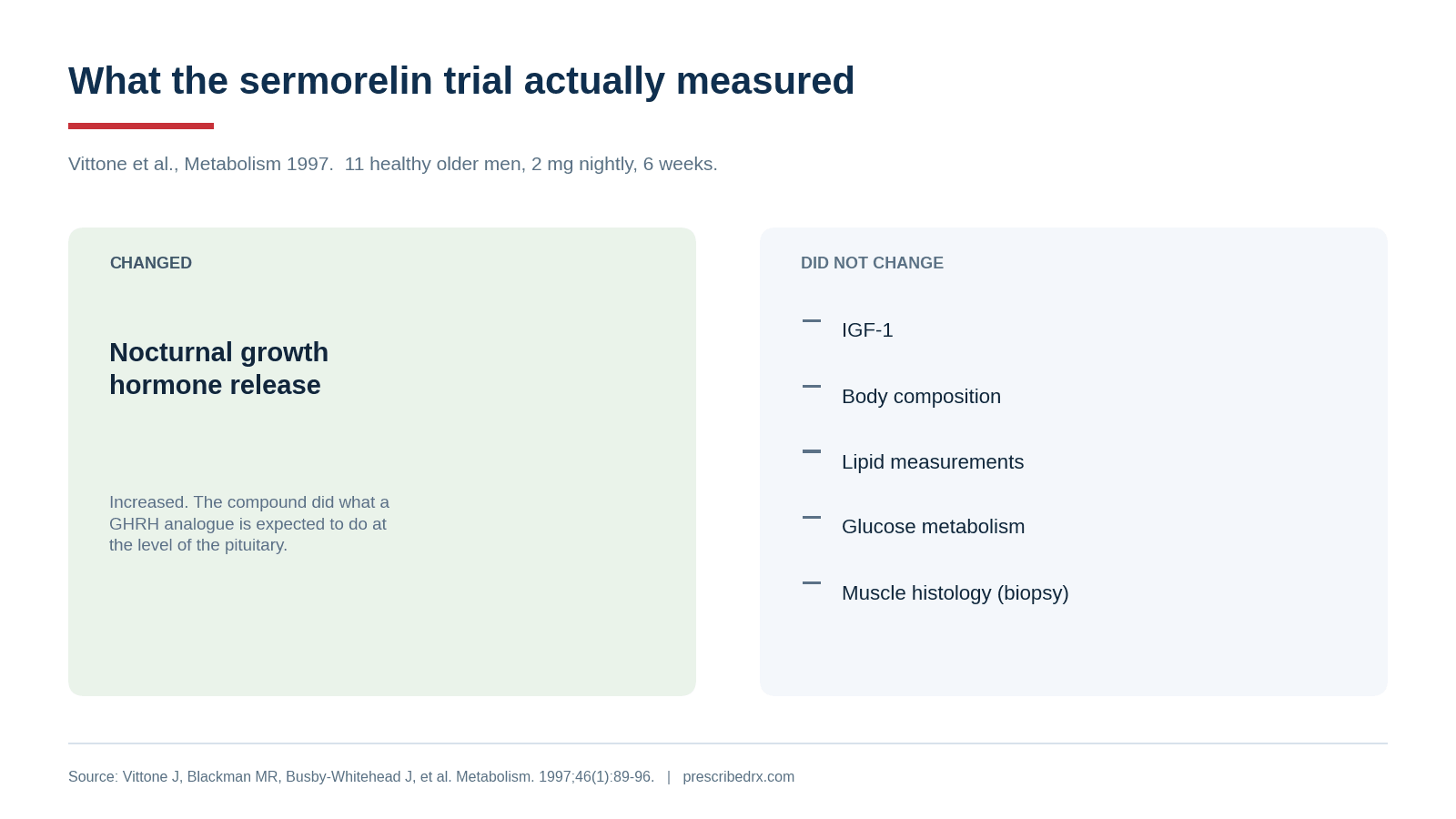
The most frequently cited controlled adult study is Vittone and colleagues, published in Metabolism in 1997. Eleven healthy older men received 2 mg nightly for six weeks.
| Measured | Result |
|---|---|
| Nocturnal growth hormone release | Increased |
| IGF-1 | No change |
| Body composition | No change |
| Lipid measurements | No change |
| Glucose metabolism | No change |
| Muscle histology on biopsy | No change |
The caveats cut both ways and both are worth stating. Eleven participants over six weeks is a small, short study that was not powered to detect modest effects, so it does not prove that nothing happens. But it is also the study most often cited in support of sermorelin, and what it found was an increase in growth hormone release without accompanying changes in the outcomes people are actually interested in.
The three tiers, sorted honestly
Tier 1: demonstrated
- Increased growth hormone release from the pituitary.
Tier 2: mechanistically plausible, not established in healthy adults
These follow logically from what growth hormone does, which is why they are the standard benefits list. What is missing is controlled trial evidence that sermorelin produces them in healthy adults.
- Sleep quality. Growth hormone secretion and slow-wave sleep are physiologically linked, and the link runs in both directions. That relationship is real. Whether adding sermorelin improves sleep in a healthy adult has not been established in controlled trials.
- Body composition. Growth hormone influences lean mass and fat distribution. The 1997 study measured body composition and found no change over six weeks.
- Recovery. Growth hormone is involved in tissue repair. There is no controlled trial of sermorelin and recovery outcomes in healthy adults.
- Bone density. Growth hormone affects bone metabolism, and the timescale of any such effect would be far longer than any sermorelin study has run.
Tier 3: asserted without support
- Specific timelines. Week-by-week schedules that promise sleep improvement by week two and body composition change by week twelve are not drawn from trial data. No published controlled study measured those outcomes on that schedule.
- Anti-aging or lifespan effects. No sermorelin study has measured aging or longevity outcomes in humans. Raising a hormone that declines with age is not the same as slowing aging, and the relationship between growth hormone signalling and lifespan is genuinely contested in the research literature.
- Comparisons to human growth hormone. Sermorelin is not growth hormone and does not replace it. Claims that it delivers HGH-like results are describing a different drug.
- Percentage improvements. Figures like a specific percentage increase in growth hormone or IGF-1 in healthy adults do not come from published human trials of sermorelin.
Why sermorelin still interests clinicians
Setting the marketing aside, there are two defensible reasons this compound keeps coming up.
The first is mechanistic. Because sermorelin acts on the pituitary rather than replacing growth hormone directly, the body’s own feedback loops remain in the circuit. Somatostatin still regulates the pulse. That is a meaningfully different pharmacological approach from administering growth hormone, and the argument that it is a more physiological one is reasonable.
The second is regulatory. Sermorelin carries no Category 2 safety-risk finding from FDA, and it does not appear in Category 1, 2 or 3 of the 503A evaluation as updated 14 May 2026. For comparison, FDA placed ipamorelin acetate in Category 2 on 29 September 2023. Sermorelin also has an unusual history: it held two FDA approvals as GEREF, and FDA stated in the Federal Register on 4 March 2013 that they were not withdrawn for reasons of safety or effectiveness.
Neither of these is evidence of benefit. They are reasons the compound is treated differently from others in its category.
Reported side effects
Compounded sermorelin has no approved label, so there is no standardised safety document of the kind an approved drug carries. Effects reported in the literature and in practice centre on injection site reactions, flushing, and headache. The absence of a large adverse event dataset reflects the absence of a marketed approved product generating one, and should not be read as a demonstration of safety.
Frequently asked
Does sermorelin actually work?
It reliably increases growth hormone release. Whether that produces the downstream benefits it is marketed for has not been established in controlled trials in healthy adults.
Is it better than HGH?
It is not the same class of thing. Sermorelin prompts your pituitary to release growth hormone; HGH is growth hormone. No trial has compared clinical outcomes between them in healthy adults.
How long before benefits appear?
No controlled trial in healthy adults establishes a timeline, so this page does not publish one.
Why does every other site list more benefits?
Most benefit lists are derived from what growth hormone does, then attributed to sermorelin. That reasoning is plausible but it is not the same as evidence that sermorelin produces those outcomes.
Considering sermorelin therapy?
PrescribedRX offers sermorelin injections by prescription. Answer a few questions about your health history and a clinician licensed in your state reviews whether treatment is appropriate for you. Compounded sermorelin is not FDA approved, and a clinician may decide it is not right for you.
References
- Vittone J, Blackman MR, Busby-Whitehead J, et al. Effects of single nightly injections of growth hormone-releasing hormone (GHRH 1-29) in healthy elderly men. Metabolism. 1997;46(1):89–96.
- U.S. Food and Drug Administration. Determination That GEREF (Sermorelin Acetate) Injection and GEREF DIAGNOSTIC (Sermorelin Acetate) Injection Were Not Withdrawn From Sale for Reasons of Safety or Effectiveness. Federal Register, 4 March 2013.
- U.S. Food and Drug Administration. Bulk Drug Substances Nominated for Use in Compounding Under Section 503A of the Federal Food, Drug, and Cosmetic Act. Updated 14 May 2026.
- U.S. Food and Drug Administration. Bulk Drug Substances That Raise Significant Safety Risks (Category 2). Ipamorelin acetate entry dated 29 September 2023.
- U.S. Food and Drug Administration. Drugs@FDA records for GEREF, NDA 019863 and NDA 020443.
Related reading
- The FDA peptide compounding status tracker, kept current
- Sermorelin therapy guide
- Sermorelin dosage
- Sermorelin before and after
- Is sermorelin FDA approved
- Ipamorelin versus sermorelin
- Tesamorelin
- Tesamorelin dosage
- Tesamorelin versus sermorelin
- NAD+ therapy: the complete guide
Longevity plans from PrescribedRX
PrescribedRX prescribes longevity treatments through clinicians licensed in your state:
- Glutathione Injection. Administered by injection after a provider consultation.
- Glutathione Nasal Spray. A nasal alternative.
- NAD+ Injections. On a schedule set by your provider.
- NAD+ Nasal Spray. A nasal alternative.
- Sermorelin Injections. By prescription after consultation.
Every plan and its current price is on the plans page and the pricing page.
These are compounded preparations. Compounded drugs are not reviewed or approved by the FDA for safety or effectiveness, and treatment outcomes are not guaranteed.
This article is for general information. It is not medical advice and it is not a recommendation for any particular treatment. Whether a treatment is appropriate for you is a decision for a licensed clinician who has reviewed your health history and current medications.
About the author
Juan MontesJuan Montes writes and reviews PrescribedRX's clinical content, covering testosterone replacement therapy, men's sexual health, weight management and hair loss. He trained as a Professional Nurse at the Colombian Red Cross in Cali, Colombia, and has worked in healthcare since 2011, roughly six of those years in direct emergency and critical care nursing. He served as Head Nurse in Emergency…
More from Juan →This article is for information only and is not medical advice. Treatment is prescribed solely at the discretion of a licensed provider following a clinical evaluation.