

Last updated 25 August 2026. Educational information about an FDA-approved prescription medicine. PrescribedRx does not currently offer tesamorelin.
Tesamorelin is unusual in this category: it is a genuinely FDA-approved drug with two adequately powered phase 3 trials behind it. It is also marketed online for a purpose its own FDA label explicitly contradicts. Both of those things are worth understanding before anything else.
What is tesamorelin?
Tesamorelin is a synthetic analogue of growth hormone-releasing factor. It was approved by the FDA on 10 November 2010 under the brand name Egrifta. The currently marketed formulations are Egrifta SV and Egrifta WR, which the label states are not substitutable for one another.
What is tesamorelin approved for?
The approved indication, quoted from the label, is “the reduction of excess abdominal fat in HIV-infected adult patients with lipodystrophy.”
That is the whole of it. The label then adds three Limitations of Use, and the second one matters enormously given how tesamorelin is sold:
- “Long-term cardiovascular safety of EGRIFTA SV has not been established.”
- “EGRIFTA SV is not indicated for weight loss management as it has a weight neutral effect.”
- “There are no data to support improved compliance with anti-retroviral therapies in HIV-positive patients taking EGRIFTA SV.”
Tesamorelin is widely marketed for fat loss and body composition. Its FDA-approved labelling states it is weight neutral and is not indicated for weight loss management. That is not our interpretation, it is the printed label.
What the pivotal trials found
Two multicentre, randomised, double-blind, placebo-controlled trials, each with a 26-week main phase and a 26-week extension. Study 1 randomised 412 patients, Study 2 randomised 404. The primary endpoint in both was percent change in visceral adipose tissue at week 26, and both met it.
| Study 1 | Study 2 | |
|---|---|---|
| Patients randomised | 412 | 404 |
| VAT change, tesamorelin | -27 cm² (-18%) | -21 cm² (-14%) |
| VAT change, placebo | +4 cm² (+2%) | -0 cm² (-2%) |
| Treatment difference | -31 cm² | -21 cm² |
So the effect is real, it was measured properly, and it is specific to visceral fat. Subcutaneous fat was not meaningfully changed, and total body weight was not the point.
The finding that most content leaves out
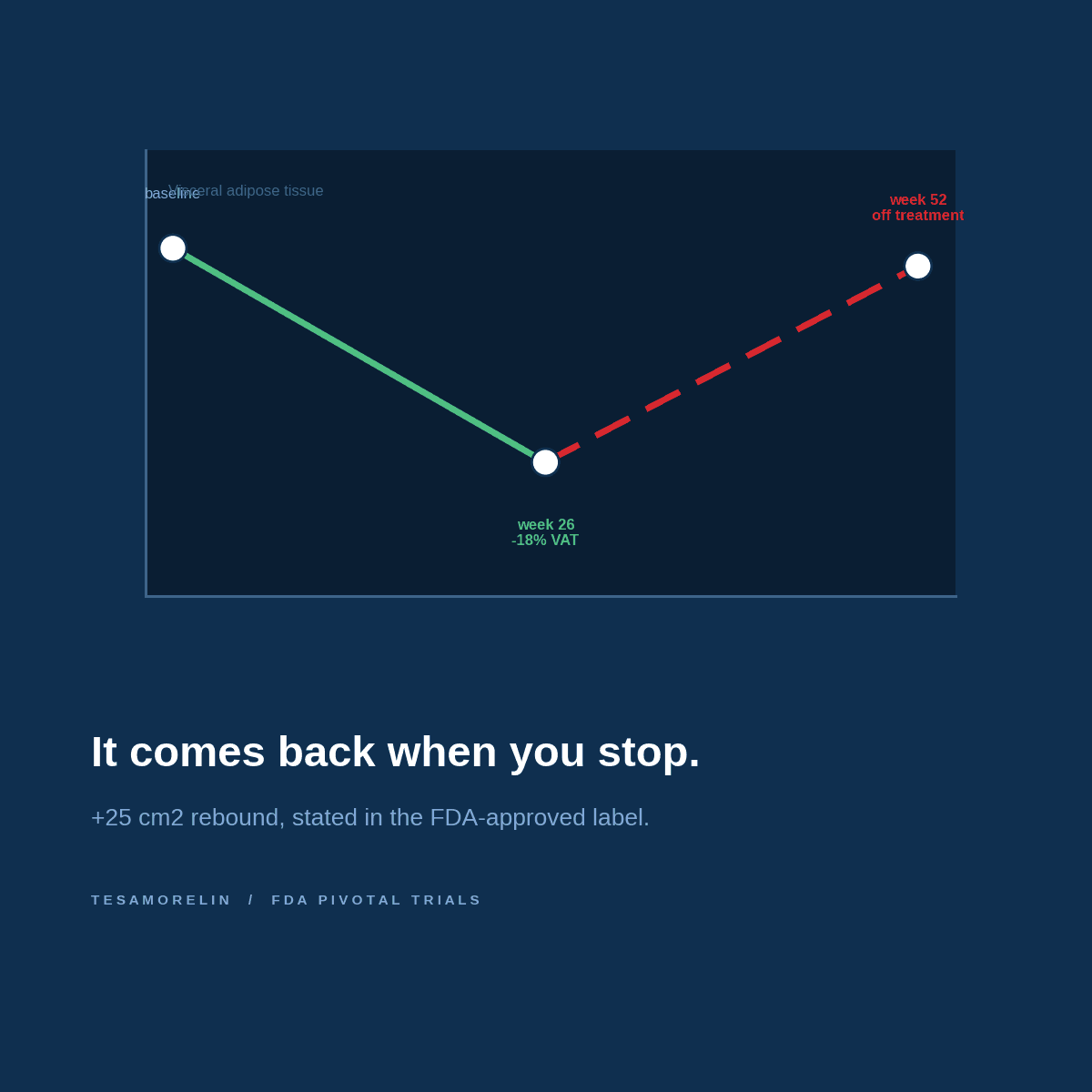
In the 26-week extension, patients who had been on tesamorelin and were switched to placebo regained visceral fat. The label reports increases of 25 cm² in Study 1 and 24 cm² in Study 2 over that period, which is close to the entire treatment effect.
The 52-week study published in AIDS in 2008 states it plainly in its abstract: “Upon discontinuation of tesamorelin, VAT reaccumulated,” and that the effects do not last beyond the duration of treatment.
This is documented both in the peer-reviewed literature and in the FDA-approved labelling. It means tesamorelin is a maintenance treatment for as long as it is taken, not an intervention with a durable result. Anyone weighing the cost should weigh it as an ongoing cost.
Is there evidence outside HIV-associated lipodystrophy?
Yes, in two specific research populations, and it would be wrong to claim otherwise. Neither is an approved indication.
- Abdominally obese adults with reduced growth hormone secretion. A 12-month randomised trial in 60 non-HIV participants (HIV was an exclusion criterion) met its primary endpoint, with visceral fat falling 16 cm² on tesamorelin versus rising 19 cm² on placebo, a net difference of 35 cm². Subcutaneous fat was unchanged.
- Older adults with mild cognitive impairment. A 20-week randomised trial of 1 mg daily reported a favourable result on a cognitive composite, driven by executive function.
What there is no evidence for
We could find no human trial of tesamorelin for athletic performance, muscle building, or general cosmetic fat loss. Those are the uses it is most heavily marketed for online, and the label affirmatively states the weight-neutral point above.
Safety and labelled warnings
There is no boxed warning. The label carries Warnings and Precautions covering:
- Neoplasms. Any pre-existing malignancy must be inactive and its treatment complete before starting, and treatment is discontinued on recurrence.
- Elevated IGF-1. The label directs monitoring of IGF-1 during therapy and says to consider discontinuing in patients with persistent elevations.
- Fluid retention
- Glucose intolerance and diabetes risk
- Hypersensitivity reactions
- Injection site reactions
- Increased mortality in acute critical illness
One further consideration specific to compounded versions rather than the branded product: in April 2020 the FDA issued a warning letter to a compounding pharmacy that named tesamorelin, citing a voluntary recall of tesamorelin products over an incorrect beyond-use date, alongside unapproved new drug and misbranding findings. Who compounds a product, and to what standard, is not a trivial detail.
Is tesamorelin legal to prescribe?
Tesamorelin is an FDA-approved drug, marketed as Egrifta SV and Egrifta WR. It is available on prescription in the United States for its approved indication.
Section 503A permits a compounding pharmacy to use a bulk drug substance that is a component of an FDA-approved drug, which is a different position from the peptides on our compounding status tracker that have no approved product behind them. Any specific compounding decision is one for a pharmacy and its counsel, not something a web page should settle.
Tesamorelin dosage
The FDA-approved dosing is set out on the label. We cover it, and what the trials used, on our tesamorelin dosage page.
What we offer
PrescribedRx does not currently offer tesamorelin. Among peptides we do dispense, see sermorelin, NAD+ and glutathione, with prices published on our pricing page. Whether any treatment is appropriate for a particular person is a decision for a state-licensed clinician after reviewing their medical history.
Common questions
Is tesamorelin FDA approved?
Yes. Approved 10 November 2010, currently marketed as Egrifta SV and Egrifta WR, for reduction of excess abdominal fat in HIV-infected adults with lipodystrophy.
Does tesamorelin cause weight loss?
The FDA label states it is weight neutral and is not indicated for weight loss management. The trials measured visceral adipose tissue, not body weight.
What happens if you stop taking it?
Visceral fat reaccumulates. The label quantifies increases of 24 to 25 cm² in patients switched to placebo, and the 52-week published trial reports the same finding.
Tesamorelin vs sermorelin, which is better?
They are different molecules with different evidence and different regulatory status. We compare them directly on our tesamorelin vs sermorelin page.
References
- FDA. EGRIFTA SV prescribing information.
- FDA. EGRIFTA WR prescribing information, March 2025.
- FDA. Egrifta approval letter, NDA 022505, 10 November 2010.
- Falutz J, Allas S, Blot K, et al. Metabolic effects of a growth hormone-releasing factor in patients with HIV. N Engl J Med. 2007;357(23):2359-2370. doi:10.1056/NEJMoa072375
- Falutz J, Mamputu JC, Potvin D, et al. Effects of tesamorelin in HIV-infected patients with excess abdominal fat: a pooled analysis of two phase 3 trials. J Clin Endocrinol Metab. 2010;95(9):4291-4304. PMID 20554713
- Falutz J, et al. Long-term safety and effects of tesamorelin in HIV patients with abdominal fat accumulation. AIDS. 2008;22(14):1719-1728. PMID 18690162
- Stanley TL, Feldpausch MN, Oh J, et al. Effect of tesamorelin on liver fat and visceral fat in HIV-infected patients: a randomized clinical trial. JAMA. 2014;312(4):380-389. PMID 25038357
- Makimura H, Feldpausch MN, Rope AM, et al. Metabolic effects of a growth hormone-releasing factor in obese subjects with reduced growth hormone secretion. J Clin Endocrinol Metab. 2012;97(12):4769-4779. PMC3513535
This page is general educational information, not medical advice, and not a description of a product available from PrescribedRx. Prescription treatment decisions are made by state-licensed clinicians.