NAD+ IV vs Injection vs Nasal Spray: What Is Documented
No human study has compared NAD+ absorption across these routes. What the research documents, and the practical differences.
 By Juan Montes
Updated October 3, 2026 · 6 min read
By Juan Montes
Updated October 3, 2026 · 6 min read
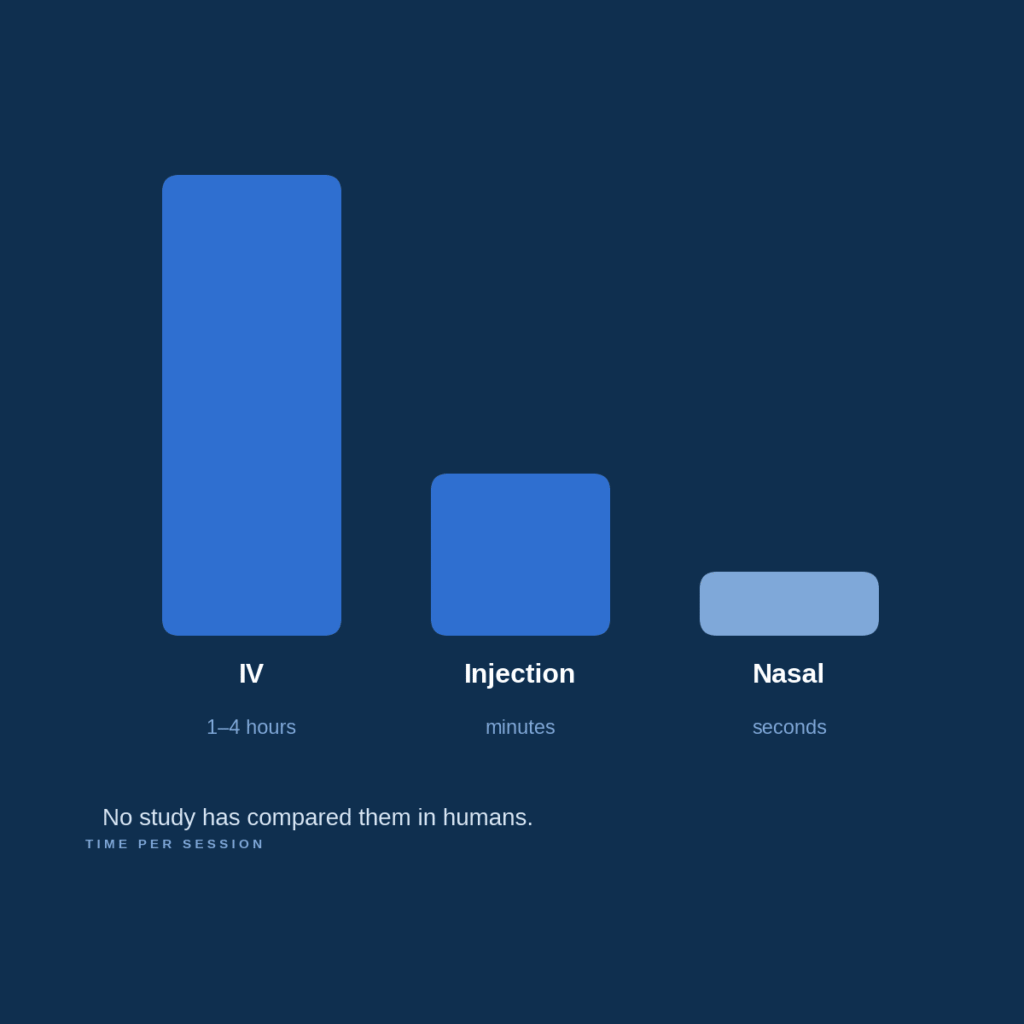
NAD+ is delivered three ways in practice: intravenous infusion in a clinic, subcutaneous injection at home, and nasal spray. Most pages comparing them present bioavailability percentages and rank the routes against each other. Those rankings are not drawn from human research, because the comparative studies have not been done.
What follows is what is actually documented about each route, what is not, and the practical differences that can be described honestly.
Important
This article is general education, not medical advice, and nothing in it recommends or endorses a treatment for you. Compounded medications discussed here are not FDA approved. Only a clinician licensed in your state can decide whether any treatment is appropriate, and that decision follows a review of your history and any testing they consider necessary. Do not start, stop or change any medication based on something you read online. If you are having a medical emergency, call 911.
The honest starting point
There is no published human study comparing NAD+ absorption across these three routes. There is also no published human study of intranasal NAD+ at all. Human research on NAD+ and its precursors has used oral or intravenous administration.
Any page presenting a table of bioavailability percentages for NAD+ by route is presenting figures that do not come from human pharmacokinetic studies of NAD+. That is worth knowing before comparing anything.
What has been studied, by route
| Route | Published human evidence |
|---|---|
| Oral precursors (NR, NMN) | Multiple placebo-controlled trials. Consistently raise blood NAD+ metabolite levels. Downstream clinical outcomes inconsistent, with generally small or absent effects in healthy adults. |
| Intravenous NAD+ | Small studies and case series. No large adequately powered controlled trials. |
| Subcutaneous injection | Very limited published human data. |
| Intranasal | No published human study. One 2006 rat model of cerebral ischaemia (PubMed ID 17127275). |
It is worth separating two things that often get merged. Oral NR and NMN are precursor molecules with a real trial literature. NAD+ itself, given by injection, infusion or spray, is a different molecule with a much thinner human evidence base. Trial results for the former are not evidence for the latter.
Practical differences that can be described honestly
| IV infusion | Subcutaneous injection | Nasal spray | |
|---|---|---|---|
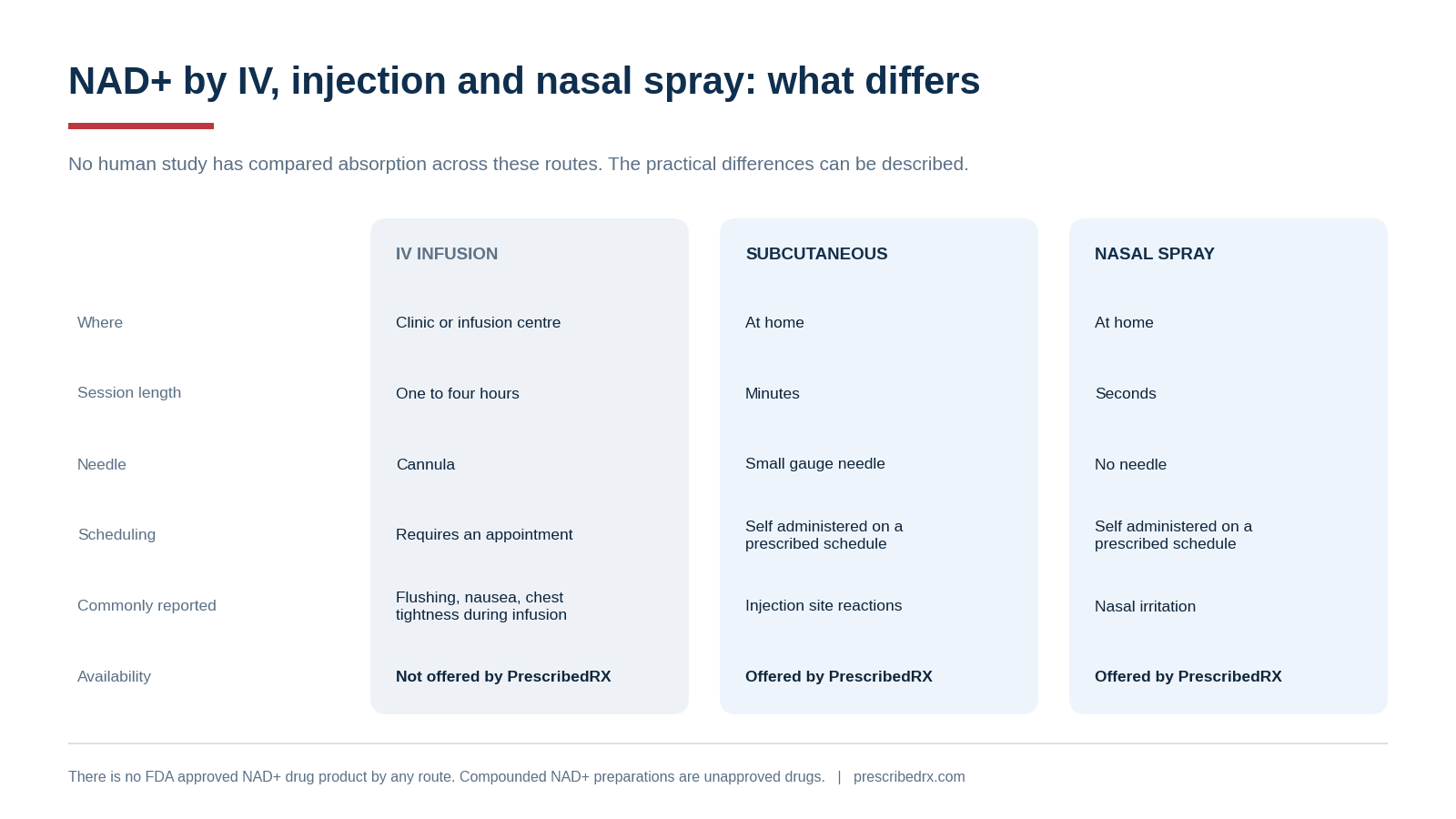
| Where it happens | Clinic or infusion centre | At home | At home |
| Typical session length | One to four hours | Minutes | Seconds |
| Needle involved | Yes, cannula | Yes, small gauge | No |
| Scheduling | Requires an appointment | Self administered on a prescribed schedule | Self administered on a prescribed schedule |
| Commonly reported effects | Flushing, nausea and chest tightness during infusion | Injection site reactions | Nasal irritation |
| Available through PrescribedRX | No | Yes | Yes |
The infusion effects listed are widely reported and are generally described as rate dependent, easing when the infusion is slowed. That is an observation about tolerability during administration, not a statement about benefit or about which route works better.
If you are searching for NAD+ IV therapy
Many people searching for NAD+ IV therapy are looking for a local infusion clinic. PrescribedRX does not offer IV infusion, so this page is not an attempt to redirect that search into something it is not.
What can be said accurately is that the human evidence base for IV NAD+ is smaller than clinic marketing generally implies, and that no study has established that infusion produces better outcomes than the other routes. The practical differences in the table above are real. The efficacy comparison is not available from published research.
Where the regulatory position stands
- There is no FDA approved NAD+ drug product by any route.
- NAD+ appears in Category 1 of FDA’s 503A bulk drug substances evaluation (list updated 14 May 2026) and on the 503B nominations list. Category 1 is a nomination and an interim enforcement discretion posture while FDA completes its evaluation. It is not an approval and not an endorsement.
- In a warning letter to GenoGenix LLC dated 20 January 2026, FDA stated that the facility “compounded drug products using bulk drug substances that are not eligible for the use in compounding under section 503B, including 5-amino-1-methylquinolinium iodide (5-Amino-1MQ) and nicotinamide adenine dinucleotide (NAD+)” and that products compounded with those substances “are not eligible for the exemptions provided by section 503B.” That letter concerned a 503B outsourcing facility. Section 503A, traditional pharmacy compounding against an individual prescription, is a separate pathway with separate eligibility rules.
- Olympia Pharmacy issued a nationwide recall of compounded sterile preparations including NAD and sermorelin on 10 March 2022 for out-of-specification product. That was a manufacturing quality failure rather than a finding about the substances themselves.
No FDA document addresses NAD+ by the nasal route specifically.
Claims this page does not make
PrescribedRX dispenses NAD+ preparations, so it is worth stating which common claims are deliberately absent:
- No bioavailability percentages by route, because no human study has measured them for NAD+.
- No ranking of the routes by effectiveness, because no comparative human study exists.
- No claim that nasal delivery reaches the brain directly.
- No use of oral NR or NMN trial results as evidence for injected, infused or nasal NAD+.
- No description of NAD+ as FDA approved, FDA cleared or “Category 1 approved.”
Information a clinician will want
Because the controlled human data is limited for every route, a prescriber will generally want a full history before considering NAD+ in any form. Points that commonly matter include pregnancy or breastfeeding, a current or previous cancer diagnosis, significant kidney or liver impairment, and any medication with a narrow therapeutic window. NAD+ has not been studied in people with active cancer, which is a gap in the evidence rather than a finding in either direction.
Which route, if any, is appropriate for a given person is a decision for a clinician licensed in their state.
Frequently asked
Is NAD+ IV better than injection or nasal spray?
No published human study has compared them, so the question cannot be answered from evidence. The documented differences are practical: setting, session length, and whether a needle is involved.
How much NAD+ is absorbed from a nasal spray?
No published human study has measured this.
Is any form of NAD+ FDA approved?
No. There is no FDA approved NAD+ drug product by any route. Compounded NAD+ preparations are unapproved drugs.
Does PrescribedRX offer IV NAD+?
No. PrescribedRX offers NAD+ injections and NAD+ nasal spray by prescription.
Considering NAD+ therapy?
PrescribedRX offers NAD+ nasal spray and NAD+ injections by prescription. Answer a few questions about your health history and a clinician licensed in your state reviews whether treatment is appropriate for you. Compounded NAD+ is not FDA approved, and a clinician may decide it is not right for you.
References
- Ying W, Wei G, Wang D, et al. Intranasal administration with NAD+ profoundly decreases brain injury in a rat model of transient focal ischemia. Frontiers in Bioscience. 2007;12:2728–2734. PubMed ID 17127275.
- Martens CR, Denman BA, Mazzo MR, et al. Chronic nicotinamide riboside supplementation is well-tolerated and elevates NAD+ in healthy middle-aged and older adults. Nature Communications. 2018;9:1286.
- U.S. Food and Drug Administration. Warning Letter to GenoGenix LLC, 20 January 2026.
- U.S. Food and Drug Administration. Bulk Drug Substances Nominated for Use in Compounding Under Section 503A of the Federal Food, Drug, and Cosmetic Act. Updated 14 May 2026.
- U.S. Food and Drug Administration. Bulk Drug Substances Nominated for Use in Compounding Under Section 503B of the Federal Food, Drug, and Cosmetic Act. Updated 21 March 2025.
- U.S. Food and Drug Administration. Olympia Pharmacy issues voluntary nationwide recall of compounded sterile preparations, 10 March 2022.
Related reading
- The FDA peptide compounding status tracker, kept current
- NAD+ therapy: the complete guide
- NAD+ dosage and what determines it
- NAD+ side effects
- NAD+ nasal spray
- Is NAD+ FDA approved?
- NAD+ injections and what the evidence covers
- Tesamorelin versus sermorelin
- MOTS-c dosage
- Is glutathione FDA approved?
Longevity plans from PrescribedRX
PrescribedRX prescribes longevity treatments through clinicians licensed in your state:
- Glutathione Injection. Administered by injection after a provider consultation.
- Glutathione Nasal Spray. A nasal alternative.
- NAD+ Injections. On a schedule set by your provider.
- NAD+ Nasal Spray. A nasal alternative.
- Sermorelin Injections. By prescription after consultation.
Every plan and its current price is on the plans page and the pricing page.
These are compounded preparations. Compounded drugs are not reviewed or approved by the FDA for safety or effectiveness, and treatment outcomes are not guaranteed.
This article is for general information. It is not medical advice and it is not a recommendation for any particular treatment. Whether a treatment is appropriate for you is a decision for a licensed clinician who has reviewed your health history and current medications.
About the author
Juan MontesJuan Montes writes and reviews PrescribedRX's clinical content, covering testosterone replacement therapy, men's sexual health, weight management and hair loss. He trained as a Professional Nurse at the Colombian Red Cross in Cali, Colombia, and has worked in healthcare since 2011, roughly six of those years in direct emergency and critical care nursing. He served as Head Nurse in Emergency…
More from Juan →This article is for information only and is not medical advice. Treatment is prescribed solely at the discretion of a licensed provider following a clinical evaluation.