

NAD+ nasal spray is widely sold and confidently described. The published evidence is thinner than most descriptions suggest, and one fact frames everything else on this page: there is no published human study of intranasal NAD+. Every human trial of NAD+ or its precursors used oral or intravenous administration.
That absence does not mean nasal NAD+ is unsafe or that it does nothing. It means the specific claims commonly attached to it, including absorption percentages, direct-to-brain delivery and bioavailability comparisons against IV, are extrapolations rather than measured findings. This page separates what is documented from what is asserted.
Important
This article is general education, not medical advice, and nothing in it recommends or endorses a treatment for you. Compounded medications discussed here are not FDA approved. Only a clinician licensed in your state can decide whether any treatment is appropriate, and that decision follows a review of your history and any testing they consider necessary. Do not start, stop or change any medication based on something you read online. If you are having a medical emergency, call 911.
What NAD+ is
Nicotinamide adenine dinucleotide is a coenzyme present in every cell in the body. It participates in mitochondrial energy production, in DNA repair through the PARP enzymes, and in sirtuin signalling. Tissue NAD+ concentrations decline with age in several animal models and in some human tissue studies. That observed decline is the premise behind the NAD+ supplement and injection market.
The premise is scientifically reasonable. Whether raising NAD+ from an external source produces meaningful clinical benefit in healthy adults is a separate question, and the published literature has not settled it.
What has been studied in humans, and by which route
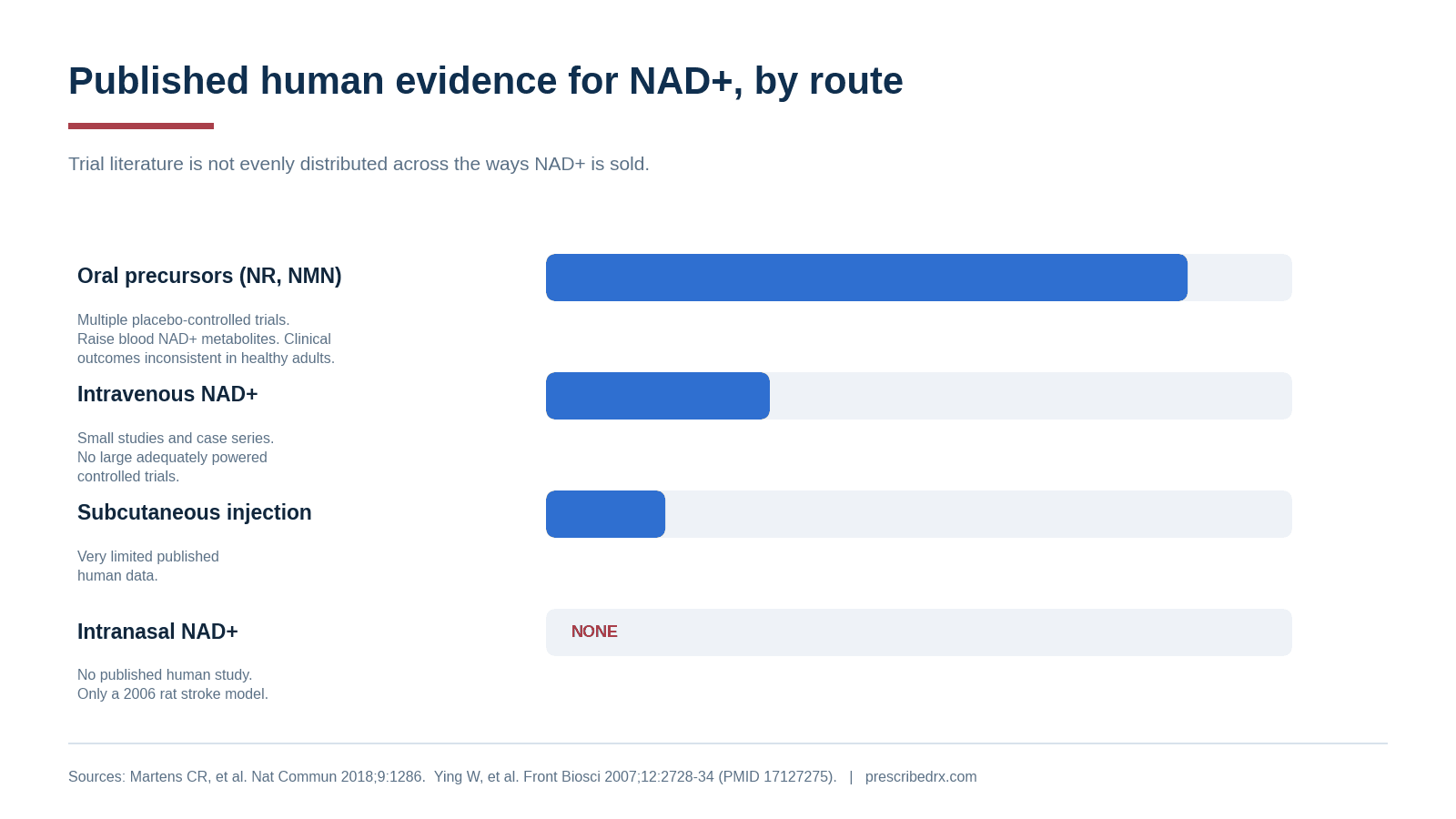
- Oral precursors. Nicotinamide riboside (NR) and nicotinamide mononucleotide (NMN) have multiple placebo-controlled human trials. They consistently raise blood NAD+ metabolite levels. Reported downstream clinical outcomes have been inconsistent, and effect sizes on measures such as muscle function and metabolic markers have generally been small or absent in healthy adults.
- Intravenous NAD+. Delivered directly into circulation. The human literature here consists largely of small studies and case series rather than adequately powered controlled trials.
- Intranasal NAD+. No published human study.
The one intranasal study in the literature
There is a single relevant intranasal NAD+ study, and it is a 2006 rat model of cerebral ischaemia (PubMed ID 17127275). Intranasally administered NAD+ reduced ischaemic brain damage in rats. It is legitimate research. It is also a rodent stroke experiment, and it does not establish whether a nasal spray raises systemic NAD+ in a healthy human, or produces any of the outcomes nasal NAD+ is commonly associated with.
The regulatory position
- There is no FDA approved NAD+ drug product by any route.
- NAD+ appears in Category 1 of FDA’s 503A bulk drug substances evaluation (list updated 14 May 2026) and on the 503B nominations list. Category 1 is a nomination and an interim enforcement discretion posture while FDA completes its evaluation. It is not an approval and not an endorsement.
- FDA has taken enforcement action involving compounded NAD+. In a warning letter to GenoGenix LLC dated 20 January 2026, FDA stated that the facility “compounded drug products using bulk drug substances that are not eligible for the use in compounding under section 503B, including 5-amino-1-methylquinolinium iodide (5-Amino-1MQ) and nicotinamide adenine dinucleotide (NAD+)” and that products compounded with those substances “are not eligible for the exemptions provided by section 503B.”
- A nationwide recall of compounded injectables including NAD and sermorelin was issued by Olympia Pharmacy on 10 March 2022 for out-of-specification product. That was a manufacturing quality failure rather than a finding about the substances themselves, but it is part of the public record.
The GenoGenix letter concerned a 503B outsourcing facility. Section 503A, traditional pharmacy compounding against an individual patient prescription, is a separate pathway with separate eligibility rules, and NAD+ does appear in 503A Category 1. That distinction is about which compounding pathway a preparation is made under. It is not a claim of approval under either.
No FDA document addresses NAD+ by the nasal route specifically. There is nothing to cite in either direction.
Nasal spray, injection and IV compared
An honest comparison here is about practicality, because comparative efficacy data between these routes does not exist.
| Nasal spray | Subcutaneous injection | IV infusion | |
|---|---|---|---|
| Published human absorption data | None | Limited | Limited |
| Needle required | No | Yes | Yes |
| Clinic visit required | No | No | Yes |
| Typical session length | Seconds | Minutes | One to four hours |
| Commonly reported effects | Nasal irritation | Injection site reactions | Flushing, nausea and chest tightness during infusion |
The infusion effects listed above are widely reported and are generally described as rate dependent, easing when the infusion is slowed. That is an observation about tolerability rather than about benefit.
Claims this page does not make
PrescribedRX dispenses NAD+ preparations, so it is worth stating plainly which common claims are absent here and why:
- No bioavailability figure for nasal NAD+, because no human pharmacokinetic study exists to derive one from.
- No claim that nasal delivery reaches the brain directly. Nose-to-brain transport is a genuine research area, but for NAD+ specifically the evidence is a rat stroke model.
- No use of oral NR or NMN trial results as evidence for nasal NAD+. Different molecule, different route.
- No description of NAD+ as FDA approved, FDA cleared or “Category 1 approved.” None of those are accurate.
Information a clinician will want before prescribing
Because there is no controlled human data for this route, a prescriber will generally want a full history. Points that commonly matter in that conversation include pregnancy or breastfeeding, a current or previous cancer diagnosis, significant kidney or liver impairment, and any medication with a narrow therapeutic window. NAD+ has not been studied in people with active cancer, which is a gap in the evidence rather than a finding either way.
Whether NAD+ is appropriate for a given person, by any route, is a decision for a clinician licensed in their state. Nothing on this page substitutes for that assessment.
Frequently asked
Is NAD+ nasal spray FDA approved?
No. There is no FDA approved NAD+ drug product by any route. Compounded NAD+ preparations are unapproved drugs.
How much is absorbed through the nose?
No published human study has measured this, so no figure can be given honestly.
Is nasal better than injection or IV?
No study has compared the routes in humans, so the comparison cannot be made from evidence. The documented differences are practical ones, set out in the table above.
Why do people report feeling better on it?
Subjective reports are real observations. They are also what an unblinded intervention with a strong narrative would be expected to produce, which is the reason controlled trials exist. For nasal NAD+, those trials have not been run.
Considering NAD+ therapy?
PrescribedRX offers NAD+ nasal spray and NAD+ injections by prescription. Answer a few questions about your health history and a clinician licensed in your state reviews whether treatment is appropriate for you. Compounded NAD+ is not FDA approved, and a clinician may decide it is not right for you.
References
- Ying W, Wei G, Wang D, et al. Intranasal administration with NAD+ profoundly decreases brain injury in a rat model of transient focal ischemia. Frontiers in Bioscience. 2007;12:2728–2734. PubMed ID 17127275.
- U.S. Food and Drug Administration. Warning Letter to GenoGenix LLC, 20 January 2026.
- U.S. Food and Drug Administration. Bulk Drug Substances Nominated for Use in Compounding Under Section 503A of the Federal Food, Drug, and Cosmetic Act. Updated 14 May 2026.
- U.S. Food and Drug Administration. Bulk Drug Substances Nominated for Use in Compounding Under Section 503B of the Federal Food, Drug, and Cosmetic Act. Updated 21 March 2025.
- U.S. Food and Drug Administration. Olympia Pharmacy issues voluntary nationwide recall of compounded sterile preparations, 10 March 2022.
- Martens CR, Denman BA, Mazzo MR, et al. Chronic nicotinamide riboside supplementation is well-tolerated and elevates NAD+ in healthy middle-aged and older adults. Nature Communications. 2018;9:1286.
Related reading
NAD+ therapy: the complete guide · NAD+ injection · NAD+ IV vs injection vs nasal spray · Longevity treatments
PrescribedRX offers NAD+ nasal spray and NAD+ injections by prescription. Whether either is appropriate is determined by a clinician licensed in your state.