

Every figure below comes from the FDA approved prescribing information for semaglutide. Both labels are linked at the bottom so you can check any number against the source.
This page is general information, not medical advice. It does not replace the prescribing information supplied with your medication or a conversation with the clinician who prescribed it. If you are experiencing symptoms, contact your prescriber.
First, the caveat that applies to most of the internet on this subject
These figures come from trials of FDA approved semaglutide products. Compounded semaglutide is not the same thing. Compounded medications are prepared by a licensed compounding pharmacy for an individual patient and are not reviewed or approved by the FDA for safety or effectiveness. No compounded version has been through the trials that produced any number on this page.
Same molecule is a reasonable basis for expecting similar behaviour. It is not the same as having measured it. A page quoting these percentages while selling you a compounded product, without saying that, is leaving out the part that matters.
The boxed warning
Semaglutide carries a boxed warning, the most serious category the FDA uses. Quoted from the label, with the brand name replaced in brackets:
“In rodents, semaglutide causes dose-dependent and treatment-duration-dependent thyroid C-cell tumors at clinically relevant exposures. It is unknown whether [semaglutide] causes thyroid C-cell tumors, including medullary thyroid carcinoma (MTC), in humans as human relevance of semaglutide-induced rodent thyroid C-cell tumors has not been determined.”
Note what it says and does not say. The effect was seen in rodents. Whether it applies to humans is unknown. It is not a finding that semaglutide causes thyroid cancer in people, and it is not a clean bill of health either.
The label directs prescribers to counsel patients on symptoms of thyroid tumours, listing a mass in the neck, difficulty swallowing, shortness of breath and persistent hoarseness. It also states that routine monitoring by calcitonin blood test or thyroid ultrasound is “of uncertain value” for early detection. There is no simple screening test that resolves this.
The actual numbers
There are two sets, because semaglutide is approved for weight management and for type 2 diabetes at different doses, and the rates are very different. Most pages quote one set without telling you which.
Chronic weight management, 2.4 mg once weekly
Reactions occurring in at least 2% of participants and more often than placebo. Placebo rates are included because that is the honest comparison, and some of these numbers are high in the placebo arm too.
| Adverse reaction | Semaglutide 2.4 mg | Placebo |
|---|---|---|
| Nausea | 44% | 16% |
| Diarrhea | 30% | 16% |
| Vomiting | 24% | 6% |
| Constipation | 24% | 11% |
| Abdominal pain | 20% | 10% |
| Headache | 14% | 10% |
| Fatigue | 11% | 5% |
| Dyspepsia | 9% | 3% |
| Dizziness | 8% | 4% |
| Abdominal distension | 7% | 5% |
| Eructation (burping) | 7% | under 1% |
| Flatulence | 6% | 4% |
| Gastroesophageal reflux | 5% | 3% |
| Hair loss | 3% | 1% |
Type 2 diabetes, 0.5 mg and 1 mg once weekly
| Adverse reaction | 0.5 mg | 1 mg | Placebo |
|---|---|---|---|
| Nausea | 15.8% | 20.3% | 6.1% |
| Vomiting | 5% | 9.2% | 2.3% |
| Diarrhea | 8.5% | 8.8% | 1.9% |
| Abdominal pain | 7.3% | 5.7% | 4.6% |
| Constipation | 5% | 3.1% | 1.5% |
Nausea at 44% against 16 to 20%. Roughly double, and it is dose. If you are reading a page that says “around 20% get nausea” in the context of weight loss, it is quoting the diabetes table.
And at the higher weight management dose
A 7.2 mg dose appears in the current label with its own table. Nausea 39%, vomiting 22%, constipation 20%, hair loss 6%, and one reaction that barely registers at lower doses: dysesthesia at 22% against 6% at 2.4 mg and 0% on placebo. Dysesthesia means abnormal or unpleasant sensation, often tingling or burning of the skin. Worth knowing it exists before it happens to you.
Something the label changed in 2026, which most pages have not caught up with
Older versions of the weight management label carried a Warnings and Precautions subsection on suicidal behavior and ideation. The FDA removed it, in a supplement approved on 25 February 2026. The current label does not contain that subsection.
That is a real change to a real label and it is worth reporting accurately in both directions. It does not mean the question was imaginary, and it does not mean nobody should mention mood to their prescriber. It means the FDA reviewed the evidence and removed that specific warning from that specific label.
Many pages you will find still list it, because they were written before February and never revisited. That is the general problem with health content that is never reviewed, and it is why this page carries a review date.
The serious warnings
The current weight management label lists the following under Warnings and Precautions:
- Risk of thyroid C-cell tumors
- Acute pancreatitis
- Acute gallbladder disease
- Hypoglycemia
- Acute kidney injury due to volume depletion
- Severe gastrointestinal adverse reactions
- Hypersensitivity reactions
- Diabetic retinopathy complications in patients with type 2 diabetes
- Heart rate increase
- Pulmonary aspiration during general anesthesia or deep sedation
- Never sharing an injection pen between patients
The one to act on
Aspiration under anesthesia. These medications slow stomach emptying, so the stomach may still hold food when it would normally be empty. Tell any surgeon, anesthetist or dentist that you take this, well before any procedure involving sedation. It is the single most actionable line on the page.
Kidney injury here is usually secondary, following dehydration from vomiting or diarrhea rather than a direct effect on the kidney. Which makes keeping fluids up during the gut effects more important than it sounds.
Who should not take it
The label lists two contraindications:
- A personal or family history of medullary thyroid carcinoma, or Multiple Endocrine Neoplasia syndrome type 2. Family history counts, not just your own.
- A prior serious hypersensitivity reaction to semaglutide or any excipient. The label notes anaphylaxis and angioedema have been reported.
Family history is the item people skip on intake forms because they have never had reason to ask. It is worth asking relatives before you answer it.
Hair loss, since it appears in the table
The label reports hair loss in 3% at 2.4 mg against 1% on placebo, and 6% at the 7.2 mg dose. These are FDA label figures, not anecdote.
Rapid weight loss from any cause can trigger a temporary shedding phase, so it is not necessarily the drug itself. There is more on the mechanism and what is and is not treatable in our hair loss guide.
The head to head trial, which settles a question most pages get wrong
You will see the two drugs compared constantly by putting one label’s nausea figure next to the other’s. That comparison is not valid, because those numbers come from separate trials with different populations, escalation schedules and dose ranges.
There is no need to guess, because a direct head to head randomised trial exists. SURMOUNT-5, published in the New England Journal of Medicine in 2025, randomised 751 adults with obesity and without type 2 diabetes to maximum tolerated doses of either drug for 72 weeks.
What it found on weight
| Outcome | Tirzepatide | Semaglutide |
|---|---|---|
| Mean weight change at 72 weeks | -20.2% | -13.7% |
| Waist circumference change | -18.4 cm | -13.0 cm |
A difference of 6.5 percentage points, favouring tirzepatide, statistically significant.
What it found on side effects, which is the surprising part
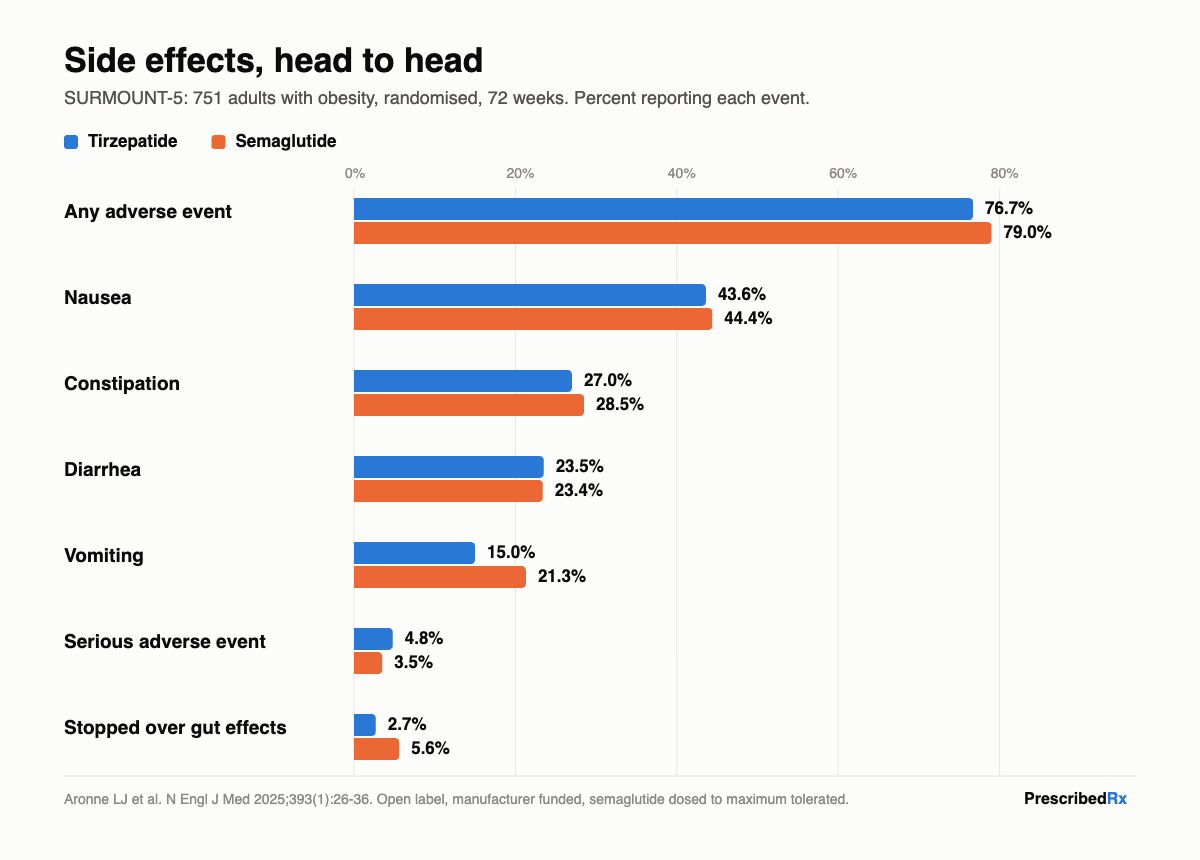
| Adverse event | Tirzepatide | Semaglutide |
|---|---|---|
| Any adverse event | 76.7% | 79.0% |
| Nausea | 43.6% | 44.4% |
| Diarrhea | 23.5% | 23.4% |
| Constipation | 27.0% | 28.5% |
| Vomiting | 15.0% | 21.3% |
| Serious adverse event | 4.8% | 3.5% |
| Stopped because of a gastrointestinal side effect | 2.7% | 5.6% |
Nausea was essentially identical. 43.6% against 44.4%. Diarrhea and constipation were within a point of each other. Tirzepatide had noticeably less vomiting and roughly half the rate of people stopping because of gut effects. Serious adverse events were numerically higher with tirzepatide, though the trial was not designed to test that comparison.
Three honest caveats. The trial was open label, so neither participants nor investigators were blinded. It was funded by the manufacturer of one of the two drugs. And semaglutide was dosed to maximum tolerated rather than to a fixed dose. None of that invalidates it, and all of it belongs in any summary of it.
So the honest read: on weight reduction the trial favoured tirzepatide. On tolerability the two were much closer than the separate label tables suggest. Full figures for the other drug are in tirzepatide side effects.
A 2026 meta-analysis of head to head studies covering 41,381 participants reached the same direction on weight, and found overall and gastrointestinal adverse events similar between the two, with serious adverse events more frequent with tirzepatide.
When they start, and whether they settle
The label reports incidence, not timing, so this is the pattern seen consistently in trial data and prescribing practice rather than a figure you can look up.
Gastrointestinal effects cluster around dose increases. Someone tolerating a dose well often sees nausea return in the days after stepping up, then settle again. That is why escalation is gradual rather than starting at target dose.
Most people who stop, stop early. Discontinuation in the trials concentrated in the first weeks.
Some effects do not follow that shape. Constipation tends to run rather than spike, and hair shedding usually appears months in, because that is how the hair cycle works.
What is usually done about the common ones
A description of what the prescribing information and standard practice cover, not instructions for you. Do not change a dose or schedule on your own.
- Slowing escalation is the most common adjustment, which is the reason to tell your prescriber early rather than pushing through quietly.
- Smaller meals. Gastric emptying is slowed, so the portion that felt normal before may not now.
- Fluids during vomiting or diarrhea, because that is what prevents the kidney complication rather than merely making you comfortable.
- Persistent vomiting is a phone call, not something to wait out.
Common questions
Do side effects mean it is working?
No. There is no established relationship between how unwell you feel and how well a treatment is doing its job. That idea circulates widely and the label does not support it.
Is compounded semaglutide safer or worse?
Unknown, and anyone telling you otherwise is guessing. What you can do is ask which pharmacy compounds it, what grade the ingredient is, and whether each lot is tested. Those are answerable questions and a provider who will not answer them is telling you something.
What about the higher dose?
Higher doses carry higher rates of most reactions, and one, dysesthesia, that jumps sharply. That is a conversation with your prescriber about trade-offs, not a decision to make from a table.
When to contact someone
Seek medical attention promptly for severe abdominal pain that may radiate to the back, particularly with vomiting, which is the pattern associated with pancreatitis. Also for difficulty breathing, swelling of the face, lips or throat, or hives.
Contact your prescriber for vomiting or diarrhea you cannot stay ahead of, signs of dehydration, or vision changes if you have diabetes. Adverse reactions can be reported to FDA MedWatch at 1-800-332-1088.
Questions worth asking your prescriber
- Given my history, particularly thyroid, pancreatic or gallbladder issues, is this appropriate for me?
- What is the escalation schedule, and can we slow it if the gut effects are bad?
- At what point would you tell me to stop rather than push through?
- Is what I am dispensed FDA approved or compounded, and which pharmacy makes it?
- What should I tell a surgeon or dentist before a procedure?
Sources
This page cites two kinds of source and it is worth knowing the difference. Regulatory documents tell you what a drug label says. Peer reviewed trials tell you what was actually measured, in whom, and how well. Both are linked so you can check anything here against the original.
Regulatory
- FDA, Prescribing information for semaglutide injection, chronic weight management indication, revised 06/2026. View source
- FDA, Prescribing information for semaglutide injection, type 2 diabetes indication, revised 10/2025. View source
- FDA, Approval letter NDA 215256/S-033, 25 February 2026. View source
- FDA MedWatch, Safety Information and Adverse Event Reporting Program. View source
Peer reviewed literature
- Aronne LJ, Horn DB, le Roux CW, et al. Tirzepatide as Compared with Semaglutide for the Treatment of Obesity. N Engl J Med. 2025;393(1):26-36. Trial registration NCT05822830. https://doi.org/10.1056/NEJMoa2416394
- Wilding JPH, Batterham RL, Calanna S, et al. Once-Weekly Semaglutide in Adults with Overweight or Obesity. N Engl J Med. 2021;384(11):989-1002. Trial registration NCT03548935. https://doi.org/10.1056/NEJMoa2032183
- Bracchiglione J, Meza N, Franco JVA, et al. Semaglutide for adults living with obesity. Cochrane Database of Systematic Reviews. 2025, Issue 10. Art. No.: CD015092. https://doi.org/10.1002/14651858.CD015092.pub2
- Ismaiel A, Scarlata GGM, Boitos I, et al. Gastrointestinal adverse events associated with GLP-1 RA in non-diabetic patients with overweight or obesity: a systematic review and network meta-analysis. Int J Obes. 2025;49(10):1946-1957. https://doi.org/10.1038/s41366-025-01859-6
- Pedersen SD, Manjoo P, Dash S, et al. Pharmacotherapy for obesity management in adults: 2025 clinical practice guideline update. CMAJ. 2025;197(27):E797-E809. https://doi.org/10.1503/cmaj.250502
Last reviewed 10 September 2026. Labels and evidence both change. If you are reading this well after that date, check the sources directly rather than relying on this page.
Related reading
More on medical weight loss:
- Online weight loss guide
- Best online weight loss programs
- Weight loss clinic near me
- Hims weight loss review
- Tirzepatide side effects
- Tirzepatide versus semaglutide
- Tirzepatide cost
- Tirzepatide online
- Compounded tirzepatide
Plans from PrescribedRX
PrescribedRX prescribes through clinicians licensed in your state. Plans in this category:
Every plan and its current price is on the plans page and the pricing page.
These are compounded preparations. Compounded drugs are not reviewed or approved by the FDA for safety or effectiveness, and treatment outcomes are not guaranteed.
This article is for general information. It is not medical advice and it is not a recommendation for any particular treatment. Whether a treatment is appropriate for you is a decision for a licensed clinician who has reviewed your health history and current medications.