

There is one trial that compared these two drugs directly, head to head, in the same people under the same conditions. Almost everything else you will read puts one drug’s label figures beside the other’s, which is not a valid comparison. This page leads with the trial.
This page is general information, not medical advice. Which treatment is appropriate for you, if either, is a decision for a licensed clinician who has reviewed your health history.
The short answer
In the head to head trial, tirzepatide produced more weight loss, 20.2% against 13.7% over 72 weeks. Tolerability was closer than most people expect: nausea was essentially identical, and the meaningful differences were in vomiting and in how many people quit.
That is the finding. The rest of this page is what sits underneath it and where it does not apply.
The trial
SURMOUNT-5, published in the New England Journal of Medicine in 2025. 751 adults with obesity and without type 2 diabetes, randomised to maximum tolerated doses of either drug, 72 weeks.
| Outcome | Tirzepatide | Semaglutide |
|---|---|---|
| Mean weight change | -20.2% | -13.7% |
| Approximate weight lost | about 22.8 kg | about 15.0 kg |
| Waist circumference | -18.4 cm | -13.0 cm |
A gap of 6.5 percentage points, statistically significant, favouring tirzepatide. It also produced higher rates of reaching every weight loss threshold the trial measured.
Side effects, which is where the assumptions break
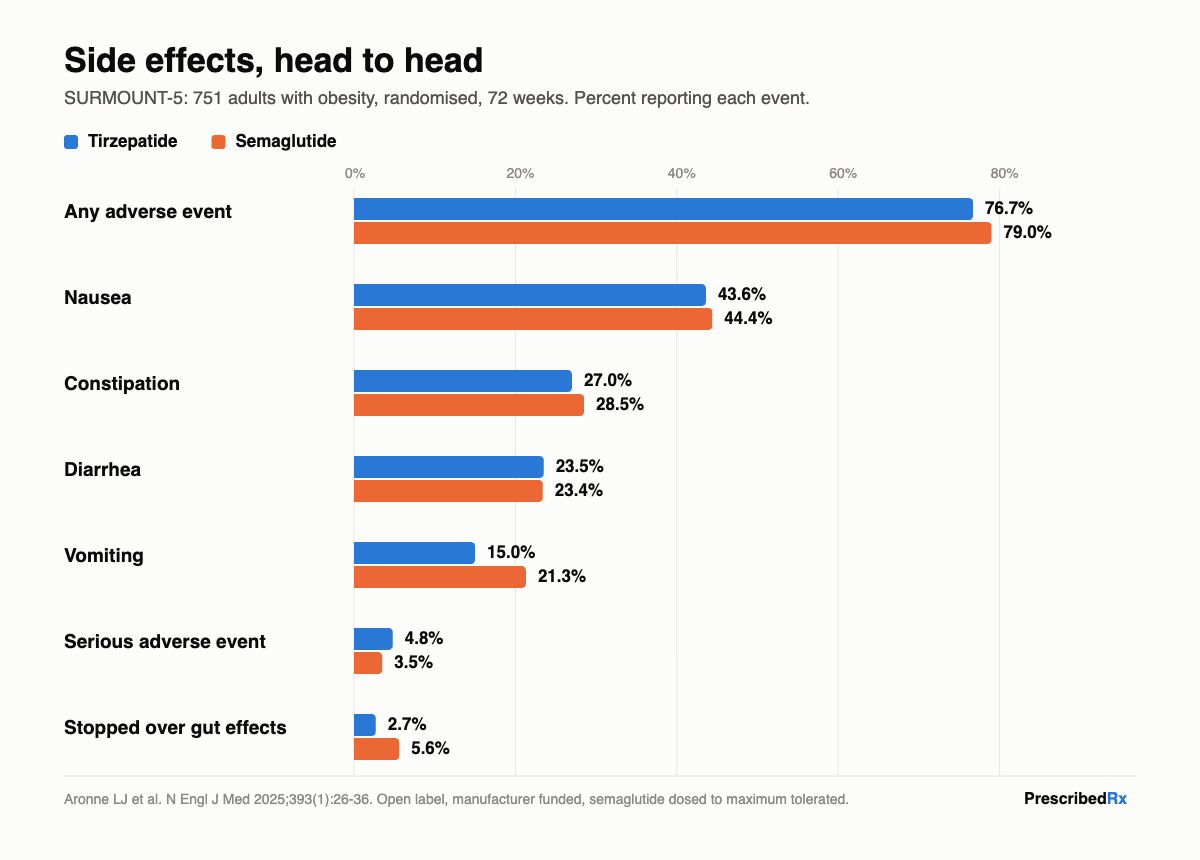
If you have compared the two labels you probably came away thinking semaglutide is considerably harder on the stomach. Its label reports nausea at 44% and tirzepatide’s at up to 29%. Head to head, in the same trial:
| Adverse event | Tirzepatide | Semaglutide |
|---|---|---|
| Any adverse event | 76.7% | 79.0% |
| Nausea | 43.6% | 44.4% |
| Constipation | 27.0% | 28.5% |
| Diarrhea | 23.5% | 23.4% |
| Vomiting | 15.0% | 21.3% |
| Serious adverse event | 4.8% | 3.5% |
| Stopped because of a gut side effect | 2.7% | 5.6% |
Nausea differed by 0.8 percentage points. Diarrhea and constipation were within a point. The label comparison was misleading, because those two numbers came from different trials with different populations and escalation schedules.
Where there is a real difference: vomiting, 15.0% against 21.3%, and discontinuation over gut effects, 2.7% against 5.6%. Roughly half as many people stopped tirzepatide for that reason. Serious adverse events were numerically higher with tirzepatide, 4.8% against 3.5%, though the trial was not designed to test that comparison.
Three caveats that belong with the result
- It was open label. Nobody was blinded, which matters most for subjective reporting like nausea.
- It was funded by the manufacturer of one of the two drugs. That does not make it wrong, and it does mean the design choices deserve reading.
- Semaglutide was dosed to maximum tolerated rather than a fixed dose, which is defensible and is also a choice.
A 2026 meta-analysis pooling head to head studies across 41,381 participants pointed the same way on weight, found overall and gastrointestinal adverse events similar between the two, and found serious adverse events more frequent with tirzepatide.
How they actually differ
Both act on the GLP-1 receptor. Tirzepatide also acts on the GIP receptor, which is the structural difference and the usual explanation offered for the larger weight effect. That is a mechanism, not a promise.
| Tirzepatide | Semaglutide | |
|---|---|---|
| Receptors | GLP-1 and GIP | GLP-1 |
| Dosing | Once weekly injection | Once weekly injection |
| Escalation | Gradual, over months | Gradual, over months |
| Boxed warning | Thyroid C-cell tumors in rodents | Thyroid C-cell tumors in rodents |
| Same hard contraindication | Medullary thyroid carcinoma or MEN 2, personal or family history | Same |
The contraindications are the same and they include family history, which people routinely skip on intake forms because they have never had reason to ask. Worth checking before you answer it.
Where the trial does not apply to you
Four situations where the headline number is not the number:
- You have type 2 diabetes. SURMOUNT-5 excluded diabetes. Weight outcomes in people with diabetes are generally smaller for both drugs.
- You cannot tolerate the top dose. The trial used maximum tolerated dosing. If you settle at a lower dose the comparison shifts.
- You are taking a compounded version. Covered below, and it is the biggest caveat on this page.
- Cost or availability decides it. A drug you can actually stay on beats a slightly better one you stop.
The compounded question
Neither drug was compounded in this trial. Every figure on this page comes from FDA approved products. Compounded preparations are made by a licensed compounding pharmacy for an individual patient and are not reviewed or approved by the FDA for safety or effectiveness. None has been through a trial like this one.
Same molecule is a fair reason to expect similar behaviour. It is not the same as having measured it, and a site quoting you SURMOUNT-5 numbers while selling a compounded product should say so. Ours does. More in compounded tirzepatide and compounded semaglutide versus tirzepatide.
So which one
Not a question a web page can answer, and the honest framing is that the trial narrows it rather than settling it.
- If weight reduction is the priority and there is no reason to avoid it, the trial favoured tirzepatide clearly.
- If you have had trouble staying on a GLP-1 before, the discontinuation gap is the number that matters more than the weight one.
- If nausea is the specific worry, the trial says that is close to a wash. Choose on something else.
- If you have a thyroid or MEN 2 family history, neither, and that is a conversation to have before an intake form.
Questions worth asking
- Given my history, is either appropriate, and is there a reason to prefer one?
- What is the escalation schedule, and can we slow it if the gut effects are bad?
- Am I being dispensed an FDA approved product or a compounded one, and which pharmacy makes it?
- At what point would you tell me to stop rather than push through?
- What should I tell a surgeon or dentist before a procedure?
That last one is not filler. Both drugs slow stomach emptying and both labels carry a warning about pulmonary aspiration under general anesthesia or deep sedation.
Full side effect detail for each is in tirzepatide side effects and semaglutide side effects. Current pricing is on the pricing page.
Sources
The trial and the label documents behind every figure on this page:
- Aronne LJ, Horn DB, le Roux CW, et al. Tirzepatide as Compared with Semaglutide for the Treatment of Obesity. N Engl J Med. 2025;393(1):26-36. Trial registration NCT05822830. https://doi.org/10.1056/NEJMoa2416394
- Paccola GP, de Oliveira RF, Mochetti MM, et al. Comparative Efficacy of Tirzepatide Versus Semaglutide for Weight Loss: A Systematic Review and Meta-Analysis of Head-to-Head Studies. Clin Obes. 2026;16(5):e70111. https://doi.org/10.1111/cob.70111
- FDA, Prescribing information for tirzepatide injection. View source
- FDA, Prescribing information for semaglutide injection. View source
Last reviewed 10 September 2026. Both labels and the evidence base change. Check the sources directly if you are reading this well after that date.
Related reading
More on medical weight loss:
- Online weight loss guide
- Compounded tirzepatide
- Compounded semaglutide versus tirzepatide
- Best online weight loss programs
- Weight loss clinic near me
- Hims weight loss review
- Tirzepatide side effects
- Semaglutide side effects
- Tirzepatide cost
Plans from PrescribedRX
PrescribedRX prescribes through clinicians licensed in your state. Plans in this category:
Every plan and its current price is on the plans page and the pricing page.
These are compounded preparations. Compounded drugs are not reviewed or approved by the FDA for safety or effectiveness, and treatment outcomes are not guaranteed.
This article is for general information. It is not medical advice and it is not a recommendation for any particular treatment. Whether a treatment is appropriate for you is a decision for a licensed clinician who has reviewed your health history and current medications.