
Last updated 25 August 2026. This page tracks United States federal compounding status for selected peptides. It is educational. It does not describe products available from PrescribedRX except where a substance is explicitly identified below as one we dispense.
Peptide compounding law in the United States changed twice in 2026 and is still unsettled. A great deal of what is currently published about which peptides are “legal” is either out of date or simply incorrect. This page tracks the actual federal position, with primary sources and dates, and is updated when the FDA acts.
The short version
As of 25 August 2026, none of the peptides reviewed at the July 2026 FDA advisory committee meeting has been added to the 503A Bulks List. An advisory committee recommendation is not a rule. Compounding these substances is not currently permitted under section 503A, regardless of what a supplier or clinic may state.
How the 503A lists actually work
Section 503A of the Federal Food, Drug, and Cosmetic Act governs which bulk drug substances a compounding pharmacy may use. A substance qualifies if it is the subject of a USP or NF monograph, is a component of an FDA-approved drug, or appears on the 503A Bulks List established by FDA rulemaking.
While that list is being developed, FDA sorts nominated substances into interim categories:
- Category 1. Substances FDA may exercise enforcement discretion over while it evaluates them. This is the only category that carries practical permission.
- Category 2. Substances FDA has identified as raising significant safety risks. Explicitly do not compound. As of May 2026 the 503A Category 2 list contains six substances.
- Category 3. Substances nominated without adequate supporting information.
- Withdrawn nominations. A separate table for substances whose nominations were withdrawn. Being here is not permission.
The distinction almost everyone gets wrong
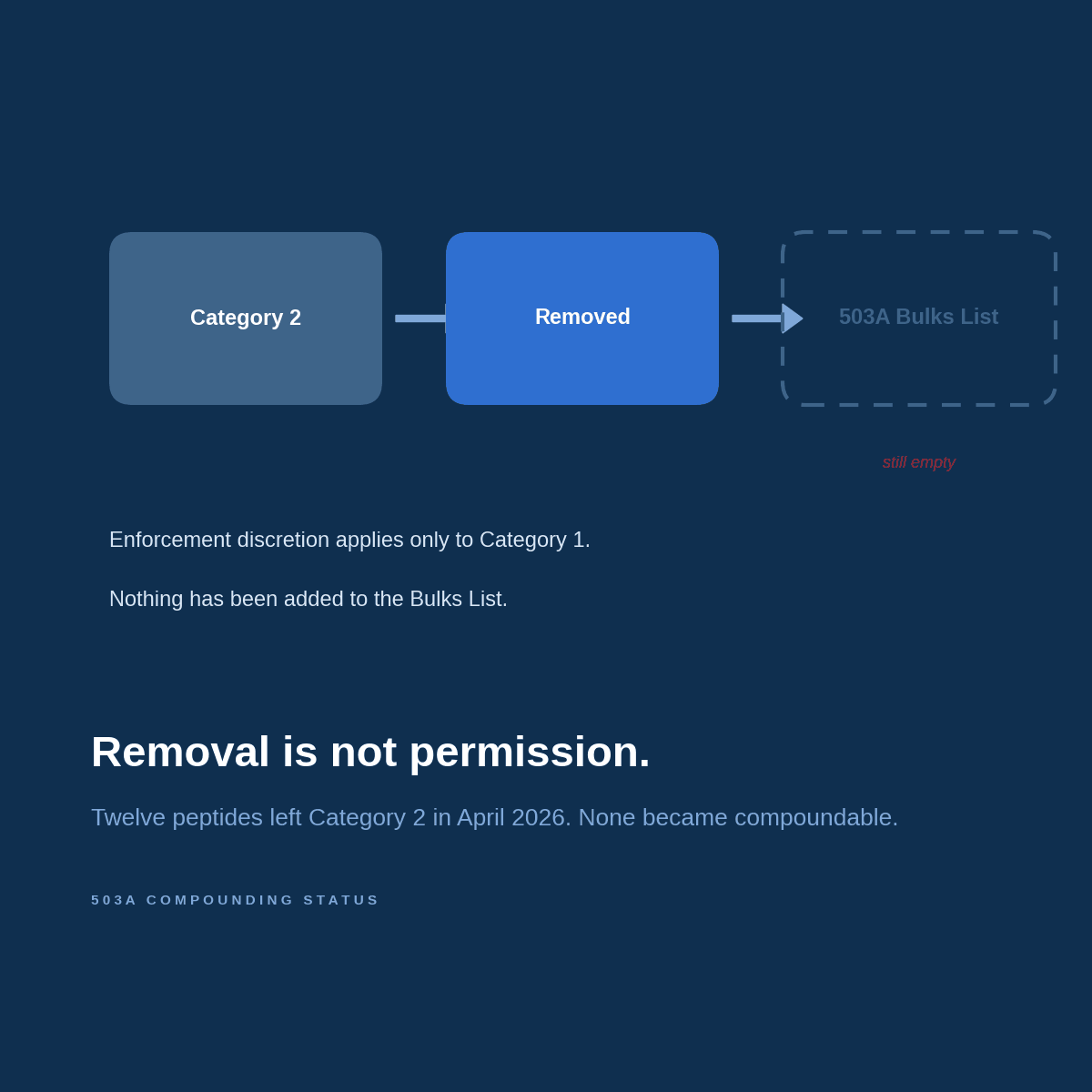
In April 2026, FDA removed twelve peptides from 503A Category 2, announced on 15 April and effective later that month. This was widely reported, and is still widely repeated, as those peptides “becoming legal again.” That is not what happened.
Category 2 is a list of substances FDA has flagged as posing significant safety risk. Removal from it means a substance is no longer on that specific list. It does not place the substance on the 503A Bulks List, and it does not move it to Category 1. Enforcement discretion currently extends only to Category 1 substances. A peptide can therefore be off Category 2 and still not be lawfully compoundable, which is precisely the situation most of the peptides below are in.
What the July 2026 advisory committee did, and did not do
On 23 and 24 July 2026, the FDA Pharmacy Compounding Advisory Committee reviewed seven peptides. In its briefing materials, FDA proposed that none of them be included on the 503A Bulks List. The committee voted against FDA staff on six of the seven.
| Peptide | PCAC vote | Outcome |
|---|---|---|
| BPC-157 | 8 to 6, 1 abstention | Recommended for inclusion |
| KPV | 8 to 6, 1 abstention | Recommended for inclusion |
| TB-500 | 8 to 6, 1 abstention | Recommended for inclusion |
| MOTS-c | 7 to 5, 2 abstentions | Recommended for inclusion |
| Semax | 8 to 5, 1 abstention | Recommended for inclusion |
| Epitalon | 7 to 4, 1 abstention | Recommended for inclusion |
| Emideltide (DSIP) | 6 to 7, 1 abstention | Not recommended |
FDA’s own assessment, set out across its briefing documents, was that clinical support for these substances was absent or very limited. For three of the seven, KPV, TB-500 and MOTS-c, FDA stated it had not identified any clinical studies or human exposure data by any route. For Epitalon, FDA did identify a small number of human studies, but stated it had not identified clinical studies assessing the safety of epitalon-related substances administered in humans.
The committee vote is advisory and non-binding. FDA must still decide, and any addition to the 503A Bulks List requires notice-and-comment rulemaking. FDA is weighing 2,659 public comments. No timeline has been announced.
Current status at a glance
Status as of 25 August 2026. Verify against the FDA source linked below before making any dispensing decision.
| Substance | Federal status | Compoundable now? |
|---|---|---|
| NAD | Category 1 | Yes |
| Glutathione | Category 1 | Yes |
| Enclomiphene citrate | Category 1 | Yes |
| GHK-Cu | Category 1 for non-injectable routes only | Topical yes. Injectable no. |
| Sermorelin | Component of a formerly approved drug | Yes |
| Tesamorelin | Component of an FDA-approved drug (Egrifta, Egrifta SV, Egrifta WR) | Yes |
| PT-141 (bremelanotide) | Component of an FDA-approved drug (Vyleesi) | Yes |
| BPC-157 | Removed from Category 2 April 2026. PCAC recommended July 2026. Not on the Bulks List | No |
| KPV | Same as above | No |
| TB-500 (LKKTETQ fragment) | Same as above | No |
| MOTS-c | Same as above | No |
| Semax | Same as above | No |
| Epitalon | Same as above | No |
| Emideltide (DSIP) | Removed from Category 2. PCAC declined to recommend | No |
| Kisspeptin-10 | Still Category 2 | No |
| Ibutamoren mesylate | Still Category 2 | No |
| CJC-1295 | Neither Category 1 nor Category 2. No pathway | No |
| Ipamorelin | Neither Category 1 nor Category 2. No pathway | No |
| Thymosin alpha-1 | Neither Category 1 nor Category 2. No pathway | No |
| AOD-9604 | Neither Category 1 nor Category 2. No pathway | No |
| Retatrutide | Investigational. Not approved anywhere | No |
| Cagrilintide | Investigational. Not approved anywhere | No |
Anti-doping status
Separate from federal compounding law, several of these substances are prohibited in competitive sport at all times. Athletes subject to testing should note that the prohibited list is explicitly non-exhaustive, and that section S0 captures any substance with no current approval by any governmental regulatory health authority for human therapeutic use.
| Substance | Prohibited list status |
|---|---|
| BPC-157 | Prohibited at all times, S0, named as an example |
| TB-500 and thymosin beta-4 | Prohibited at all times, S2.3 Growth Factors |
| MOTS-c | Prohibited at all times, S4.4.1 Metabolic Modulators, as an AMPK activator |
| KPV, Semax, Epitalon | Not named individually. S0 may still apply |
The MOTS-c classification is easy to miss, because it sits under metabolic modulators rather than under peptide hormones and growth factors.
What PrescribedRX dispenses
We are a telehealth platform working with US state-licensed clinicians and licensed compounding pharmacies, and we are LegitScript certified. From the substances above, we currently offer sermorelin, NAD+ and glutathione. Whether any treatment is appropriate for a given person is a decision for a state-licensed clinician after review of that person’s history.
We do not offer BPC-157, KPV, TB-500, MOTS-c, Semax, Epitalon or any other substance listed above as not currently compoundable, and we will not offer them unless and until federal rulemaking permits it.
Individual peptide pages
Educational pages covering what the published research actually shows for each substance, including which studies were conducted in humans and which were not:
For substances we currently dispense, see our sermorelin guide and NAD+ guide, with prices on our pricing page.
Two peptides that are lawfully available and often confused with the list above: tesamorelin, which is an FDA-approved drug, and sermorelin. Reconstituting any of these involves arithmetic that is easy to get wrong, so we also publish a peptide reconstitution calculator.
Sources
- FDA, Certain Bulk Drug Substances for Use in Compounding That May Present Significant Safety Risks
- FDA, 503A interim bulk drug substances category lists (PDF)
- FDA, Pharmacy Compounding Advisory Committee meeting, 23 to 24 July 2026
- FDA, PCAC briefing document, July 2026 (PDF)
- Holland & Knight, FDA Advisory Committee Endorses Compounding of Certain Peptides, 4 August 2026
- Frier Levitt, FDA Peptides Do-Not-Compound List Update 2026
This page is general information about federal regulatory status. It is not legal advice and it is not medical advice. Compounding decisions should be made with counsel and with reference to the FDA sources above, which supersede this summary.
Related reading
More on peptide and longevity therapy:
- Peptide reconstitution calculator
- NAD+ IV versus injection versus nasal spray
- Sermorelin before and after
- KPV peptide
- Glutathione side effects and the sourcing question
- NAD+ therapy: the complete guide
- Sermorelin therapy guide
- BPC-157
- Glutathione therapy: the complete guide
- Best peptide affiliate programs
This article is for general information. It is not medical advice and it is not a recommendation for any particular treatment. Whether a treatment is appropriate for you is a decision for a licensed clinician who has reviewed your health history and current medications.